Article | A Conversation With Christopher Kane
Sweet and Dark: A Conversation with Christopher Kane
The photographic image has been an influence on fashion designer Christopher Kane since the beginning of his career. We sat down with Christopher to discuss his love of the medium and how it all started with Joseph Szabo.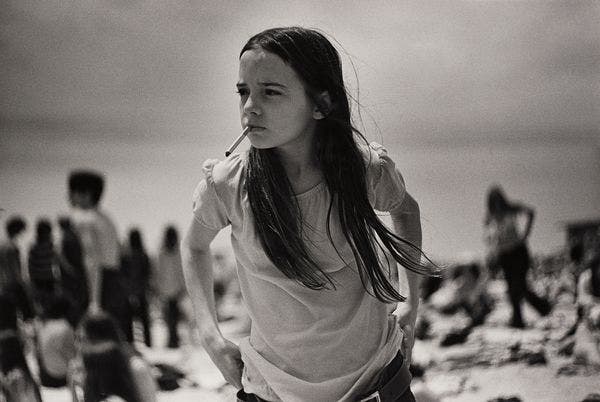
Joe Szabo Priscilla, 1969
Photography and fashion have been entwined in history for many years. Vogue put the first photographic image on their cover in 1950, and ever since, fashion designers have worked with photographers to convey their aesthetic and communicate their vision.
Christopher Kane's appreciation of photography started when he was very young and the photographic image has been an influence on the designer since the beginning of his career. We asked Christopher to curate a selection of images from our May Photographs auction which were exhibited in his London store to show how photography relates to his own designs.
Genevieve Janvrin, Phillips's head of Photographs in Europe, sat down with Christopher to talk about the works he chose from the sale, how photography informs his design process and how his love of the medium all started with Joseph Szabo.
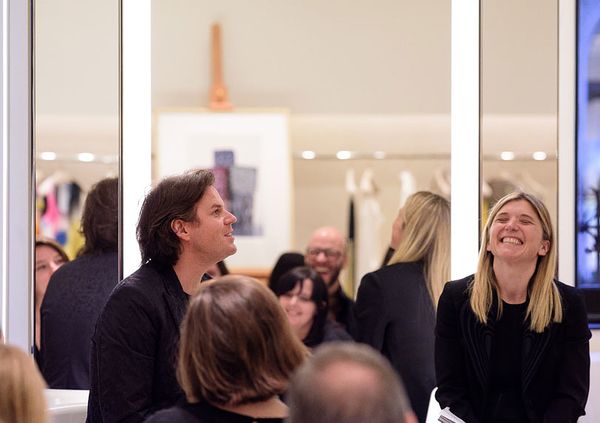
Christoper Kane and Phillips's Genevieve Janvrin in conversation.
Genevieve Janvrin: We’re going to talk about two photographs by Joseph Szabo. The first shows this fantastic couple [Backstage Couple, 1979]. The most important element of Szabo’s work is this decisive moment: the moment when the photographer clicks the shutter, and capture a feeling—that timeless moment, that is sometimes incredibly difficult to describe. So Christopher, tell us a little bit about this artist’s work and the piece—and what it means to you.
Christopher Kane: I’ve always loved Szabo’s work, particularly because I suppose it reflects my landscape growing up in Scotland…so it’s nostalgic. Nostalgic in the sense that I’ve got two crazy brothers, and I grew up in a house with my sisters, and there was always mischief. There’s so much honesty in his work. Szabo worked with these amazing kids, and to bring them out of their shell, he thought of the great idea of using photography.
These pictures really resonate with me because they also remind me of characters from Scotland. Priscilla, for me, is like the ultimate Christopher Kane girl. She reminds me a lot of [my sister] Tammy growing up. We were rebellious. We grew up in a household surrounded by strong women, especially my mother, and harsh sisters. They were all smoking, laughing. Scotland has a very dark sense of humour—we don’t take ourselves too seriously.
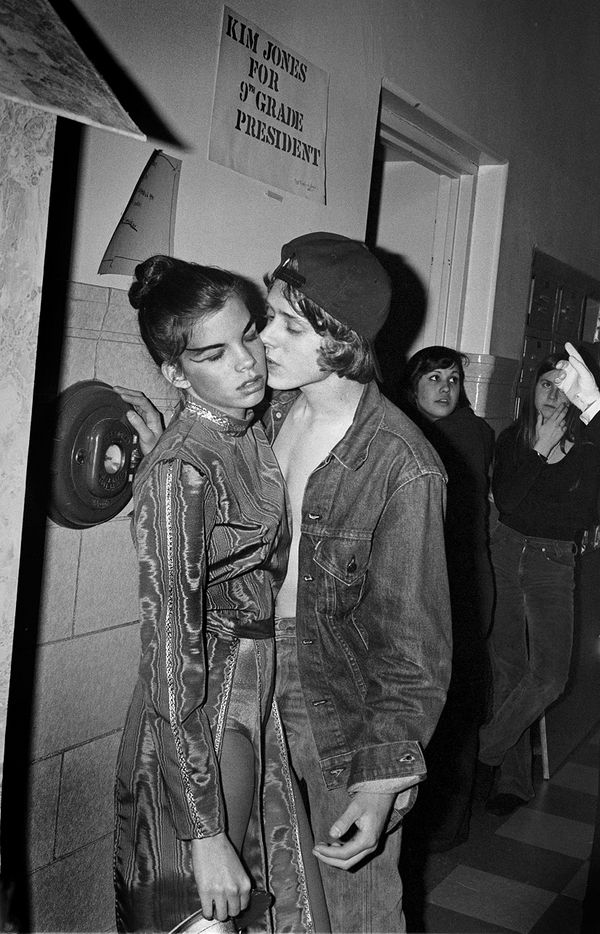
Joe Szabo Backstage Couple, 1979. Courtesy of the artist.
CK: And that moire dress [in Backstage Couple, 1979]…that inspired a collection, in Autumn/Winter 2013. I’ve always loved moire: it’s always been stuck in history as being Queen Victoria’s favorite fabric…but we scaled it up in a jacquard, for AW13, and this moire dress was inspirational. I just love that cut-out. You can see her pants. It doesn’t leave much to the imagination, but, she’s super classy. And they’re just the ultimate couple in a way.
GJ: Staying in America, but moving back slightly; you selected these three still lifes by esteemed Vogue photographer Irving Penn. Now, in the same way that Joseph Szabo is a documentary photographer, who documents—their process is about what’s in front of them—a fashion photographer creates. A lot like a designer. There’s a blank studio, they create their vision, what they want you to see, just as you do too. And I think with Irving Penn, we’ve got three examples that show an alternative approach to a mundane object. In art history, this is seen as a surrealist approach, exploring the uncanny; making us look at things we would see in everyday life, and think again, see things differently. That’s how you approach your creative process too. You’re creating from scratch. How do your garments come about?
CK: Well, like you say, when you look at the Irving Penn, he’s taking the mundane, and making something so beautiful. His still lifes were so perfect. His fashion photography was perfect too. I love the lampshade. I love that it’s a photograph of his favourite lamp, one of his favourite things, one of his pals. He did a face mask, which was a liquid gel facemark—it was super crazy, this 80s face mask—and I loved that picture. That took us to AW11, where we filled garments with liquid, referencing that picture. And that’s also one of the things I do every day in my work, I always look out for things that are a little odd, but everyday. Like frozen peas; a screw in the floor.
He just wanted to something new and different. Some didn’t get these still lifes, but I think he just loved taking those silly objects, and making them perfect, or desirable. People don’t need to get it straight away. They’re perfect in my eyes. I love that they’re engineered, thought out. That’s what our work is: starting from scratch. It could be a frozen pea, or whatever else, but it’s literally taking obscurity and transforming that, subverting that. And we’re in our own way trying to do that with these codes of femininity.
GJ: It’s interesting that you talk about approaching your subject laterally. Penn’s Frozen Foods I think was intended as an editorial feature on soup. His actual brief, as a photographer, was to take a photograph of soup. But he said - no thanks.
CK: He challenged it. And it’s funny, because the fact is, do I want that hanging in my living room? I do. It’s really damn good. You always need to be challenged, or taken out of your comfort zone. It’s not all about a flower and a vase. It’s about frozen peas sometimes.
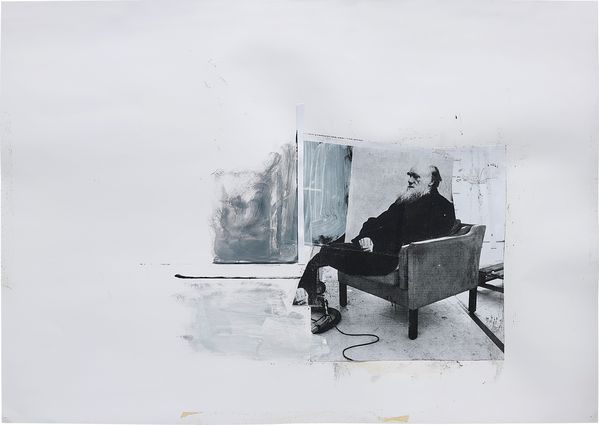
Nobuyoshi Araki Selected Images from Shijyo, Tokyo - Marketplace of Emotions and Kakyoku, 1997-1998
GJ: People sometimes ask me what makes a good photograph. And I always say that it has to be timeless. And I think you could say that about a garment, or a dress, too—it needs to stand the test of time.
CK: Yes, and it also serves as a memory, too. A lot of our collections are so personal. They feel like my children, the clothes.
GJ: You’ve had an incredible journey over the last decade. Your influence has been through photography but also photographers. The characters of the people behind these images. You selected an incredible work by the Japanese photographer Nobuyoshi Araki, who you met up with a few times and collaborated with on various levels. Could you talk a little about Araki?
CK: With Araki…you see a different kind of beauty. He used to say that women were gods, that he liked to treat them like gods, even though you look at his pictures and you see them bound up and gagged. He desired these women. He had sex with all of his subjects. For him, the woman is god. I’ve always loved that. Because again, he’s following his natural impulse, and his honesty in his work is amazing.
And again, it’s very personal what he does. I love that it’s erotica. It feels like women are strong and powerful in this context. In this image, we have flowers. We love to use flowers in our collections. I love the sexuality of the flowers too. In Scotland, my mum, we used to call the vagina a flower and the penis a tulip. And I loved that. The Sex Ed collection of SS13 was looking at that. The reproductive system of flowers and so on. How it related to the female insides and male outsides. These Araki flowers, they’re beautiful—but they’re sexual too. Organic, beautiful, raw and deserving of being a subject. Everything he photographs looks amazing.
GJ: The key with Araki is that he has also never compromised his vision or his process. He’s controversial, yet in Japan he has huge respect. Women want to be photographed by him.
CK: Sex is such a taboo. We’re so British. In Japan it’s something else. He’s so mischievous, in such a beautiful way.
My work has always got that sweet and dark quality that you have here.
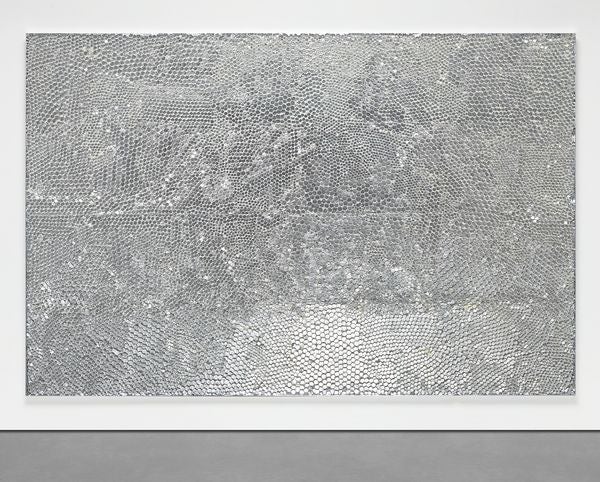
Richard Mosse Endless Plain of Fortune, 2011
GJ: So let’s talk about this sumptuous pink landscape that you selected, by Irish contemporary photographer Richard Mosse. Richard has come to fame in the last few years in particular with this project Infra. But again we have an alternative approach to his subjects, and a double edged sword. This project was based around the Congo. He was a photo journalist, working for The New York Times amongst publications: but he was angry at how little the Congo’s conflict—which has been going on for decades—was actually written about in the papers, because it’s so confusing. He wanted to get attention, but he needed to do it in a very simplistic way. So he took ex-military night vision film, which turns everything that is green to pink, and he went through the landscape photographing the beauty and the pain. It’s a combination of landscapes and portraits, of refugees, the pain behind war, but all presented in this beautiful way. Again, he’s finding beauty in the strangest of places, just as Irving Penn did. It’s a project that’s very respectful of the area, and it has been very well-received. What attracted you to these works?
CK: I thought these were animated, with a sort of Disney quality. I grew up loving Disney, wanting to work for Disney—it was amazing to me. It had that fantasy element. My work has always got that sweet and dark quality that you have here. His green turns pink in these killing fields—showing that conflict. There’s conflict in my work too. Once, we did bright pink gingham—but that was thinking about the Jonestown massacre. We did fringes, which were thinking about mental illness. So actually there’s always a surreal moment where you have to be like—oh, it’s okay to say that. The pink is so beautiful, but when you read into it…there’s huge conflict. But that’s just nature in itself.
GJ: The reason behind him doing this was to get people talking about it. And he’s got the attention of the art world, the media, and the press—so he has succeeded really.
CK: Absolutely. And I can’t say it enough, in all art—there seems to be a bit of a dark element that can turn sweet. That’s alright too. People need to be shaken up a little bit sometimes. Initially, I loved these pictures because of Disney—but then Disney was also so dark! So funny.
Robert Mapplethorpe Calla Lily, 1986
GJ: One of the last photographers you selected is Robert Mapplethorpe. You chose the lily, in black and white. Mapplethorpe was a very polemic photographer during the 1980s, in the New York scene. He worked alongside Andy Warhol, Basquiat, and he always said that if he had been born earlier he would have been a sculptor. His work is incredibly sculptural. You can see this constantly, whether it’s a nude or a lily. Everything has this three dimensional form. And obviously your art is three dimensional: so tell me, at what point do you start to think three dimensionally when you’re working? Do you think that way while you’re working?
CK: Firstly, I love this image. It’s so phallic! In terms of thinking three dimensionally…you start from scratch. With a fabric, a textile, a person. And it does start from a body. Mapplethorpe was just such an expert on that. I saw the Mapplethorpe documentary recently and completely fell in love again. Going to college, being a 17 year old student, and seeing those big dicks—all this erotica—as a young gay seeing that, you’re literally like god this is AMAZING. There’s a pulse in your pants. You should feel something. You should feel drawn to it. That’s what it should all be about.
GJ: Thank you, Christopher.
CK: Thank YOU! I want all of these.