
Jean Dubuffet Barbe des rites, 1959
Your beard is my boat
Your beard is the sea on which I sail
Beard of flux and influx
Beard-bath and rain of beards
Element woven of fluids
Tapestry of tales.
— Jean Dubuffet, excerpt from La fleur de barbe, 1960
With its energetic haze of brushstrokes and painterly marks, Barbe des rites perfectly encapsulates the unfettered invention and enthusiasm of Jean Dubuffet. Painted in July 1959, Barbe des rites dates from early in Dubuffet’s exploration of the theme of the beard, and crucially is one of the frst oil paintings from the series, which he exhibited the following year at Daniel Cordier’s gallery. In Barbe des rites, the backdrop and the face in the painting are filled with scraped patterns, with marks and stains that give a sense of texture, as though Dubuffet had leant the canvas against a brick wall and manipulated the paint. Through this thinned, textured surface peer two tiny eyes, perched near the top of the painting, embedded within the mass of a face.
Meanwhile, the beard of the title is a riot of movement: flecks of grey, black and cream dart in every direction, given all the more verve by the various marks that Dubuffet has incised in the paint surface. The latticework of brushstrokes and incisions is further punctuated by drips which give the sense of some complex constellation, while also recalling the repleteness of Jackson Pollock’s paintings.

(Left) Jean Dubufet, Marcus Aurelius, le célébrateur du sol, 1959. Pen on paper © 2016 Artists Rights Society (ARS), New York/ ADAGP, Paris. (Right) 2nd Century A.D. Marble bust of emperor Marcus Aurelius, AD 161-180. From Turkey, Ephesus. Selcuk, Archaeological Museum/ Bridgeman Images.
This area of beard recalls Dubuffet’s Texturologies, the series of abstract-seeming landscape-style works that he had been painting at the time, which were often based on the appearance of the soil itself. Dubuffet considered the Barbes to be Texturologies hanging from a chin. The Barbes had their inception in a humorous illustration that Dubuffet had included in a letter to his friend the poet Georges Limbour in May that year. Responding to Limbour’s description of the artist as a Stoic because of the ascetic Texturologies, Dubuffet included an image of the bearded philosopher-emperor Marcus Aurelius.
This was the spark that led to the densely-worked surfaces of the abstract Texturologies becoming collage elements in the emphatically-figurative Barbes. Later in May, he wrote to André Pieyre de Mandiargues, "I am trying my hand at painting beards...I would like to paint a series of vast, cosmic, mystic beards" (Jean Dubuffet, quoted in D. Abadie (ed.), Dubuffet, exh. cat., Paris, 2001, p. 384). These terms are all too apt when looking at the constellation of brushstrokes and marks within the beard in Barbe des rites, painted only two months afterwards.
I am trying my hand at painting beards...I would like to paint a series of vast, cosmic, mystic beards.
— Jean Dubuffet
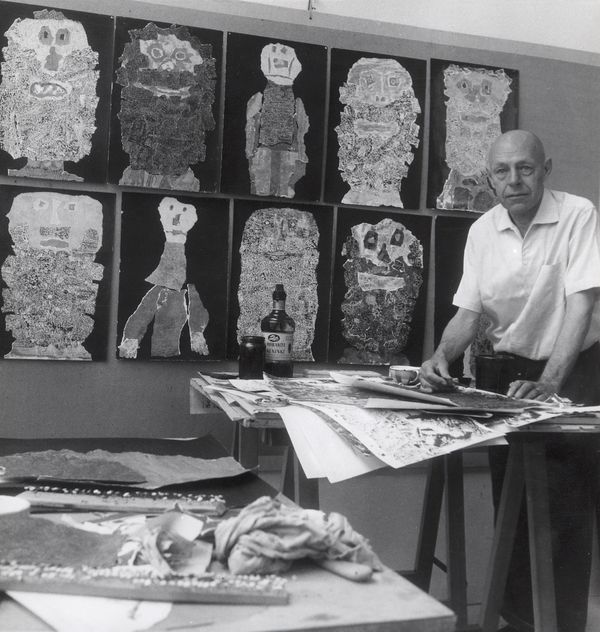
Jean Dubuffet in his studio in Venice, France, 1959. Image © John Craven, courtesy of the Dubuffet Foundation. Artwork © 2016 Artists Rights Society (ARS), New York/ADAGP, Paris.
In the earlier pictures from this series, their metamorphosis from the earlier Texturologies was effected through collage: Dubuffet used various elements made from printed sheets covered with various patterns, arranged so as to create the image of a bearded man. Dubuffet was taking his own Texturologies and retasking them, making figurative assemblages from these abstract works. Dubuffet used four of these Barbes, as well as the essentially abstract Prairie de barbe, to illustrate La feur de barbe. A number of these Barbes, created using rearranged lithographies, are now in public collections, including the Museum of Modern Art, New York, and the Fondation Dubuffet, Paris.
Within a short time of the inception of the Barbes, Dubuffet was also exploring a similar technique using oils, taking pieces of paper or canvas and re-arranging them so that a Texturologie formed a beard. In the case of Barbe des rites and some of its sister-pictures, Dubuffet moved beyond this technique, creating oil paintings that centre on densely-worked areas that recall the Texturologies yet which are here given a new context—as facial hair. In Barbe des rites, the centre of the painting is dominated by a field of feathered, hatched, frenetic brushstrokes and marks, giving the impression of the tangle of hair. The effect is heightened by Dubuffet’s use of light incisions in the paint surface, adding to the fine mesh. The beard is thrown into further relief by its contrast with the rest of the canvas, not least the barely-delineated face that crests this turbulent maelstrom of beard.

Detail of Barbe des rites.
In using the Texturologie in this way, harnessing a vision inspired by the soil within the framework of this bearded face, Dubuffet blurred the lines between landscape and portraiture—it is for this reason that examples of his Barbes were included in the recent exhibition, Jean Dubuffet: Metamorphoses of Landscape, held at the Beyeler Foundation, Riehen, whose own collection includes one of the pictures, Table de barbe; another dating from July 1959, Barbe des combats, is now in the National Gallery of Art, Washington DC. By appropriating his own Texturologies in this way, Barbe des rites and its fellows incorporated Dubuffet’s language of landscape within the format of the portrait, fusing the two, thus achieving one of the artist’s long-stated goals.
In 1947, when Dubuffet displayed his legendary Portraits plus beaux qu’ils croient, which went so far towards marking the beginning of his mature career, Dubuffet had declared, "I think portraits and landscapes should resemble each other because they are more or less the same thing. I want portraits in which description makes use of the same mechanisms as those used in a landscape—here wrinkles, there ravines or paths; here a nose, there a tree; here a mouth and there a house" (Jean Dubuffet, 1947, quoted in R. Bouvier (ed.), Jean Dubufet: Metamorphoses of Landscape, exh. cat., Beyeler Foundation, Riehen, 2016, p. 40).
I think portraits and landscapes should resemble each other because they are more or less the same thing.
—Jean Dubuffet
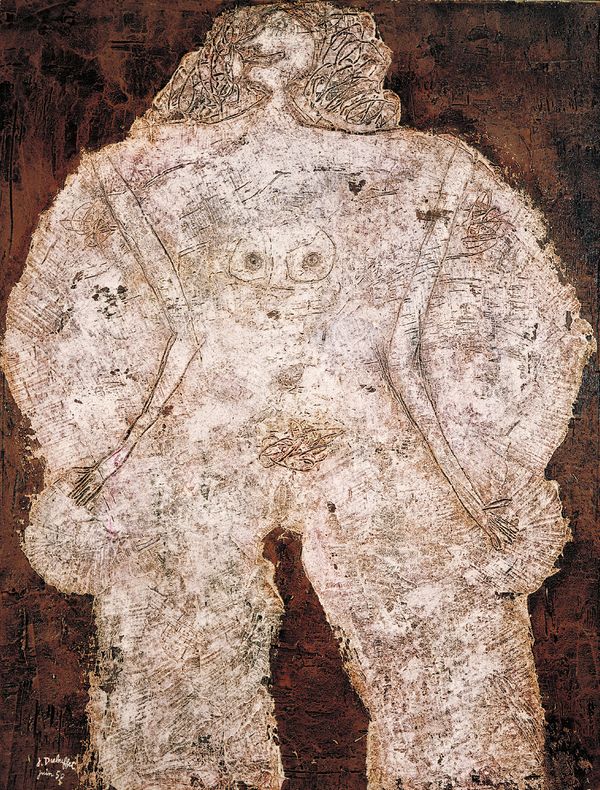
Jean Dubuffet Corps de Dame—Château d’Étoupe, 1950. Oil on canvas, Allen Memorial Art Museum, Oberlin College, Ohio © 2016 Artists Rights Society (ARS), New York/ADAGP, Paris.
This language, this fusion between landscape and portrait, made a huge impact in 1947, marking Dubuffet out as one to watch. Its combination of post-war grit and charming wit enchanted a generation of critics and collectors. The notion of marrying landscape and portraiture, which would re-emerge in the iconic 1950 Corps de dame series which featured women depicted as a fattened, impastoed terrain, would appear almost a decade later in the Barbes. It even bled into Dubuffet’s poem La feur de barbe, which was written in 1959 and published the following year illustrated with five of the beard pictures. In that poem, descriptions of the landscape, of the spring coating of fauna, were melded with imagery relating to beards. Barbe des rites perfectly encapsulates this potent mixture with both the frenetic foliage-like thatch of the beard itself, and the more stony backdrop and monolithic neck and face.
By hanging his Texturologies on people’s chins, Barbe des rites and its fellows marked a return not just to the figurative, but also to the crazy characters that fill so many of Dubuffet’s greatest works, including the Portraits plus beaux qu’ils croient and the Corps de dames. It is filled with a zest for life, not least in the effervescent brushwork that makes up the beard of the title. Dubuffet’s decision to reinstate human subjects in his Barbes can even be seen as a prelude to the Paris Circus series that would emerge only two years later.
The Corps de dames are often seen as celebrations of and assaults upon female archetypes in Western art. Dubuffet does away with the clichéd images of femininity so espoused and celebrated by his forebears; instead, in a manner that can be seen as a parallel to Willem de Kooning’s pictures of women, introduces something rawer, something unexpected but no less true. In a sense, Dubuffet’s Barbes can be seen in similar terms, as explorations of the signifers of manhood and masculinity.

Jean Dubuffet Barbe des Combats, 1959. Oil on canvas, National Gallery of Art, Washington D.C., © 2016 Artists Rights Society (ARS), New York/ ADAGP, Paris.
Again, Dubuffet has created pictures that both tap into archetypes, and smash them. Looking at Barbe des rites, there is a sense that the traditional aspects associated with the depiction of men, strength and virility, have been ignored in favour of the beard itself. And that beard, that sign of masculinity, has become all-consuming. Indeed, it conceals as much as it reveals. In this way, Dubuffet has once more managed to turn the tropes of Western art upon their (hirsute) heads. The more mystical side of the Barbes was refected in Peter Selz’s essay on Dubuffet, published on the occasion of the 1962 retrospective of the artist’s works at the Museum of Modern Art, New York and the Art Institute of Chicago. Unlike so many retrospectives, which feature predominantly on the earlier part of an artist’s oeuvre, that exhibition featured a number of Dubuffet’s more recent works, including a number of Barbes as well as the subsequent Paris Circus pictures. Selz, who was in correspondence with the artist, wrote lyrically of the series in terms which clearly apply to Barbe des rites:
"Some of the Beards... look like gravel runs and have that geological feeling inherent in so much of Dubuffet”s work. Some resemble great rock formations or age-old boulders predating man’s presence on this planet. Or they appear to be survivors of ancient barbaric—that is to say, bearded—civilisations. Their shapes recall the menhirs of Stonehenge and the Winged Bulls from Assyrian palaces. The beard is the ageless symbol of manhood, and most cultures worshipped bearded divinities such as the Greek earth gods, Titan and Cyclops as well as the Olympians who followed them, the vengeful Hebraic god as well as the frst person of the Trinity. It is the memory of these archetypes that Dubuffet now evokes" (Peter Selz, The Work of Jean Dubuffet, New York, 1962, p. 149).

Assyrian Civilization, 8th Century B.C. chalky alabaster statue of Gilgamesh, King of Uruk from Khorsabad, Iraq. Musée Du Louvre, Paris. De Agostini Picture Library / G. Dagli Orti / Bridgeman Images.
In keeping with Selz’s observations, there is a totemic aspect to the bearded figure in Barbe des rites that is underscored by its title. Be he a seer or a deity, this personage has a beard that is a universe in its own right, a portal to a dizzying, kaleidoscopic swirl of movement. At the same time, the face and neck are deliberately slab-like, recalling the menhirs invoked by Selz, or perhaps even the sculptures from Easter Island. It is in part through its combination of the mystic beard and the stern face that Barbe des rites taps into an earthy atavism, uniting the cosmic and the chthonic.
Discussing his motivations, Dubuffet himself wrote to Selz to discuss his work at the time that he was painting the Barbes, explaining to him:
"I have liked to carry the human image onto a plane of seriousness where the futile embellishments of aesthetics have no longer any place, onto a plane of high ceremony, of solemn ofce of celebration by helping myself with what Joseph Conrad calls: “a mixture of familiarity and terror,” out of which the devotion is made which many religious minds offer to their gods and which does not, at times, exclude the use of swear words directed at them" (Jean Dubuffet, quoted in ibid., p. 149).
Thus Dubuffet himself underlined the ritual dimension at play in Barbe des rites and its fellows. But his sense of ritual is one that allows inclusion and approachability. Not for him the distant glaze of the classical figures or the crisp, rigid notions of beauty through which so much Assyrian Civilization, ancient sculpture was created. Instead, there is a sense that the figure in this picture has sprung directly from some mystical flux, channelled through the tumult of darting brushstrokes. Barbe des rites appears to have emerged from a similar zone of creativity to the fetish sculptures of Africa into which nails are hammered. With its "mixture of familiarity and terror," the bearded figure in Barbe des rites may appear fallible, but remains nonetheless formidable.
Art should make us laugh a little and frighten us a little, but never bore us.
—Jean Dubuffet
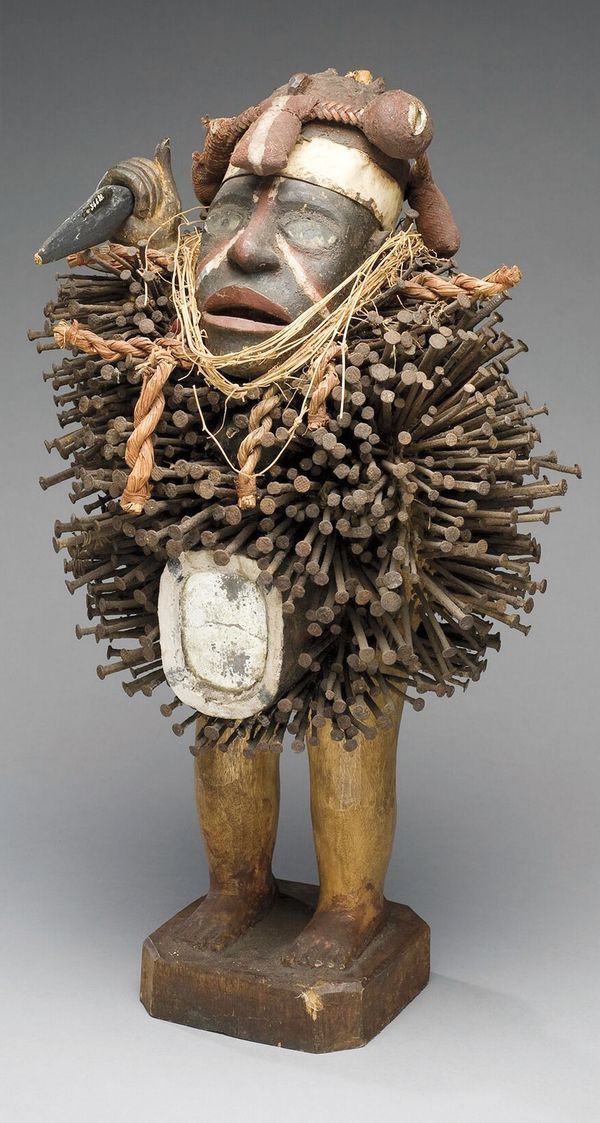
Woyo Ritual Sculpture wood, pigment, glass, metal. Royal Museum for Central Africa, Tervuren.
The notion that the Barbes represent deities to whom swear words might be directed indicates an irreverence that itself cuts to the heart of Dubuffet’s work. He was ever the iconoclast, willing to discard the traditional and the accepted in order to jar his viewers into reappraising the world around them. Instead, Dubuffet looked to the art of cultures that were considered somehow unfiltered: the lack of schooling in children’s pictures, the savagery of the art of the insane, the directness of tribal sculpture, the mysterious communion at play in the ancient works of prehistoric civilisations. This all related to his interest in and support for Art Brut, an area which be brought to international attention. In Barbe des rites, the sheer, manic energy of the beard provides an electric jolt that would be lacking in the cool depictions of Roman gods and emperors—the antecedent of the ever-rational Marcus Aurelius, the great philosopher, has had its stoicism blasted away.

Detail of Barbe des rites.
The crisp classicism of the Greek and Roman gods and heroes has been replaced with something far more vivacious, more visceral. Dubuffet explained his emphatic renunciation of traditional and canonical Western aesthetics in idiosyncratic terms that are pertinent both to his own works, and to Art Brut:
"If you serve someone spinach that is cooked the way it should be, no one notices or remembers that they have eaten spinach. Whereas if you burn it, it shocks their taste-buds and they become immediately aware that it is burned spinach and they gain new insights into the characteristics of spinach, cooking, etc." (Dubuffet, quoted in Margit Rowell, "Jean Dubuffet: An Art on the Margins of Culture", pp.15-34 in Jean Dubufet: A Retrospective, New York, 1973, p. 23).
See Also: Feature Video | Jean Dubuffet’s ‘Barbe de rites’: Disruption in Disguise
Barbe des rites and a number of its sisterpictures were exhibited in the gallery of Daniel Cordier the year after they had been created. Entitled Jean Dubuffet. As-tu cueilli la Fleur de Barbe, the show dated from an important period in his relationship with the dealer. At this time, Dubuffet was moving away from the New York-based dealer Pierre Matisse, with whom he had a number of disagreements, and gave Cordier—the first owner of Barbe des rites— increasing access to his works. Cordier would even open a gallery in New York partly to this end, and helped to promote Dubuffet internationally at a time that his reputation was truly in the ascendant—indeed, at the end of the same year as the Barbes exhibition, Dubuffet was granted a retrospective at the Musée des arts décoratifs, Paris.
Barbe des rites therefore dates from a watershed moment in Dubuffet’s career, as he was gaining wide-ranging recognition in France and beyond. With its figurative content and sheer sense of glee, Barbe des rites clearly revives Dubuffet’s fascination with the figurative, with characters such as those featured in his earlier Portraits, while also paving the way for Dubuffet’s seminal Paris Circus two years later. At the same time, its humorous little eyes, its focus on the human face and its electric blaze of brushstrokes all ensure that Barbe des rites retains an energy—and a charm—that is very much its own.