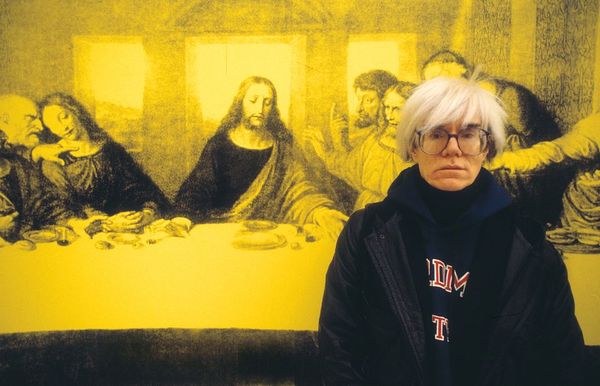
Andy Warhol in front of The Last Supper (Yellow), 1986 at the opening of Andy Warhol – Il Cenacolo at Palazzo delle Stelline, Milan, January 22, 1987. Photo by Mondadori Portfolio/Archivio Giorgio Lotti via Getty Images
Francesco Bonami: Last Supper is basically Andy Warhol's last work. He died right after the opening. I remember the opening in Milan in 1987.
Douglas Fogle: If you think about the Last Supper paintings, they're very much — and I'm not the first to say this — they are the first and the last Disaster paintings. You know, the Last Supper — it's the greatest story ever told. I mean it's a Hollywood narrative in a way. I don't mean to be dismissive of the story of Christ but to a certain extent, it informs the narrative structure of Hollywood — but also goes back to Greek mythology.

Andy Warhol and Fred Hughes with Pope John Paul II, 1980. Image Lionello Fabbri/SCIENCE SOURCE
FB: Warhol was a Catholic but do you see it as a religious painting?
DF: It's a good question. I only see that series of paintings as religious paintings in the sense of how human culture has venerated images around certain kinds of stories, whether they're myths of creation or whether they're religious epiphanies…
FB: The fascination was with the image, with the story around the image.
DF: Catholicism was one of the great commissioners of images and this was no different. So this is really part of that. If you think about the way in which any religion—in particular, Catholicism—used images to try to get people to come to church and as a teaching device, but also as a device of veneration and awe, there's a similar kind of operation of image production in the kind of building up of stars in the Hollywood system and in the media. And then if you look at someone like Marilyn Monroe or even Jackie Kennedy—who wasn't trying to be a star in that way—but the way in which Warhol used the images of Jacqueline Kennedy are very much like religious icons and images of the Virgin Mary. Marilyn a little bit too, and there's tragedy in all these stories.
He was attracted to all of these things. The Last Supper is the ultimate story of rags to riches, but also the self-abnegation of letting go…
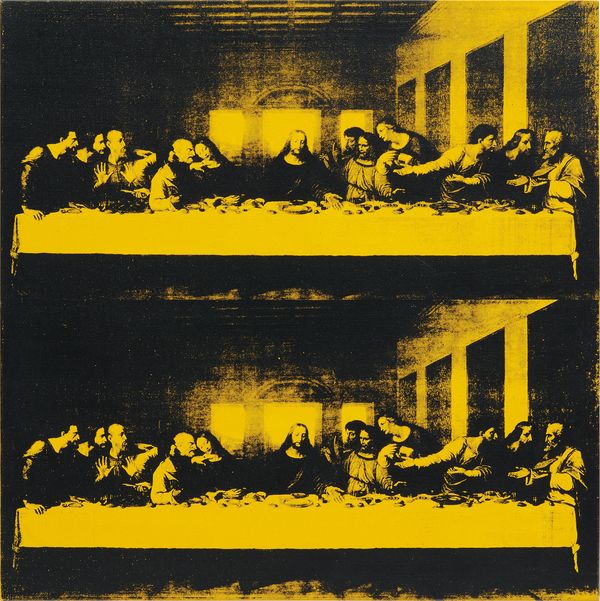
Andy Warhol Last Supper, 1986. Synthetic polymer paint and silkscreen ink on canvas. This work will be offered in our New York Evening Sale of 20th Century & Contemporary Art on 17 May 2018.
FB: Do you think Warhol was more fascinated with the icon, the image, or with the author: Leonardo?
DF: If you think about Leonardo as one of the first art stars—and Warhol was obsessed with de Kooning and Pollock and Johns. Before he was in advertising, he studied art at Carnegie Tech, which is now Carnegie Mellon University. He grew up in Pittsburgh and went to New York with Philip Pearlstein, who was another painter. He really wanted to make it as a fine artist but the only work that he could find was as an advertising illustrator. He then became the most highly compensated and most famous commercial illustrator in New York. He was so well-compensated that he bought a brownstone in Midtown. He was really well-off at that point but he desperately wanted to be an art star as opposed to a commercial artist. He looked at those artists as the models of what he wanted to be, and he wanted that recognition. So, if you look at how many times he's appropriated other painters, Leonardo might be the main one.
FB: I think there is not just the appropriation of painters but there is also a self-identification with his subject—he wants to be the subject that he was painting. And in that case, I think in Last Supper, do you agree, that maybe he was achieving his ultimate dream to become this object, Jesus and the author. So, the combination of Jesus and Leonardo is unbeatable, I think.
DF: I mean it's megastardom at a level beyond—well, actually, Mao was probably more famous than Jesus at one point in terms of the amount of people following him.
I don't think that he very consciously was attempting to elevate himself to the realm of Jesus; although he did do self-portraits and there is a sense, if you move backward from the Last Supper, one can make all sorts of readings back into the self-portraiture and whatnot...from the Shadow Paintings all the way back to the earliest photo booth self-portraits. But I do think that the end of it is what you mentioned in terms of the Master of the Renaissance, Leonardo. That must've been a huge draw for him too, because he also wanted to be considered a Master. He had that desire to make it. I'm sure he would've been very happy with how things have turned out.

Source material and drawings for Andy Warhol's Last Supper series. Image The Archives of the Andy Warhol Museum Pittsburgh © 2018 Andy Warhol Foundation for the Visual Arts/Artists Rights Society (ARS), New York
FB: If you look at the Last Suppers, they are quite remarkable, but is our perception of the work influenced by the fact that it's the last work that he produced?
DF: I don't think so because it wasn't supposed to be the last work. One could read it that way because, in the end, the narrative of the market and art history often gives undue weight to something that happens to be the last work because the artist died prematurely.
Reading it from a historical perspective, it's interesting to consider them as the last body of work. I'm very curious what he would have worked on in the 10 to 20 years after that, had he lived, because he died pretty young. I mean he was only in his fifties...
FB: Would you compare the Last Supper to his skulls?
DF: Well, if you think about the skulls as memento mori, then we are going back to the Renaissance as well...I think there's this idea of the reliquary at work as well. Whether you're thinking about it as religious or not, there is a sense of the memento mori and reminding us of the veil of tears, that life is ephemeral and short and that we are only here for a short time and whether that points to a life beyond within the Christian narrative or otherwise…I would certainly connect them to that. And if you think about him looking at Renaissance Masters, the skull operates as memento mori in both still-lives and portraits in the Renaissance. It's one of the prime tropes of that period of painting.
To a certain extent — whether Warhol was religious or not — he was interested in the mechanisms of religion, Christian iconography and the way in which it's circulated in artwork. That puts him in the lineage of artists who were commissioned to make works, religious or otherwise, going back to the Renaissance or Middle Ages. Whether it leads us to characterize him as a kind of art saint or not, I don't think that was his intention. When I look at the General Electric logo on top of the disciples in the Last Supper that belongs to MoMA, or the Dove soap printed over the figure of Jesus, it begs the questions: What is religion in the end? Is Procter & Gamble any different than a proselytizing monotheistic religion that wants people to join it? To a certain extent, our religions today are reality television and the narcissism inherent in Instagram.

Andy Warhol Last Supper, 1986. The Museum of Modern Art, New York, Image © The Museum of Modern Art/Licensed by SCALA/ Art Resource, NY, Artwork © 2018 Andy Warhol Foundation for the Visual Arts/Artists Rights Society (ARS), New York
FB: And to conclude, the position of Jesus in the last supper is perfect for the electric chair.
DF: You can read the Electric Chair paintings religiously. You know, they're the only Disaster paintings that don't have figures in them. They are the only Disaster paintings with a missing body which has perhaps ascended...They are also, to my mind, the only Warhol Disasters with a very graphic admonition in the back of the room with a sign that says, "Silence" (in the execution chamber). And that sign implies an audience…witnesses to the execution of state power. So, there's a real connection to the Christian narrative in the Electric Chairs.
If you look at the position of the electric chair in the image that Warhol appropriated, what's incredible is that the chair is in exactly the same position as Christ in the Last Supper paintings. They might be empty and devoid of human presence, but you can absolutely connect them to Warhol’s Last Supper.

Andy Warhol Little Electric Chair, 1964-1965, San Francisco Museum of Art © The Andy Warhol Foundation for the Visual Arts, Inc. / Artists Rights Society (ARS), New York