
On view in New York, from left to right: Wolfgang Tillmans Freischwimmer 154, 2010; Christopher Wool Untitled (S134), 1996; Joe Bradley Big Boy, 2010; Rudolf Stingel Untitled, 2012
It was the French painter Maurice Denis who, in his famous statement of 1890 for Art et critique, addressed the nature of abstraction in painting: "It should be remembered that a picture—before being a war-horse, a nude, or an anecdote of some sort—is essentially a flat surface covered with colors assembled in a certain order." This was more than a century ago and yet Denis' dictum still remains extremely relevant in the observation and creation of abstract art.
Many things have happened on the canvas in terms of abstraction since 1890, but today's generation of artists have pursued the resurgence of abstraction in ways that would have been unforeseeable more than half a century ago. While in the early 1950s abstraction was considered the savior and figurative painting the villain, the artists of today have rendered this binary thinking obsolete. Rather, they embrace abstraction as one possible path among many.
Today's generation of artists...embrace abstraction as one possible path among many. It is within this imaginative universe that [these artists] float like astronauts...

Rudolf Stingel Instructions, 1989. The Museum of Modern Art, New York, Image © The Museum of Modern Art/Licensed by SCALA/Art Resource, NY, Artwork © Rudolf Stingel. Courtesy Paula Cooper Gallery, New York
Technology helped artists establish a much more liberal approach to the visual content of their work. Computers, digital technologies and other, continuously more sophisticated, tools of production have provided artists with the freedom to disentangle themselves from the modernist chains of their forebears, particularly the idea of abstraction as anchored in Barnett Newman's notion of the "sublime." Reality in all its forms and shapes has become much more alluring than a distorted and overwhelming idea of purity and spirituality. It was without a doubt Andy Warhol, who, diving into the El Dorado of silkscreening, broke the boundaries of painting that had hitherto confined it to a realm of manual activity, verging on skill and craftsmanship devoid of any content.
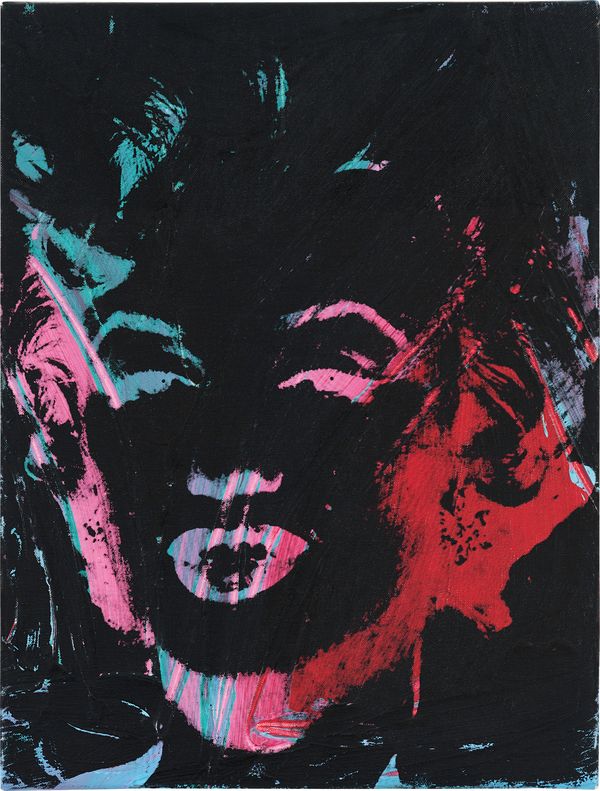
Andy Warhol 1 Colored Marilyn (reversal series), 1979
If Philip Guston was the brave pioneer—who bridged abstraction with figuration and bore all the consequences and risks of this betrayal in the 1960s—the artist who truly placed abstraction, technology and figurative art into the same ring was Gerhard Richter by establishing a unique and disenchanted relationship between the (mostly photographic) image and the passionate abstract gesture.
Since Richter, countless artists have pursued abstraction both in image and in language in fascinating ways. The list is long but we could start with Rudolf Stingel, who has challenged the romantic notion behind the creation of an artwork to the point that he steps back and lets the viewer intervene. In his Celotex series, viewers were given free rein to draw, write or scratch across the pristine surface of his Celotex panels, which the artist would then transform into another material. Cast in copper and plated in gold, Stingel elevates the mundane, and often aggressive, action into an almost abstract and sacred dimension.

Rudolf Stingel Untitled, 2012

Installation view of the exhibition Rudolf Stingel, Whitney Museum of American Art, New York, 2007. Photograph Andrea Mohin/The New York Times/Redux, Artwork © 2017 Rudolf Stingel
While evoking such precious objects as religious Byzantine mosaics or icon paintings, closer consideration reveals how the richly textured surface is incised by banal graffiti. Untitled belongs to the group of works that originated from the site-specific, participatory installations mounted at Stingel's major mid-career retrospective at the Museum of Contemporary Art, Chicago, and the Whitney Museum of American Art, New York, in 2007, where visitors were invited to transform the walls covered with easily malleable Celotex insulation paneling with whatever was to hand. Executed in 2012, the present work is among the first works that Stingel created by casting these panels and electroplating them in copper.
By casting, electroplating and gilding these panels to create detailed 1:1 one-off copies, Stingel crucially adds another layer of complexity to his conceptual process: he plays with the century-old tradition of replication — particularly evoking nineteenth-century electrotyping and the plaster cast replication technique, the latter of which has its origins in Antiquity and continued into the late 19th century. While, historically, the purpose of plaster casts and electrotypes was to replicate masterpieces deemed precious, Stingel's modern-day reincarnation of copper casting fundamentally reverses this premise by elevating the banal and the random into timeless opulence.
Christopher Wool took a different direction in his pursuit of abstraction, yet he, too, maintained a form of automatic intervention on the surface of his work. Borrowing from the legacy of print-making and graffiti art, Wool has produced a powerful series of works that combine the lightness of Cy Twombly's scribbling with the directness of strong and effective advertising. Seemingly chaotic, Wool's works reveal an audacious control of abstraction and legibility—allowing all these layers of meaning to maintain their readability.
I became more interested in 'how to paint it' than 'what to paint'.
— Christopher Wool

Christopher Wool Untitled (S134), 1996
Pulsating with characteristic anarchistic vigor, Christopher Wool's Untitled (S134), 1996, celebrates the full range of innovation that the artist deployed in his reinvigoration of the genre of painting during the late 1980s and early 1990s. With a sly nod to Andy Warhol's Flowers, 1964, here Wool plays on the larger themes of seriality and abstraction that had thus dominated the legacies of post-war American art. In Untitled (S134), Wool has built up a complex composition in pitch-black enamel using the diverse visual language of his career up to this point: stenciled floral patterns reminiscent of his first works from the late 1980s mingle with screen-printed floral motifs. Wool has intentionally made visible the breakdown and slippage contingent in his artistic process, letting the rectangular frame that remained from the dragging of the silkscreen from the aluminum panel to become a compositional device in its own right, hovering, somewhat misaligned, on top of the floral palimpsest. Wool countered the mechanized silkscreen process synonymous with Pop Art by obscuring this imagery with graffiti-like loops that forcefully explode across the vast panel, injecting the composition with a palpable energy.
Meanwhile, in this contemporary love affair with abstraction, the natural heir to Guston's conflict with figuration and abstraction is Joe Bradley. Bradley plays with the challenging subject of abstraction and the seemingly outdated indulgence with the physicality and process of painting. His work is violent, powerful, and yet child-like at the same time. If Guston viewed painting as a struggle and a source of contradictions, Bradley sees it as a playful regenerative game.

Joe Bradley Big Boy, 2010
Big Boy epitomizes Bradley's sophisticated engagement with the history of abstraction, its weathered textures and bold lines paying homage to the legacies of such painters as Jackson Pollock, Willem de Kooning, Jean Dubuffet, Jean-Michel Basquiat, Guston and Twombly. And yet, as Bradley explained, while he does naturally absorb these art historical influences, ultimately "the idea is to sublimate that in the work and to come up with something that feels and looks like your own."
Closer to the spirituality and anxiety of Abstract Expressionism, filtered through pop culture, is the work of Mark Grotjahn. With a wink to Malevich and Futurism, Grotjahn's butterfly paintings reverberate with a subliminal nod to Roy Lichtenstein's "Bang!" or "Whaam!".

Mark Grotjahn Untitled (White Butterfly Blue Big Nose Baby Moose), 2005
Grotjahn intentionally complicates the incongruous poles of abstraction and figuration by playing with a formal motif that simultaneously alludes to winged insects, illusionistic spatiality and abstract geometry. While retaining an outward appearance of geometric purity and symmetry within his works, he champions the irregularities produced during his creation process that sees the artist shift between precise mark-making and more intuitive slathering of paint. Notwithstanding their careful execution and rational, works like Untitled (White Butterfly Blue Big Nose Baby Moose) invite and embrace imperfection. Grotjahn's openness to chance and overall handmade aesthetic subverts the hard-edge precision usually associated with high modernism's abstract forms.
Finally, the new entrant into the club of technological abstraction is not a painter, but a photographer, Wolfgang Tillmans. His dramatically enlarged microscopic images become landscapes reminiscent of ancient Chinese and Japanese painting. In Tillmans' works, abstraction and technology merge into a totality that encapsulates this new frontier.
These are images that I create with my hands and with tools that emit light.
— Wolfgang Tillmans

Wolfgang Tillmans Freischwimmer 154, 2010
While Tillmans already explored issues of surface and scale with his early photocopier experiments, the Freischwimmer series exemplifies his more sustained engagement with camera-less abstract photography since the turn of the millennium. Though Tillmans has remained relatively elusive about the exact process behind the creation of his camera-less works, he describes his abstract pictures as belonging to certain "families" grouped together based on the specific techniques used in their making.
Tillmans' Freischwimmer series, exemplified by Freischwimmer 154 from our New York Evening Sale, is executed in the darkroom without a camera. Its German title refers to the level of swimming proficiency attained by being able to swim for 15 minutes without any support. While evoking aquatic and liquid associations, Tillmans has emphasized that "the name doesn’t relate to the fluids used in the production…These are images that I create with my hands and with tools that emit light."
It is within this imaginative universe that the new generation of contemporary artists, including the likes of Tillmans, Wool and Stingel, float like astronauts in absolute awe of a newfound dimension. This is a dimension they can seize or let go of as they wish and desire.