Article | Matthew Wong Painting The World He Couldnt Find
Matthew Wong Painted the World He Couldn't Find
The recluse’s dwelling place turns out to be the painting itself.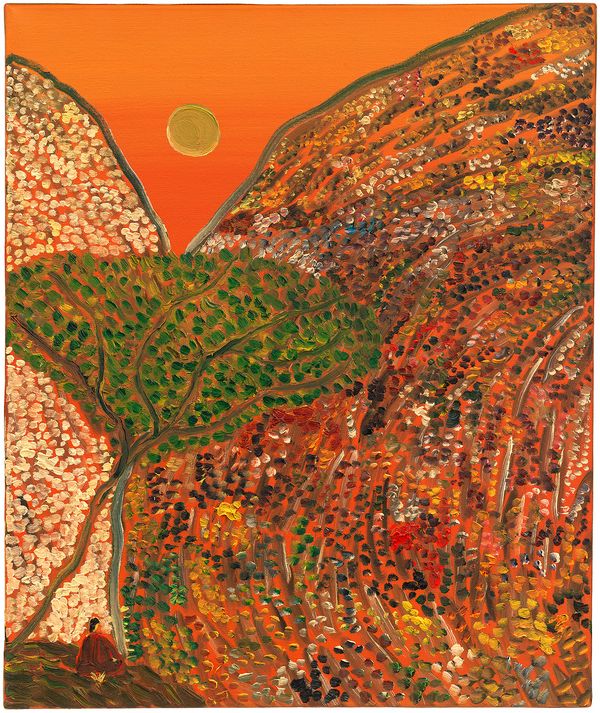
Matthew Wong, The Recluse, 2017. Modern & Contemporary Art Hong Kong.
As Phillips presents its Modern & Contemporary Art Sale in Hong Kong on 2 June 2026, The Recluse (2017) stands as one of the most quietly arresting works in the sale. At 61 by 50.8 centimetres, it is small in scale, but immense in presence, holding its ground through precise calibration that came to define Matthew Wong’s brief but extraordinary practice.
“I would say my work is a dialogue with myself... a way to find a place in a world where I often felt like an outsider.”
—Matthew Wong
A solitary figure rests beneath a lush emerald tree, dwarfed by towering mountains rendered in dense layers of pointillist brushstrokes. On the left-hand peak, white and pink highlights are applied with vigour, catching the light in a way that suggests sunlight filtering through a mountain pass. Elsewhere, violet sits beside ochre, producing an optical vibration that flat colour mixing could never achieve. Against the warm glow of an orange sky, the foreground tree presses its vibrant greens cool and alive, its foliage bleeding into itself, evoking humidity, growth, and breath. The scene feels quiet and still. And yet the surface is entirely alive with movement and tension.
That lone figure is a recurring motif in Wong's work, and it feels like a stand-in for the artist himself: someone quietly making his way through a landscape that is at once serene and overwhelming. The contrast between the small human presence and the vast mountains recalls Song Dynasty landscape painting and Daoist thought, where the human being is only one small part of a much larger cosmos. Yet Wong departs from those traditions by saturating the scene with vivid colours and rich textures, drawing the distance inward, bringing the landscape so close that it almost engulfs the viewer.
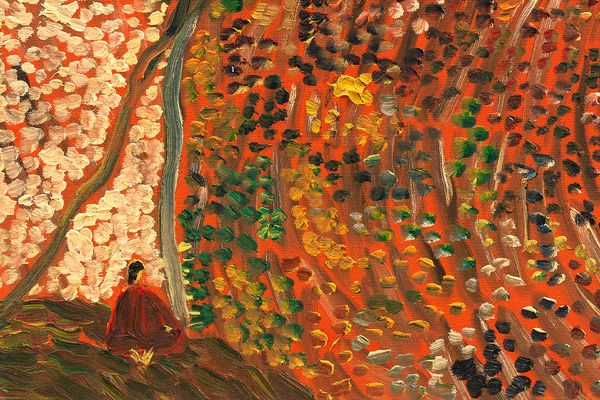
Matthew Wong, The Recluse (detail), 2017. Modern & Contemporary Art Hong Kong
In the Chinese literati tradition, the recluse — the yǐnshì — is not a figure of failure but of deliberate inwardness: a scholar who withdraws from public life in fidelity to contemplation, to nature, to the self. The figure in this painting is not presented as defeated but as self-possessed, sitting securely within the curve of the mountain, sheltered by the tree's canopy. The scene is calm but not empty. It feels full of hidden life, and the viewer is not asked to observe it from outside but to enter it, to inhabit that state of stillness and quiet attention.
“I do believe that there is an inherent loneliness or melancholy to much of contemporary life, and on a broader level I feel my work speaks to this quality in addition to being a reflection of my thoughts, fascinations and impulses.”
— Matthew Wong
Born in Toronto in 1984, he moved with his family to Hong Kong at age seven and lived there until fifteen, when the family returned to Canada. He was never fully of one place or the other. That sense of apartness runs through everything Wong made.
His influences were as hybrid as his upbringing: the expressive surfaces of Van Gogh, of whom Wong said, “I see myself in him — the impossibility of belonging in this world”; the radiant intensity of Gauguin’s Tahitian landscapes; and the atmospheric stillness of classical Chinese painting.
The title The Recluse suggests retreat, but not necessarily loneliness; it also implies reflection, shelter, or inwardness. Wong spoke openly about mental health and isolation, and painting often appears to have functioned for him as a form of meditation. That quality is present in The Recluse itself, in the repetitive labour of countless pointillist brushstrokes.
Wong died in October 2019 at thirty-five, just as critical recognition was beginning to consolidate. Late start, rapid ascent, sudden end: his arc has inevitably shaped how his work is received.
Wong is widely acclaimed in the global contemporary art scene, with widespread influence in both Western and Asian markets. His paintings are held in the permanent collections of prestigious global institutions, including The Metropolitan Museum of Art in New York, the Museum of Modern Art (MoMA), the Solomon R. Guggenheim Museum, and the Art Gallery of Ontario.