Article | Artists To Watch Spring Sings In New York
Artists to Watch: Spring Sings in New York
The icons and emerging names on our shortlist ahead of a marquee week on Park Avenue.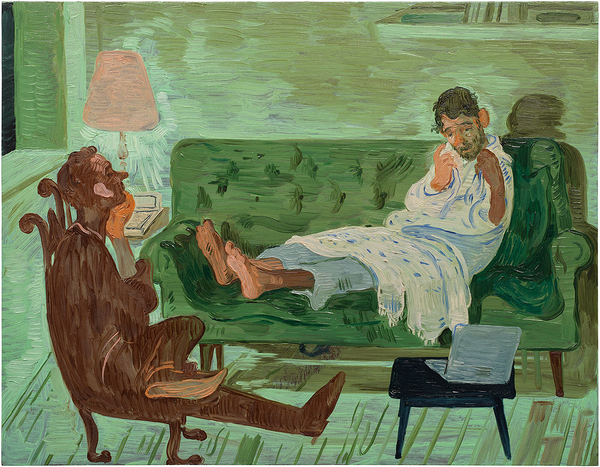
Salman Toor, Two Friends, 2020. Modern & Contemporary Art Evening Sale, New York.
Salman Toor
Salman Toor’s (b. 1983) small-scale, oil-on-panel paintings depict the imagined lives of young, queer, Brown men navigating the dual landscapes of South Asia and New York: dancing in apartments, lounging on stoops, gathered around kitchen tables, or, in the case of Two Friends (2020), engrossed in the glow of a laptop screen. Tender and precarious, the subjects occupy a space between poise and uncertainty, the enjoyment of one another’s company and the contingent nature of shared screen time. This tension between private and public life is at the heart of Toor’s practice, and the artist continues to explore how the two domains blend.
Toor’s institutional profile is remarkable for an artist of his generation. Following a landmark solo exhibition entitled How Will I Know at the Whitney Museum of American Art, New York, in 2021, his work entered the collections of the Metropolitan Museum of Art, New York, the Guggenheim Museum, New York, the National Gallery of Art, the British Museum, and the Pinault Collection, among many others. In 2025, Luhring Augustine presented Toor’s acclaimed solo show, Wish Maker, and his next major survey, Someone Like You, opens at the Courtauld, London, in October 2026.
Anna Ancher
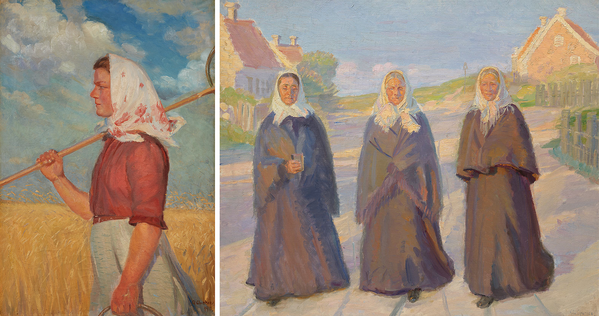
Left: Anna Ancher, Harvest Girl (Høstpige), 1903–1911. Modern & Contemporary Art: Morning Session, New York. Right: Anna Ancher, On the Way to Church (På vej til kirke), circa 1928. Modern & Contemporary Art: Morning Session, New York.
The only member of the storied Skagen Painters (Skagensmalerne) to have been born in the remote Danish fishing village, Anna Archer (1859—1935) holds a unique position in the history of both the movement and the environment that would define her practice. Her family’s inn, Brøndums Hotel, was the social center of the artists’ colony and a gathering place for artists from across Europe, as well as where Ancher absorbed the influence of plein air painting and developed a visual language of her own. She trained privately (women were denied enrollment at the Royal Danish Academy of Fine Arts until 1888), eschewing the dramatic seascapes and harbor scenes of her male contemporaries and instead rendering the women and children of her community with the coastal light that Jutland’s far north offered the artist so beautifully. On the Way to Church and Harvest Girl both demonstrate Ancher’s full command of psychological depth and commitment to imbuing her subjects with a luminous, Old Master-influenced resonance.
Though a household name in Denmark, Ancher has only recently gained wider international attention. The Dulwich Picture Gallery mounted the first UK exhibition dedicated to the artist in 2025, along with a new catalogue of her work published by Simon & Schuster the same year. Her works are held in the collections of the Skagens Museum, Denmark, The Hirschsprung Collection, and the National Museum of Women in the Arts, Washington, D.C. Earlier this year, Young Girl Reading a Letter (Ung pige, der læser et brev) achieved over three times its high estimate at Phillips' Modern & Contemporary Art Sale in London, setting a new auction record for the artist.
Pat Passlof
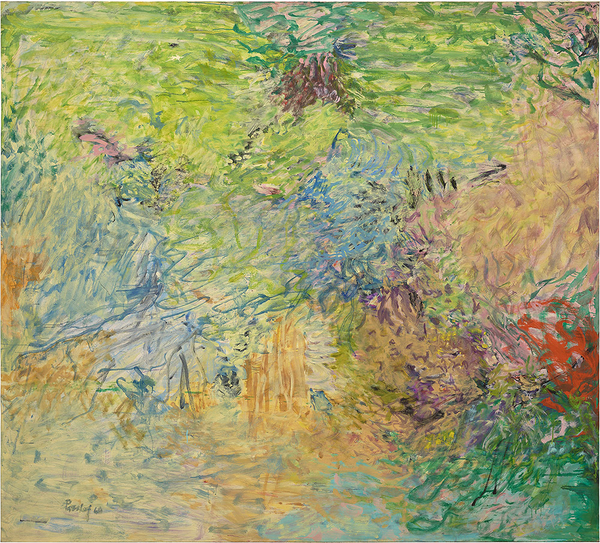
Pat Passlof, Fortune, 1960. Modern & Contemporary Art Evening Sale, New York.
Measuring seventy by seventy-seven and one-half inches, Pat Passlof's Fortune is substantial in scale and ambition, its dimensions aligning it with the heroic formats favored by her Abstract Expressionist contemporaries. Executed in the year preceding her 1961 solo exhibition at Richard Bellamy's Green Gallery in New York, the work marks the decisive consolidation of Passlof's transition from the biomorphic, shape-based vocabulary of the mid-1950s into the idiom of complete abstraction. It is a major canvas from Passlof’s most consequential period, when her work achieved the sustained all-over structure and chromatic sophistication that define her contribution to the second generation of the New York School. Preserving the integrity of each brushstroke, Passlof creates a surface that remains a visible record of the act of depositing pigment, balancing spontaneity and assurance within a disciplined planar structure. The inclusion of Passlof in this auction brings renewed attention to a pivotal figure in post-war abstraction. Offered for the first time at auction, and marking the artist’s debut in an Evening Sale, Fortune stands among the defining achievements of her early maturity.
Emily Mason
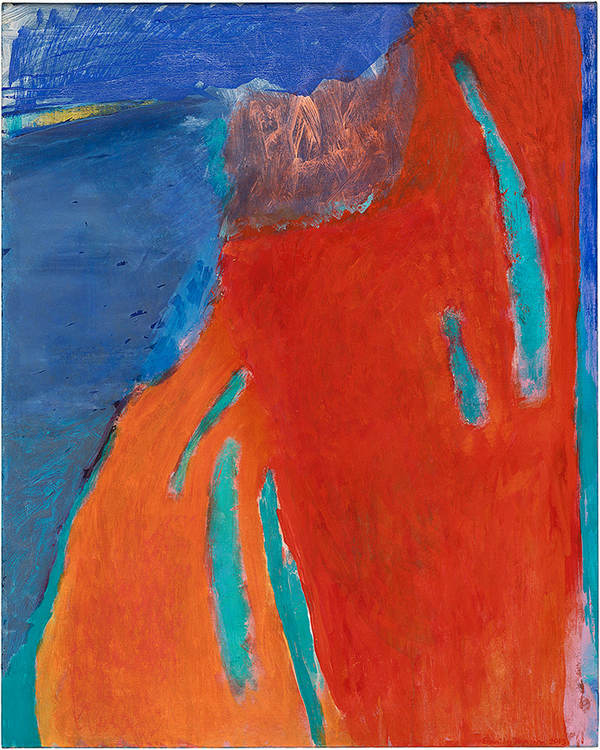
Emily Mason, Reactivated, 2013. Modern & Contemporary Art: Morning Session, New York.
Emily Mason (1932—2019) grew up within the legacy of American abstraction: her mother, Alice Trumbull Mason, was a founding member of the American Abstract Artists, and her Greenwich Village home was frequented by the likes of Josef Albers and Joan Mitchell, yet the younger Mason’s artistic development and practice maintained her singular perspective for over six decades. She often poured mixtures of oil and solvent directly onto the canvas, creating unexpected harmonies and veil-like compositions, which she then structured into sensational works. Reactivated (2013) is characteristic of this approach: the shifting colors move across and over one another while still emerging from a shared space and navigating the canvas’s surface tension with wonderful spontaneity.
In 2025, Rizzoli published Emily Mason: Unknown Possibility, the first comprehensive monograph of the artist’s life and work. Largely overlooked during the market’s boom years for Abstract Expressionism, Mason’s recent rediscovery has brought greater attention to her expansive practice, including exhibitions at Miles McEnery Gallery and the Bruce Museum, Greenwich, Connecticut. Among other institutional collections, her work is held in the National Academy Museum and the New Britain Museum of American Art.
Lee Bontecou
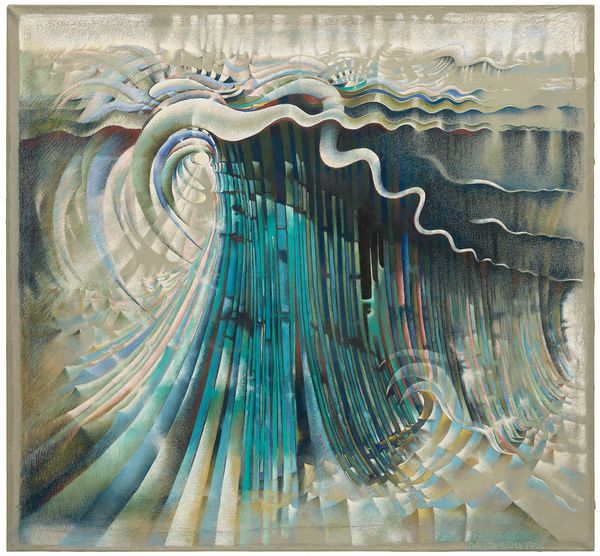
Lee Bontecou, Untitled, 1985–2001. Modern & Contemporary Art Evening Sale, New York.
Lee Bontecou (1931–2022) is best known for her wall-mounted reliefs that combine biological and mechanical elements, set against an almost cosmic, otherworldly unease. One of the artist's few works on canvas and the culmination of a decades-long cycle of drawings, Untitled, 1985–2001— which toured three national museums in a major traveling retrospective between 2003 and 2004 — is her most important two-dimensional work ever to appear at auction. This luminous, expansive pastel composition, defined by sweeping wave-like forms, embodies Bontecou's notion of the "worldscape," where landscape, organism, and imagined terrain converge into a single field of energy and transformation, animated by the medium's capacity to gather and diffuse light across its surface.
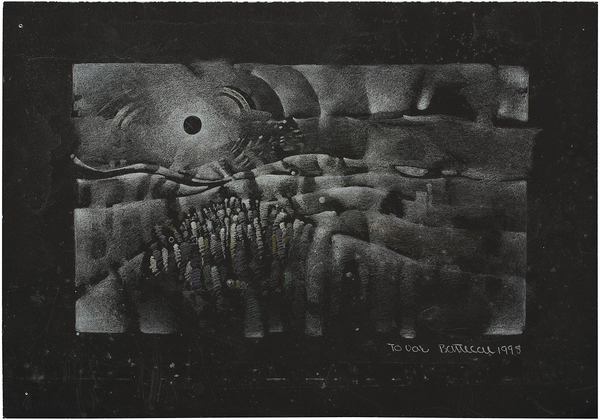
Lee Bontecou, Untitled, 1998. Modern & Contemporary Art: Morning Session, New York.
First coming to art world attention at the height of Abstract Expressionism and Minimalism, Bontecou rejected affiliation with either movement, instead forging a practice shaped by Cold War anxiety, science fiction, and the natural world. Her works possess a startling physicality, balancing menace and elegance through intricate constructions in which the viewer’s gaze navigates around the work while being held by the gravity of a fixed point, often resembling an event horizon or black hole, as in Untitled (1998).
After withdrawing from the public eye for decades and teaching at Brooklyn College from the 1970s through 1990s at Brooklyn College, Bontecou’s work was reintroduced to a new generation of audiences through a landmark retrospective at the Museum of Modern Art, New York, and the Museum of Contemporary Art, Chicago, in 2003 and 2004, respectively. Since then, interest in her work has grown considerably, and her work has been featured in recent group shows, including Through, Dusk at Ortuzar, New York, in 2025-26, and Sixties Surreal at the Whitney Museum of American Art, New York.
Firelei Báez
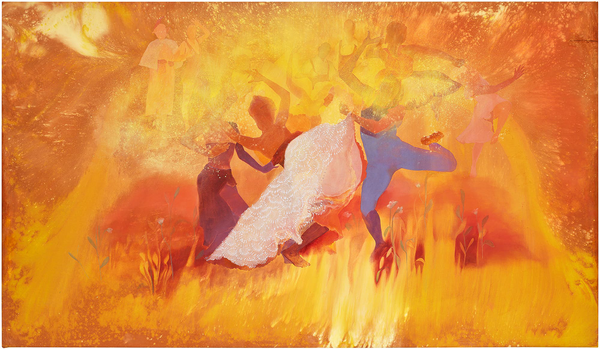
Firelei Báez, magnitude and bond, 2018. Modern & Contemporary Art: Afternoon Session, New York.
Firelei Báez's (b. 1981) densely layered paintings reimagine the histories of colonialism, migration, and the Black diaspora through a vivid, fantastical visual practice. Born in the Dominican Republic and based in New York, Báez frequently transforms archival materials into scenes populated by mythological figures drawn from Caribbean folklore and Afro-Atlantic histories. Created for the acclaimed Joy Out of Fire exhibition organized by the Studio Museum in Harlem, magnitude and bond (the title references the closing line of Gwendolyn Brooks’s poem “Paul Robeson”) is awash with flame-like intensity, and the work marks a departure for the artist in how she examines her subjects and sources. Rather than being transformed into something mythological or abstract, the women’s forms closely correspond to historical photographs — the present dancers are unmistakably drawn from Katherine Dunham’s 1938 ballet L’Ag’Ya, a performance rooted in Caribbean dance traditions. As Báez explained in an interview with Hồng-Ân Trương: “I think the first instinct was that these were real women, and I wanted their real selves to be in conversation with the viewer.”
Báez's first major solo exhibition in the UK was held at the South London Gallery in 2024, following acclaimed shows at the Institute of Contemporary Art, Boston, and the Wadsworth Atheneum Museum of Art. A mid-career survey of the artist’s works is currently on view at the Museum of Contemporary Art Chicago and the artist is currently exhibiting a solo show at Hauser & Wirth in New York from 12 May through 31 July.
Cynthia Hawkins
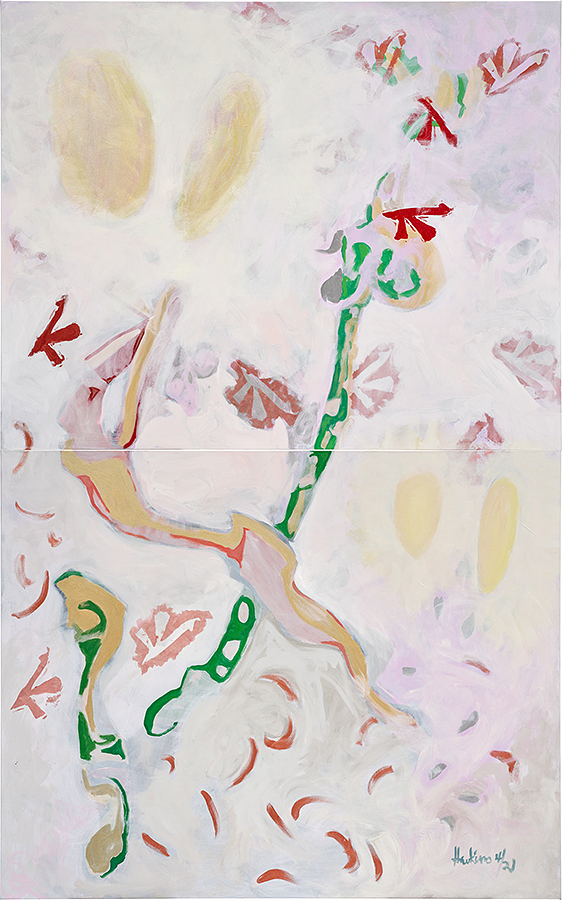
Cynthia Hawkins, The First to Arrive, 2021. Modern & Contemporary Art: Afternoon Session, New York.
A scholar, curator, and painter in equal measure, Cynthia Hawkins has pursued a rigorous practice spanning over half a century. The artist first rose to prominence in the early 1970s as a mainstay in the burgeoning Black-owned gallery scene in New York, where she exhibited alongside artists like David Hammons at Linda Good Bryant’s Just Above Midtown gallery, where she also held her first solo show in 1981. Her paintings are composed of a highly personal network of signs, symbols, geometric contours, and calligraphic marks that draw on her early fascinations with totems, Cycladic figurines, cave paintings, and jazz improvisation. The First to Arrive (2021) exemplifies Hawkins’ monumental approach with two panels at nearly 100 inches in length, each featuring layered, chromatic forms that, despite their disparate placements, give the work a structure befitting its scale.
In 2023, Hawkins received the Helen Frankenthaler Award for Painting. Two years later, she was included in the inaugural exhibition at the Studio Museum in Harlem, New York, and the Bienal de São Paulo, as well as a solo exhibition at Paula Cooper Gallery, New York. Hawkins is well represented in museum collections, including the Museum of Contemporary Art, Los Angeles, and the Bronx Museum of the Arts, New York.
Leilah Babirye
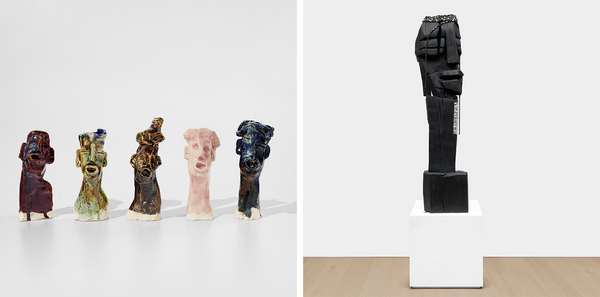
Left: Leilah Babirye, Abambowa (Royal Guard Who Protects the King), 2021. Modern & Contemporary Art: Afternoon Session, New York. Right: Leilah Babirye, Prince Ggamotoka from the Kuchu Royal Family of Buganda, 2021. Modern & Contemporary Art: Afternoon Session, New York.
Leilah Babirye (b. 1985) transforms discarded materials into commanding, sculptural portraits that celebrate queer identity and community. Born in Uganda and based in New York, the artist draws on African carving traditions while incorporating found debris and objects into her works. Babirye’s sculptures reclaim language historically used to persecute and instill it with dignity and power, as seen in Abambowa (Royal Guard Who Protects the King), named after an elite warrior force tasked with protecting the Kabaka (King) and bound by a strict code of conduct and honor-bound duties. The rough-hewn surfaces of the sculptures and open-mouthed unison suggest the deep bonds and singular purpose of the subjects. Likewise, Prince Ggamotoka from the Kuchu Royal Family of Buganda stands with a royal posture and knowing gaze atop a plinth, as if surveying his territory.
In 2023, the artist was the subject of a solo exhibition at the de Young Museum in San Francisco, and her work has since been included in the collections of the Whitney Museum of American Art, New York, the Hammer Museum, Los Angeles, and the Musée d’Art moderne de Paris. Recent exhibitions include Stephen Friedman Gallery, London, and Gordon Robichaux, New York.
Adriana Varejão
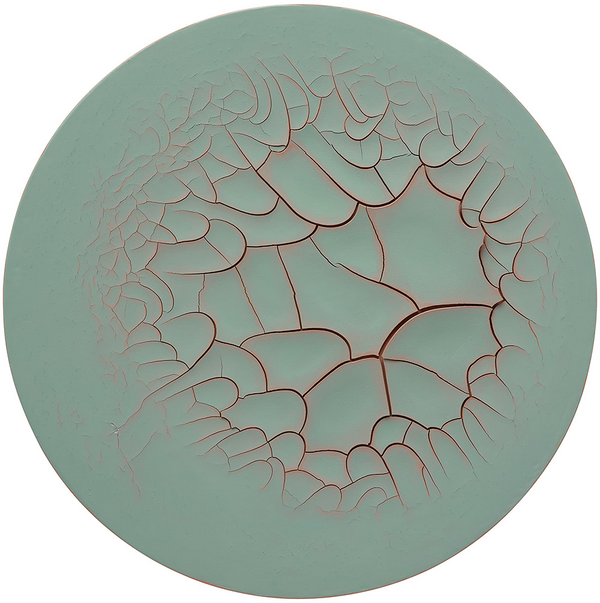
Adriana Varejão, Monocromo redondo Guan, 2014. Modern & Contemporary Art: Afternoon Session, New York.
Among the most influential contemporary Brazilian artists to emerge in recent decades, Adriana Varejão (b. 1964) has built a practice that confronts the legacies of colonial violence. Her paintings and sculptural works are immediately recognizable for their cracked surfaces, which appear to split open, revealing visceral undercurrents. Drawing on the visual language of tilework, Baroque architecture, and decorative wall painting, Varejao exposes the tension between seduction and brutality that underlie Brazil’s cultural formation. Monocromo redondo Guan balances the artist’s meticulous craft with an unsettling beauty — the cool, circular field gives way to a venous web that spreads through the work before diminishing at the farthest reaches, like an incomplete circulatory system or rivers that end before finding a mouth.
Varejão has been the subject of major retrospectives at the Museu de Arte Moderna de São Paulo and the Hispanic Society Museum & Library, as well as in museum collections including the Tate, London, and the Museum of Contemporary Art San Diego. Currently, Varejão is representing Brazil alongside Rosana Paulino at the 61st Venice Biennale.