Article | Ponti And Fornasetti Among Floras Butterflies Design Auction London April 2026
Ponti and Fornasetti Among Flora's Butterflies
Brian Kish on the Important 'Fiori e farfalle' low table.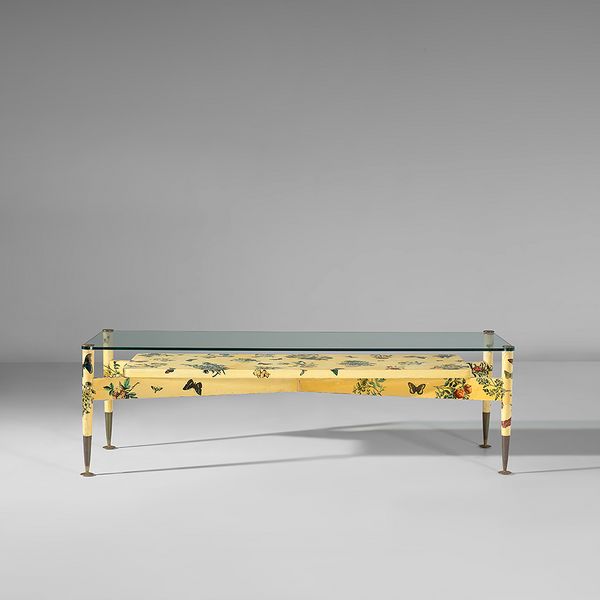
Gio Ponti and Piero Fornasetti, Important 'Fiori e farfalle' low table, circa 1951. Design London.
By Brian Kish, art historian, curator, specialist in 20th Century Italian Architecture and Design, and senior consultant to the Gio Ponti Archives, since 2006.
“Surface design is the illustration of illusiveness that Ponti considered an indispensable quality of architecture.”
—Salvatore Licitra
Gio Ponti's relationship with Piero Fornasetti went beyond transforming the design object into decor. It involved a more complex dynamic, where a particular Milanese culture is evident in avant-garde art and architecture. Within this privileged context Ponti embarked on a singular, yet universal design trajectory. Piero Fornasetti's artistic creations transcended his lithographic transfer technique to become a living embodiment of Ponti's concept of the furnished environment, the casa attrezzata.
The present 'Fiori e farfalle' low table is a highlight of his collaborative oeuvre. Alongside tall trumeaus and related furnishings, it was one of a small number of exceptionally crafted designs executed with an artisanal cabinetmaker’s skill that stands apart from industrial production. Later Fornasetti modified some of the Ponti versions and produced them under his newly formed company which remains active today.
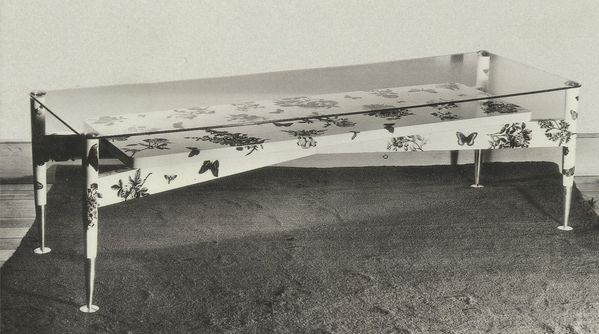
The present rare 'Fiori e farfalle' low table. Image: Courtesy Archivio Fornasetti
This table is an early example of this type at the height of the Ponti–Fornasetti collaboration; records suggest relatively few were produced, and the lithographic application of flowers and butterflies has a variegated pattern distribution with subtle tonal variation suggesting possible hand-colouring, further distinguishing it.
While there had been an intense, surrealist-inspired collaboration between Ponti and Fornasetti at Fontana Arte in the early 1940s, it is around 1950 that the Ponti-Fornasetti synergy reached its climax in three critically acclaimed interior design projects: the Italy At Work exhibition for the Brooklyn Museum, the Dulciora sweet shop, and Casa di fantasia. In the dining room installation for the Italy At Work exhibition. Ponti relied on the transformative energies of his younger colleague, leaving him free reign to curate the display of their jointly designed multifunctional furniture and objects. The overall exhibition design was a microcosm of Ponti's universe wrapped in the aura of Fornasetti's enigmatic drawings. This installation also featured a standalone Ponti designed glass-topped coffee table, made of a solid brass frame with an irregularly cut antique marble slab. This table’s form was initially seen in the Casa Cresmashi in 1948, and in 1951 can be seen as the starting point for the present table.
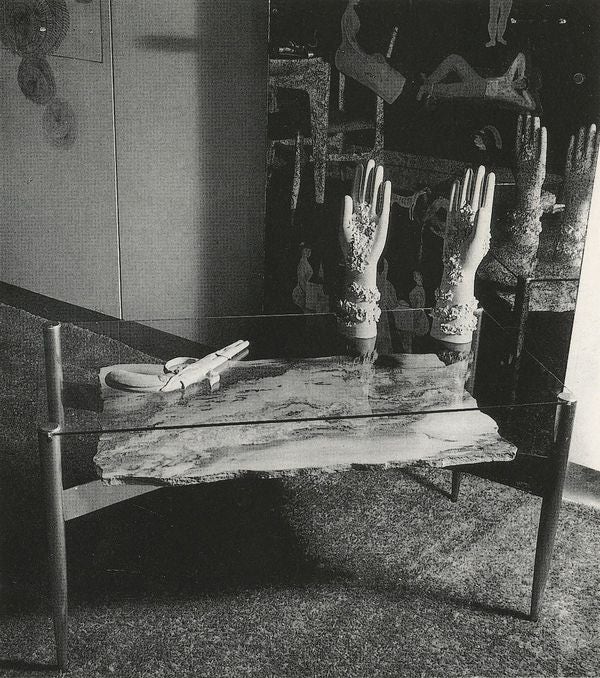
Gio Ponti, coffee table, exhibited at the Italy at Work exhibition at the Brooklyn Museum, 1950. Image: © Gio Ponti Archives
Clearly, these tables share structural features: four tapering legs connected by crossbars that support an elongated rectangular element, beneath a tempered glass top secured at four corners by brass caps. In both tables, all emphasis is on the hovering rectangle under the glass top which acts like a lens focused on the image. That they appear as two unrelated table concepts demonstrates Ponti's ability to achieve two divergent readings that paradoxically evolve from the same source, as is his focus on the Metaphysical art of the brothers Giorgio De Chirico and Alberto Savinio. For those with a contemplative mind, Ponti meticulously examined the emblems found in De Chirico and Savinio's world, where antique Roman marble fragments or untethered floral patterning recur, appearing romantic and funereal while suspended "in everlasting abandonment." Thus, fundamentally static structures become animated in the mind's eye, whether they are stone slabs of ancient Mediterranean heritage or atomized flowers and butterflies. In European culture butterflies are often associated with transformation and more specifically the notion of Anima, the soul moving freely between the living and the dead. Meanwhile flowers embody not just fertility (the Goddess Flora) but also serve as bridges between the human and the divine.
Ponti's 1951 Fiori e farfalle table serves as a coda to a range of specific surrealist projects that Fornasetti promptly developed into his magnum opus. A galaxy of images grafted onto endless typologies of domestic items. This defined the Fornasetti principle where form dissolves into patterns, gaining ever greater appeal and relevance well into the 21st century.