Article | Specialist Picks London Design Auction April 2026
Specialist Picks: Design London
Our team share their favorites ahead of the April auction.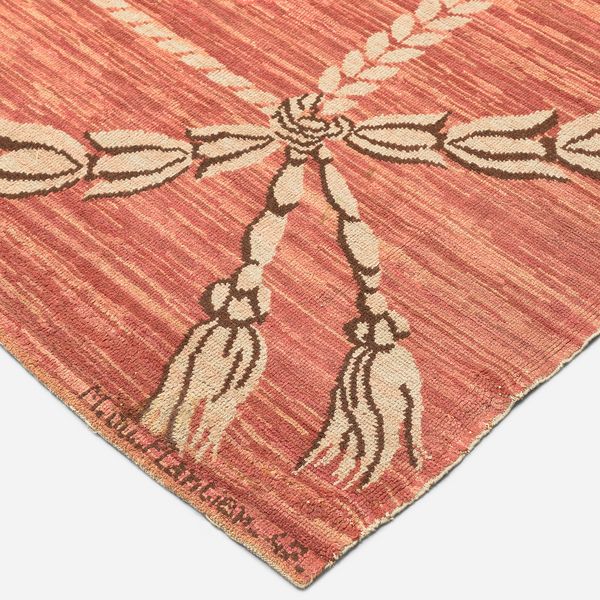
Marc du Plantier, Large carpet, 1947. Design London.
Marc du Plantier
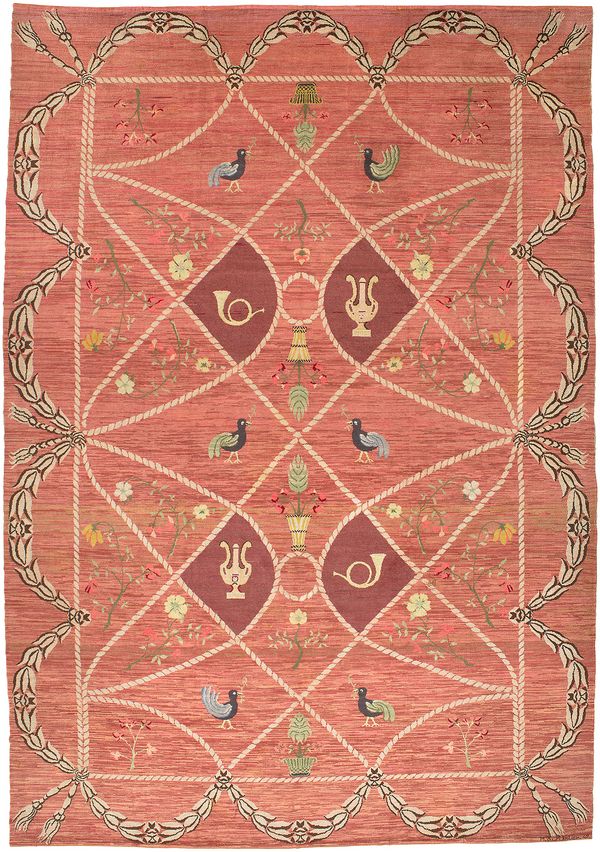
Marc du Plantier, Large carpet, 1947. Design London.
Elie Massaoutis, Head of Design, France, and Senior International Specialist
The large carpet — likely a unique piece — that Marc du Plantier made for the Mirat Diego family is extraordinary in many ways. First for its scale, then for its simplicity and a “classical modernity” that perfectly reflects the artist’s work during his Madrid period during World War II. In contact with the local aristocracy, du Plantier devised decorations that draw on a vocabulary inherited from the late 18th century and the Louis XVI style, yet reinterpreted its modes with a modern sensibility and a twist. As seen in an archival photograph, he created a total decor, letting the gilded-iron furniture garlands converse with those depicted on the carpet: great art in the service of great patrons. Truly a must-have.
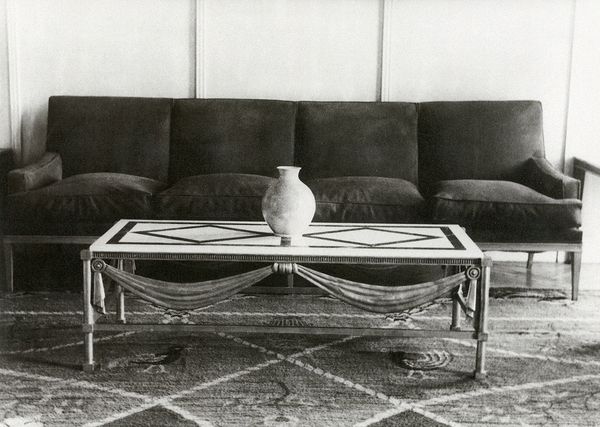
The present model large carpet in the Mirat Diego family residence, Madrid, circa 1947. Image: Fondazione du Plantier · Montebello (Collezione Jérôme Zieseniss)
Piero Bottoni
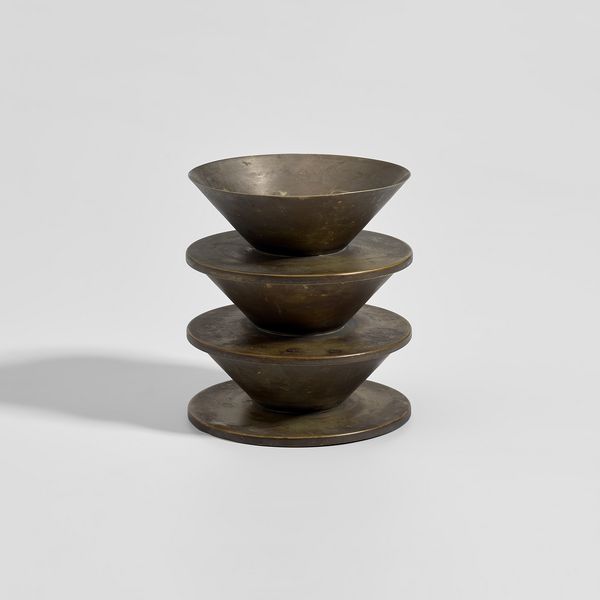
Piero Bottoni, Modular dessert stand, circa 1929. Design London.
Carlotta Pintucci, Cataloguer and Assistant to the Head of Design, Europe
There is perhaps no gesture more quietly noble than keeping something sweet at home for those who arrive. A small offering, almost invisible, yet capable of turning an encounter into a ritual. Sweetness is not merely food: it is an invitation, a promise of welcome. And every ritual, to be fulfilled, requires its object. This modular dessert stand by Piero Bottoni emerges within that subtle space between function and meaning. Designed circa 1929, it belongs to a moment when design began to construct languages and to imagine new forms of everyday life.
Yet the gesture it serves is older than the object itself. As early as the nineteenth century, in the drawing rooms of France and Italy, the bonbonnière held sugared almonds and chocolates as quiet tokens of attention, a discreet center of domestic life, never the protagonist, yet always essential. Bottoni inherits this lineage and refines it. When its elements are separated, they reveal themselves as pure forms: rational, almost archetypal geometries. But it is when they are assembled that a deeper meaning emerges: modularity as openness, as a readiness to adapt to the space and to the gestures that inhabit it.
From a stand, the object becomes something else. It comes alive in space, exceeding function. Each configuration feels almost theatrical, a pose, a fragment of choreography. One is reminded of Oskar Schlemmer and his Triadic Ballet, where the human body is transformed into geometry through costumes that both constrain and reveal movement. In the same way, this object does not merely hold sweets: it composes a rhythm. Its parts, whether joined or dispersed, follow an internal logic, like slow mechanisms, or like marionettes without strings, finding balance within form itself. Function remains, but it expands, charged with a quiet, almost celebratory tension. And so, the initial gesture, offering a sweet, presenting a chocolate, is transformed. No longer simple courtesy, but a small domestic staging, a visible act of care. The object is not merely a support — it is an accomplice. It preserves the sweet, and above all, it preserves the moment.
Ron Arad
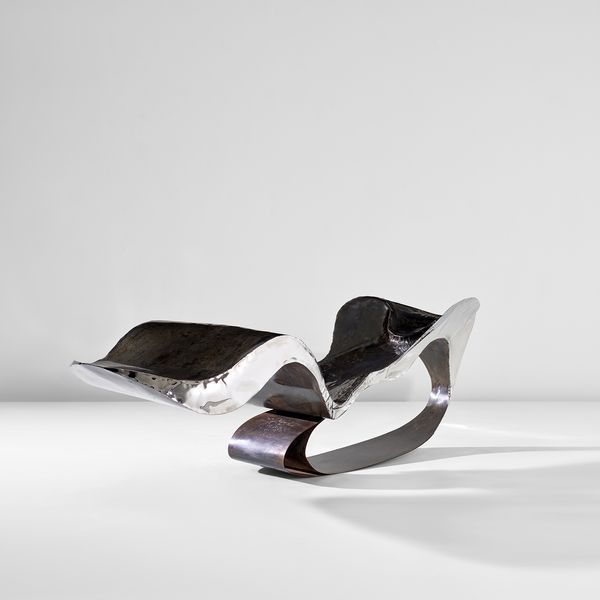
Ron Arad, Unique 'Sapporo Spring', 1990. Design London.
Madalena Horta E Costa, Specialist, Design
Ron Arad’s Unique ‘Sapporo Spring’ captures the raw energy and boundary-pushing experimentation that defined his early years at One Off London. It embodies the spirit of a time in his practice when the line between art and design was deliberately blurred. It is a masterpiece — one that boldly explores material, form, and an undeniable sense of movement.
What makes this work particularly compelling is its sculptural presence — unapologetically daring and expressive. The play between rough, welded edges and the patinated, polished, and sprung steel creates a dynamic tension, emphasizing its industrial roots while still showcasing refined craftsmanship. There is a visceral quality in the visible traces of the artist’s hand, yet this rawness is balanced by an underlying elegance, which feels both elevated and almost resolved in its form.
Beyond its bold sculptural force, the work also carries a sense of humor — one edge is shaped like a tongue, with “chaise tongue” welded into the seat. It’s a piece with real attitude — instinctive and unrestrained — yet, at the same time, it remains remarkably refined and, in moments, almost poetic in its resolution.
Osvaldo Borsani and Lucio Fontana
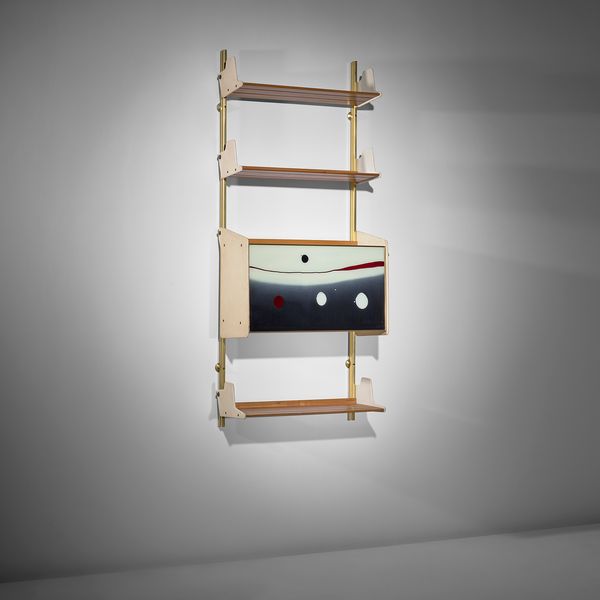
Osvaldo Borsani and Lucio Fontana, Rare modular wall-mounted shelving unit with drop front cabinet, model no. L60, circa 1952. Design London.
Margherita Manca, Senior Cataloguer, Design
I would love to live with this work by Osvaldo Borsani in collaboration with Lucio Fontana. It perfectly captures post-war Italian design at its most experimental and refined. Borsani, founder of Tecno, approached furniture with an architect’s logic, developing highly flexible modular systems that could adapt to a modern lifestyle. What makes this example exceptional is Fontana’s intervention: a striking hand-painted glass panel over a drop-front cabinet door that introduces a singular, artistic gesture into an otherwise rational, industrial framework.
The component parts of the L60 system are made from a varied and innovative combination of finishes. The brass wall uprights, warm wood shelves with vinyl-clad ends, and a painted glass cabinet door all bring together industrial precision and material experimentation typical of the period. These elements form a modular composition that can be reconfigured with ease, creating an adaptable structural rhythm. This sense of order is complemented by the presence of a drop-front cabinet, which folds open to reveal a potential writing or bar surface alongside concealed storage — an elegant and practical feature that speaks directly to mid-century ideals of compact, multifunctional design suited to modern living.
What I find most compelling is this tension: Borsani’s precise, repeatable system versus Fontana’s expressive, one-off surface. The result is both machine-age and deeply personal. It is not just shelving, but a composition on the wall, where art and design meet seamlessly, and where utility becomes something quietly extraordinary.
Lucie Rie
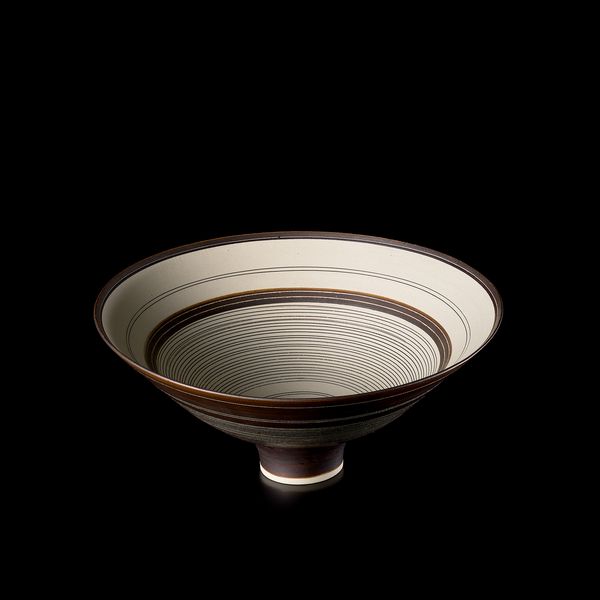
Lucie Rie, Footed bowl, 1969. Design London.
Freya Wood, Intern, Design
Ceramics often carry a certain tension to them, derived from the time and care invested in them, juxtaposed with their fragility. Lucie Rie’s ‘Footed bowl’ falls firmly into this category. Its fragility, although inherent to its medium, is further amplified through its form: the wide-flaring body poised on a slim foot, threatening to tip over. This feeling of uncertainty is counteracted by Rie’s painstaking process of creation, which can be read in those exceptionally delicate repeating lines of sgraffito, hand-incised with great care and precision. These concentric bands are reminiscent of the growth rings of a tree — a visual indicator of its age and lived experience, each ring representing a specific time period and its conditions. Rings, bands and circles are a continuous presence in Rie’s work throughout her career, inviting us to consider her own growth and evolution as a ceramicist, culminating in the present footed bowl — a repetitive meditation on time dynamically offsetting the bowl’s threat to topple.