Article | Carlo Scarpa Murano Venetian Glass Auction London April 2026
Carlo Scarpa and Murano: Vivid and Varied
A mini-survey of the master's glass works comes into sight at Phillips London.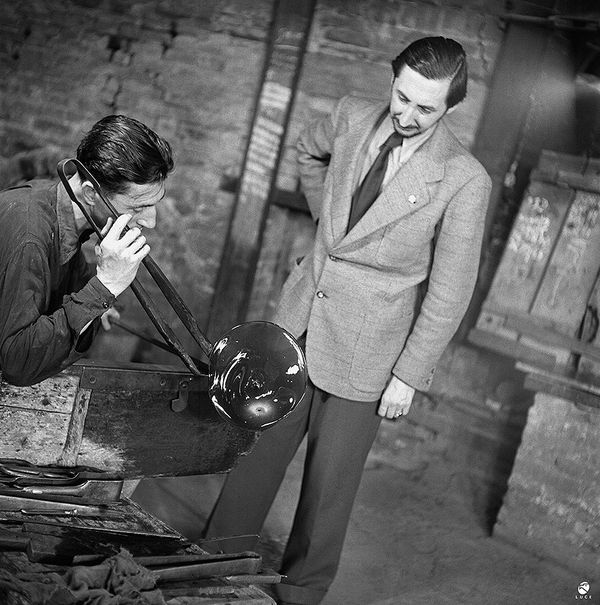
Carlo Scarpa (Right) with glassmaker Arturo Biasutto in the Venini Factory, Murano 1943. Credit: Luce Cinecitta Historical Archive - Foto Attualita
Long before he became internationally renowned for buildings such as the Brion Cemetery or the transformation of the Museo di Castelvecchio, a young Carlo Scarpa was a fixture in the furnaces of Murano, taking a hands-on approach to his collaborations with glassblowers. Between the late 1920s and the early 1940s, he developed a language that fundamentally reshaped modern Venetian glass, working first with M.V.M. Cappellin, and later with Venini, where he became creative director in 1934.
Scarpa’s collaborative sense was rooted in true partnership. Like a great composer working with virtuoso performers, he was eager to learn from the highly trained craftsmen of Venini and M.V.M. Cappellin. He engaged in long conversations with them to understand their techniques and traditions, often staying after closing time to sift through the residues left by the day’s work in search of new approaches to materials.
Scarpa’s work stands out for its ability to transform materials and traditions rich in historical associations, integrating them into the modern world. He approached glass not as a decorative medium but as a material of architecture, a material capable of structure, rhythm, and spatial presence. With Murano’s master glassblowers, he reinterpreted historical techniques such as murrine, lattimo threads, and pasta vitrea through a modernist sensibility that emphasized geometry, surface pattern, and the interplay of light.
The works gathered here illustrate the breadth of Scarpa’s early experimentation, from sculptural objects to architectural lighting and mirrors. Together, they reveal three recurring themes in his glass practice: the translation of traditional techniques into modern abstraction, the transformation of light into structure, and the idea of glass as an architectural surface.
Modernizing Murano: Tradition reimagined at Cappellin

Carlo Scarpa, Ceiling light, 1930. Design London.
Scarpa’s earliest works for M.V.M. Cappellin demonstrate his fascination with historic Venetian glass techniques and his reinterpretation of them through modern form. As he once explained, “A master is he who expresses the new which can be understood by others.”
A ceiling light decorated with murrine, dating to around 1930, shows how Scarpa transformed this ancient mosaic technique into a graphic surface. Rather than using murrine purely as ornament, he arranged them in rhythmic patterns that are even more striking when illuminated.

Carlo Scarpa, Octopus sculpture, model no. 4747, circa 1929. Design London.
Equally emblematic of this early period is the striking Octopus sculpture in red pasta vitrea (model no. 4747, circa 1929). Here, Scarpa explores the sculptural potential of dense colored glass, allowing the creature’s tentacles to emerge as fluid extensions of the material itself. The object embodies the dialogue between craft and experimentation that defined Murano in the interwar years.
These Cappellin works mark a moment when Scarpa was testing the expressive limits of glass, discovering how traditional processes could be adapted to modern aesthetics.
Glass as architecture: Light at Venini

Carlo Scarpa, Pair of rare ceiling lights, circa 1935. Design London.
When Scarpa began collaborating with Venini in the early 1930s, his work shifted increasingly toward the architectural role of glass. Lighting fixtures became laboratories for exploring how transparency, structure, and illumination interact.
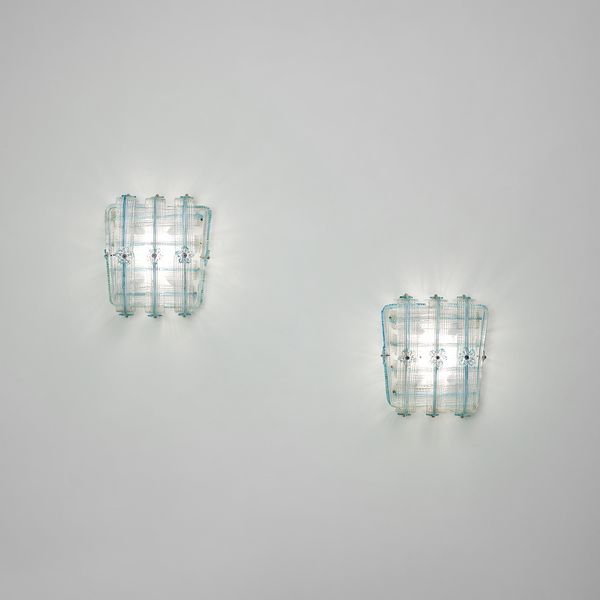
Carlo Scarpa, Pair of wall lights, from the 'Blown Ribbon' series, circa 1940. Design London.
A pair of ceiling lights from around 1935 and a later pair of wall lights from circa 1940 reveal Scarpa’s ability to transform functional lighting into carefully composed volumes. Their geometric clarity reflects the designer’s growing architectural sensibility: glass becomes both diffuser and structural element, organizing light within the surrounding space.
The rare ceiling light model no. 5300 exemplifies this approach. Its composition balances decorative detail with an underlying structural logic, reflecting Scarpa’s belief that even ornamental glass should possess an architectural coherence.

Carlo Scarpa, Ceiling light, model no. 5300, circa 1939. Design London.
Mirrors: Reflection and surface
Scarpa’s mirrors represent another dimension of his glass experimentation. Rather than simple reflective objects, they serve as framed architectural surfaces that shape our perception of space.

Carlo Scarpa, Rare illuminated mirror, circa 1940. Design London.
The rare pink illuminated mirror from around 1940 demonstrates Scarpa’s sensitivity to color and atmosphere. A softly tinted and ribbed glass frame complements the work’s reflective surface, creating a luminous field and subtly altering the surrounding atmospheric light.
Similarly, the mirror model no. 30 (circa 1937) reflects Scarpa’s fascination with framing and layered surfaces, an interest that would later appear in his architectural detailing. The mirror becomes a composition of glass planes and edges, where reflection and structure are carefully balanced.
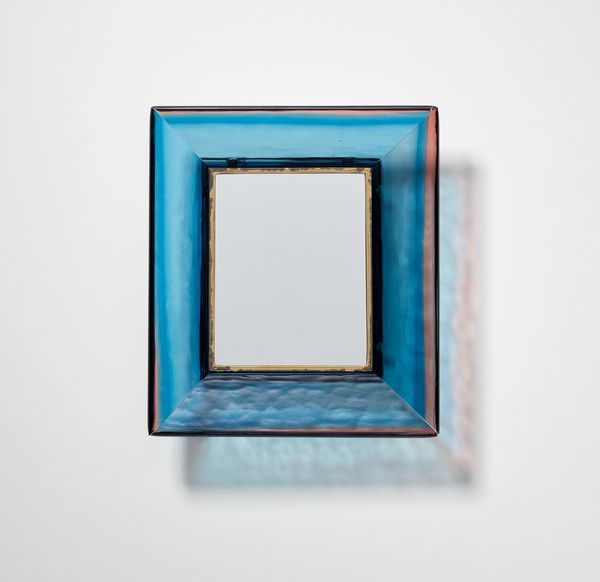
Carlo Scarpa, Mirror, model no. 30, circa 1937. Design London.
Where craft meets Modernism

Glassware designed by Carlo Scarpa and exhibited at the Venini exhibition within the 21st Venice Biennale (1938), period photograph.
Across these works, from Cappellin’s sculptural experiments to Venini’s architectural lighting, Scarpa’s approach remains remarkably consistent. Each piece reveals his conviction that modern design could emerge from the deep knowledge of traditional craft.
By working directly with Murano’s artisans, Scarpa developed a vocabulary in which the historical techniques seen in these works became vehicles for modern abstraction. Light, colour, and surface were treated not as decoration but as structural elements within the design.
Seen together, these objects illustrate the extraordinary range of Scarpa’s early glass production and the formative role it played in shaping one of the most distinctive design languages of the twentieth century.