Article | Fountains Of Inspiration
Fountains of Inspiration
Phillips Editions invites you to explore the world of one of the most pivotal artists of the 20th century in DUCHAMP & COMPANY, Curated by Francis M. Naumann.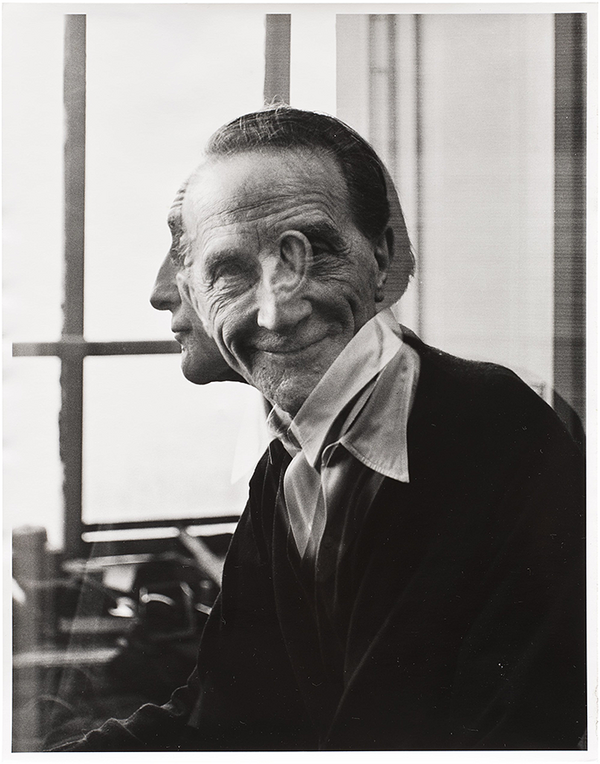
Victor Obsatz, Portrait No. 29 (Double Exposure: Full Face and Profile) Portrait of Marcel Duchamp, 1953. DUCHAMP & COMPANY, Curated by Francis M. Naumann, New York.
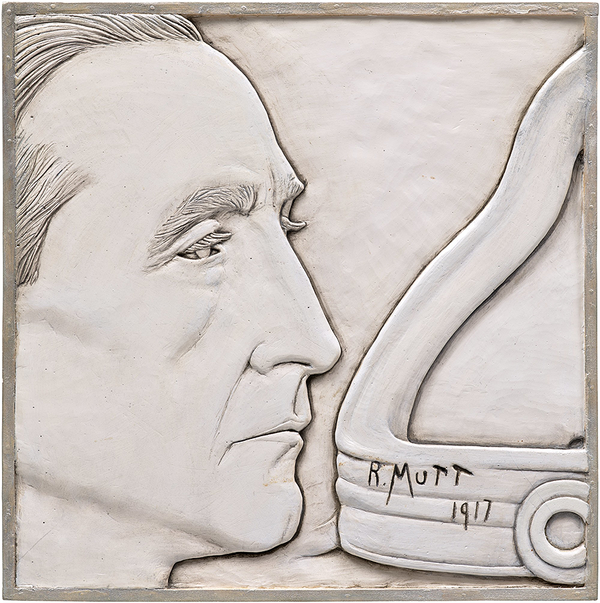
Jonathan Santlofer, Portrait of Richard Mutt, 1996. DUCHAMP & COMPANY, Curated by Francis M. Naumann, New York.
The title selected for this sale — "Duchamp & Company" — was coined by Alfred Stieglitz in a letter to Georgia O’Keeffe in describing the people who brought the original 1917 Fountain to Duchamp’s gallery to be photographed. Over a century later, Duchamp's interventions continue to engage artists and audiences alike; the artist is currently the focus of an exhibition at the Museum of Modern Art, New York, through August. Duchamp & Company is here used to refer to a host of mainly contemporary artists who are consciously influenced by him and feature in this auction, including Man Ray, Robert Rauschenberg, Richard Pettibone, Mike Bidlo, Sherrie Levine, John Baldessari, and Joseph Kosuth. With 48 lots by Duchamp and 62 examples by his contemporaries and those inspired by his oeuvre, the sale offers a glimpse into the profound impact Duchamp’s legacy has had on modern and contemporary art.

L-R: Pamela Joseph, Censored Small Fountain, 2014. Pablo Echaurren, U/siamo tutti Duchamp (We all are/use Duchamp), 2015. Mike Bidlo, Fractured Fountain (Not Duchamp Fountain 1917), 2015. John Baldessari, Repository (Green/Red), 2002. Rachel Lachowicz, Untitled (Lipstick Urinals), 1992. DUCHAMP & COMPANY, Curated by Francis M. Naumann, New York.
In 2004, a group of English art professionals determined that Marcel Duchamp’s Fountain — the urinal that he submitted to the First Exhibition of the Society of Independent Artists in New York in 1917 under the pseudonym of R. Mutt — was the single most influential artwork produced in the modern era. This object was called by Duchamp a readymade, a commonplace manufactured object that he designated a work of art. Indeed, in having introduced the concept of the readymade — where ordinary and commonplace objects could be transformed into works of art by the mere act of selecting and declaring them as such — he had already done more to elevate the intellectual status of an artist than anyone before him. No single work of art before the readymade more emphatically forced viewers to confront the definition of art, that is, to ask themselves exactly what it was about a given object or its display that allowed for this classification.
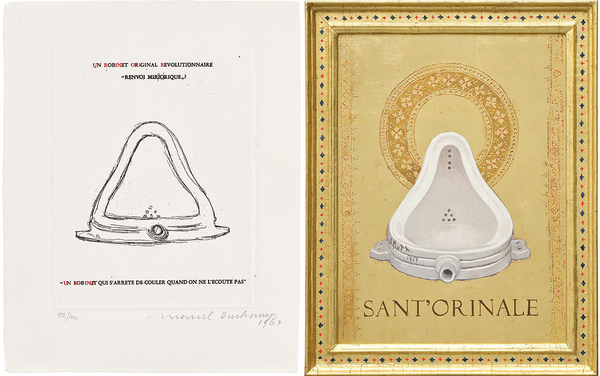
Left: Marcel Duchamp, An Original Revolutionary Faucet: Mirrorical Return, 1964. Right: Kathleen Gilje, Sant' Orinale (Saint Urinal), 2017. DUCHAMP & COMPANY, Curated by Francis M. Naumann, New York.
DUCHAMP & COMPANY features eight contemporary references to Duchamp’s infamous urinal, including one of Mike Bidlo’s repeated variations (this example is in bronze), John Baldessari’s green ceramic bedpan multiple bearing the phrase "THE ARTIST IS A FOUNTAIN," and Kathleen Gilje’s golden icon deifying Duchamp’s Fountain. Rachel Lachowicz’s set of three urinals comprised of lipstick, wax, and Hydrocal seems to even directly draw on Duchamp’s assertion of the importance of the number three: "One is unity," he explained, "two is double, duality, and three is the rest."
The readymade allowed for artists to think that anything could be legitimately considered a work of art, and that is exactly what happened, especially in the 1950s and 1960s, when artists like Robert Rauschenberg (lot 437) and Jasper Johns began to pay attention to Duchamp’s innovations. This occurred in the era of Pop Art, where artists seized upon imagery drawn from popular culture, and then shortly thereafter by conceptual artists who sought the primacy of an idea over whatever form it took. This tendency reached its pinnacle in the 1980s, when appropriation artists like Elaine Sturtevant (lot 485), Richard Pettibone (lots 463, 464, and 494), Sherrie Levine (lots 404, 491, and 495) and Mike Bidlo (lots 431 and 477), consciously sought to replicate the example of his work, some literally (as in recreating works he had made) to others who introduced significant variations, all acknowledging the precedence of Duchamp and the importance of ideas his work introduced.
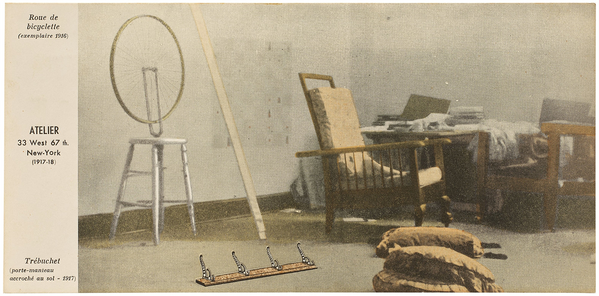
Marcel Duchamp, Marcel Duchamp's studio at 33 W. 67th Street, New York (1917-18), 1940. DUCHAMP & COMPANY, Curated by Francis M. Naumann, New York.
In addition to the Fountain, DUCHAMP & COMPANY includes plentiful references to Duchamp’s most iconic imagery by a range of contemporary artists. Perhaps most immediately recognizable are the works inspired by Duchamp’s first readymade, the Bicycle Wheel. If you look closely, you might catch a reconstruction of the original work in Marcel Duchamp's studio at 33 W. 67th Street, New York (1917-18). Damian Elwes, known for his practice of depicting artists’ studios, features the Bicycle Wheel in Duchamp's Studio 2 in a similar setup to Duchamp's photograph. The harlequin pattern is reminiscent of the diamond color samples painted on Duchamp’s final painting on canvas Tu m’, and perhaps of a distorted chessboard. Richard Hamilton’s photograph of Readymade Shadows, Richard Pettibone’s replica Bicycle Wheel 1913, and André Raffray’s pencil drawing Shadow of the Bicycle Wheel all emphasize the continuous impact of Duchamp’s ideas and practice.
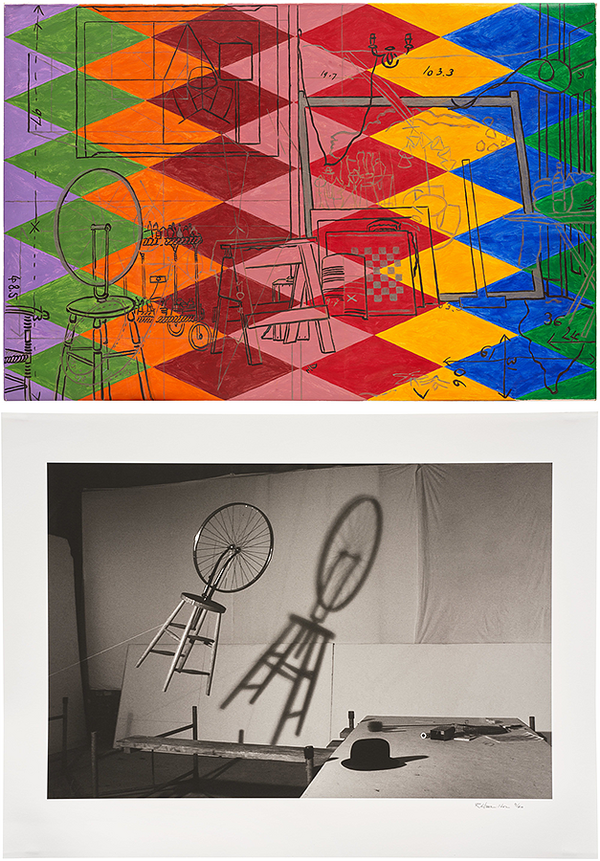
Top: Damian Elwes, Duchamp's Studio 2, 2003. Bottom: Richard Hamilton, Readymade Shadows, 2005-6. DUCHAMP & COMPANY, Curated by Francis M. Naumann, New York.
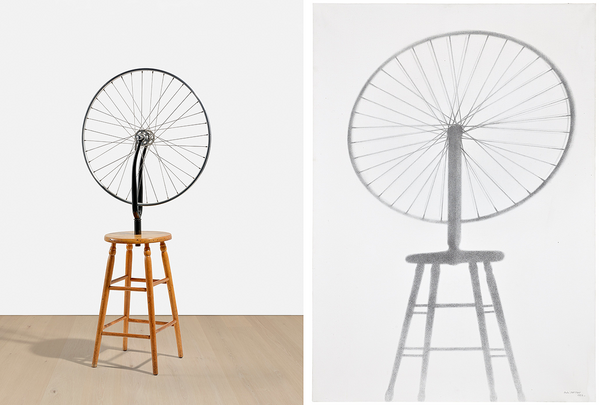
Left: Richard Pettibone, Bicycle Wheel 1913, 1998. Right: André Raffray, Shadow of the Bicycle Wheel, 1993. DUCHAMP & COMPANY, Curated by Francis M. Naumann, New York.
One might also spot numerous references to Duchamp’s 1919 tongue-in-cheek work L.H.O.O.Q., in which he originally drew a beard and mustache atop a postcard of Leonardo da Vinci’s Mona Lisa. With his 1965 return to the imagery, Duchamp mounted playing cards featuring da Vinci's famous subject on a dinner invitation card, adding the inscription "rasée" or "shaved," as she was missing Duchamp’s added mustache and goatee. When spoken phonetically in French, "L.H.O.O.Q." sounds like "elle a chaud au cul," which translates to "she has a hot ass" — Rob Wynne’s 1997 adaptation She Has a Hot Ass features Mona Lisa with a store-bought costume mustache and beard and the English translation stitched around the frame, a cheeky nod to Duchamp’s original.
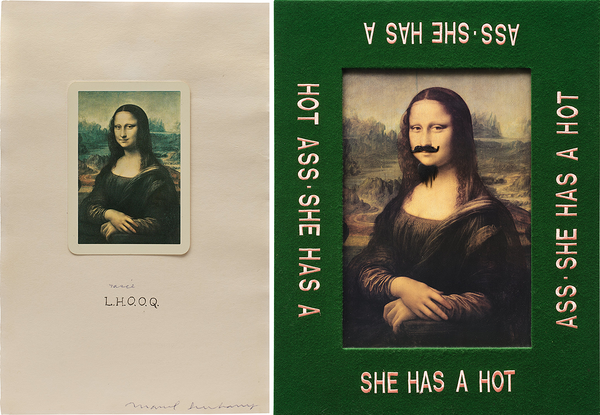
Left: Marcel Duchamp, L.H.O.O.Q. rasée (shaved), 1965. Right: Rob Wynne, She Has a Hot Ass, 1997. DUCHAMP & COMPANY, Curated by Francis M. Naumann, New York.
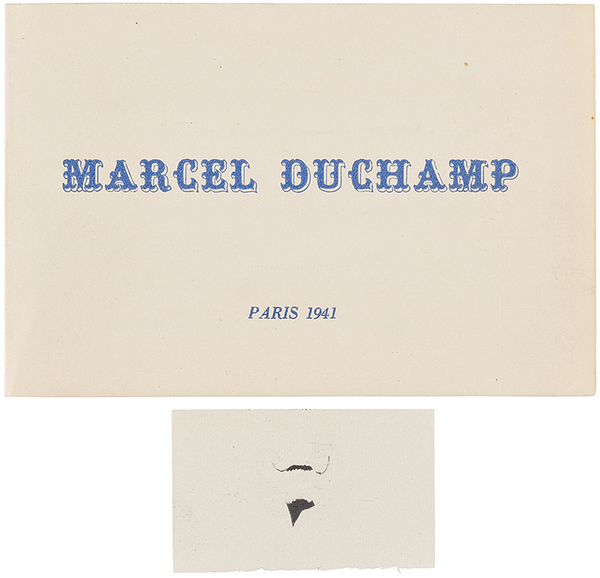
Marcel Duchamp, Mustache and Beard of L.H.O.O.Q., 1941. DUCHAMP & COMPANY, Curated by Francis M. Naumann, New York.
A particularly special highlight of the sale is De ou par Marcel Duchamp ou Rrose Sélavy (La Boîte-en-valise), série F (From or by Marcel Duchamp or Rrose Sélavy (The Box in a Valise) series F), in which Duchamp created miniature reproductions of eighty of his most significant works, to be stored and displayed within a red, fabric-covered box within a red leather suitcase. Considered a "portable museum," his self-referential masterpiece is the ultimate Duchamp multiple and a perfect encapsulation of Duchampian iconography.
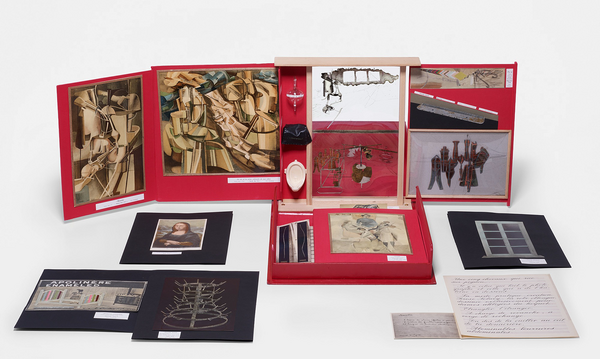
Marcel Duchamp, De ou par Marcel Duchamp ou Rrose Sélavy (La Boîte-en-valise), série F (From or by Marcel Duchamp or Rrose Sélavy (The Box in a Valise) series F), 1935-40/1966. DUCHAMP & COMPANY, Curated by Francis M. Naumann, New York.
After 1923, Marcel Duchamp was largely considered an artist who had stopped making art to devote his life to playing chess, but as is now known, he never fully abandoned the idea of producing art. His artistic output may very well have been curtailed by his activities as a chess player, but it had clearly not ceased. The degree to which Duchamp perpetuated the rumor of his inactivity as an artist is difficult to say. At the time, we know that he did nothing to contest it, although years later, he would disavow ever having made such a claim. Among the alternatives he explored was to replicate earlier examples of his own work, reproducing it in sufficient numbers to make it more accessible to a larger audience. He produced prints, designed book covers and posters, and created a suitcase containing small-scale replicas of his work, all of which are featured in this sale.
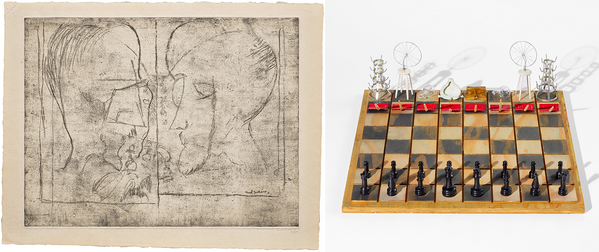
Left: Marcel Duchamp, The Chess Players, 1965. Right. Charles Juhàsz-Alvardo, Duchamp in Check (Readymade Chess), 1995. DUCHAMP & COMPANY, Curated by Francis M. Naumann, New York.
Duchamp’s influence on contemporary art cannot be overstated, though it has often been misguided and vastly exaggerated. Whenever anyone sees in a work of art an object they recognize from their everyday lives, the specter of Duchamp is invoked. As a result, he is blamed for much of the bad art produced over time, but he is also rarely credited for what is considered good, except by artists, many of whom consciously seek to have their work associated with his. "All art (after Duchamp) is conceptual (in nature)," wrote Joseph Kosuth (lots 416 and 492) in 1969, "because art only exists conceptually."
Discover more from DUCHAMP & COMPANY, Curated by Francis M. Naumann >