Article | The New World Remade
The New World Remade
American Modernism and the frenetic movement of the 20th century.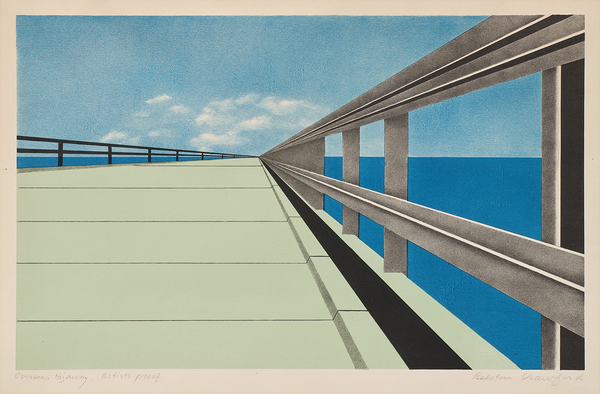
Ralston Crawford, Overseas Highway, 1940. MODERNISM: Editions & Works on Paper New York.
Ask for a definition of Modernism and expect to get more questions than answers; build a fence around it, and something will always slide through the pickets. It is in this shifting landscape that many American artists found themselves embracing the movement as a continuous interchange between images and modes, of a rapidly developing society, and the prospect that an expansive, globally-connected country was opening new creative avenues for art. They found it in the high and low urban landscapes and the newly connected countryside, in their trips to European salons and soldiers’ returns stateside, in the quietude of personal psychology, and in the spectacle of crowds. With such scope to bear, it can be daunting to tackle its immensity, but thankfully, there’s a verse for every vessel.
Join us as we explore a range of works from our upcoming MODERNISM: Editions & Works on Paper sale in New York, featuring 40 works of American Modernism from the Tanenbaum Family Collection. Over their lifetime, they collected works by key artists of the movement from iconic American Art galleries, including Hirschl & Adler, Inc., Kraushaar Galleries, Richard York Gallery, Kennedy Galleries, Inc., and Silvan Cole Gallery.
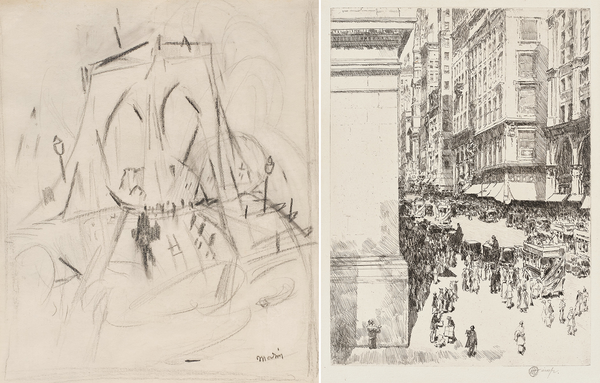
Left: John Marin, Brooklyn Bridge, circa 1912. Right: Childe Hassam, Fifth Avenue, Noon, 1916. MODERNISM: Editions & Works on Paper New York.
John Marin rips apart the Brooklyn Bridge
Into bits and shares, graphite lays
the cables of a nervous system.
A restless age awaits, so they say in Vienna,
and the search for lost time has already begun.
But across town, noon up Fifth
we are drowned in Childe Hassam’s flag-light
for a crowd etched,
dissolved to almost-nothing
while vertical services resume overhead.
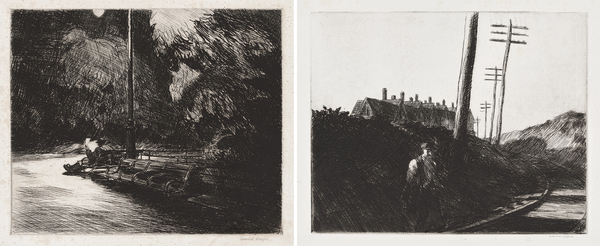
Left: Edward Hopper, Night in the Park, 1921. Right: Edward Hopper, The Railroad, 1922. MODERNISM: Editions & Works on Paper New York.
Edward Hopper’s park: one lamp,
one man, a dark arranged by absence.
The railroad cuts the frame, berm or embankment
to take us anywhere; there’s a country out there,
somewhere, and a new American loneliness yet to be named.
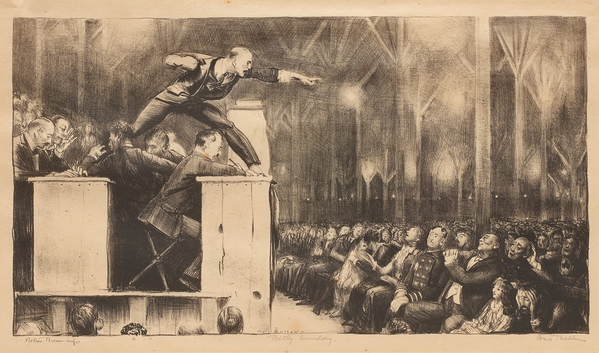
George Bellows, Billy Sunday, 1923. MODERNISM: Editions & Works on Paper New York.
Bellows fills the hall to bursting — a great pulpit bawl
from a ballplayer-pastor
the audience a single, heaving animal
fed by spectacle, a convert for any dogma,
oh does Billy love a Sunday.
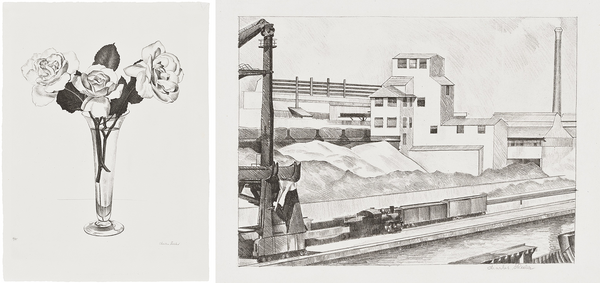
Left: Charles Sheeler, Roses, 1924. Right: Charles Sheeler, Industrial Series #1, 1928. MODERNISM: Editions & Works on Paper New York.
Sheeler renders the rose as though set and stamped
by our factory lines: each petal precise, negotiating with light.
Then the factory as if it were a rose: clean and unashamed, all the better for it.
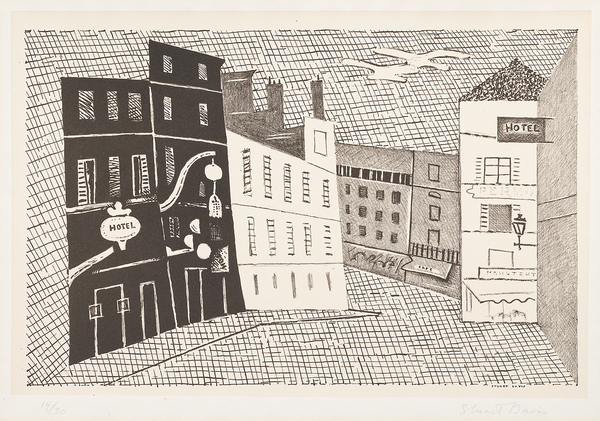
Stuart Davis, Rue de l'Echaudé (Echaudé Street), 1929. MODERNISM: Editions & Works on Paper New York.
A Paris alley flattens to jazz for Stuart Davis, all things equal between cobblestone and signage,
all too loud, all too familiar, of course.
You can take the artist out of New York...
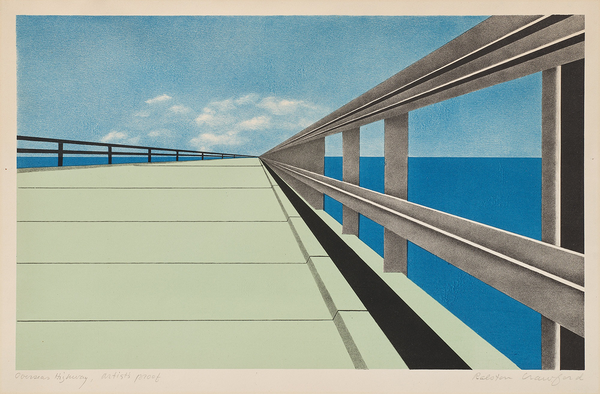
Ralston Crawford, Overseas Highway, 1940. MODERNISM: Editions & Works on Paper New York.
Now there is a war on
so Ralston Crawford gets to work on his highway. With him are
one band of concrete,
one stretch of sky,
and a hard seam horizon — that somewhere, eventually, will too be paved.
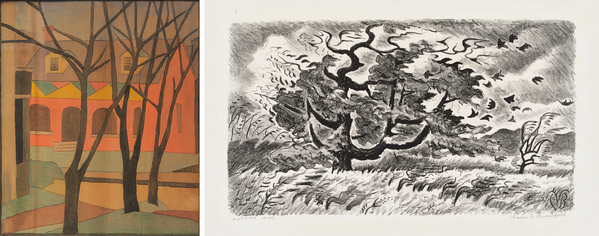
Left: Blanche Lizzell, Three Trees, 1950. Right: Charles Burchfield, Autumn Wind, 1952. MODERNISM: Editions & Works on Paper New York.
Three trees cut from silence
with a block Blanche Lazzell creates a world by removal
what stays is the shape of what is taken
bending toward sunlight without leaves to carry
or obstruct our view of life through dormers.
Burchfield catches up and hears the wind
the trees knowing what comes next,
a murmuration of birds, a midair ballet
in an autumn air so thin and light.
And this century learned to see that
the new world was no place, no land. It was
a method, a way of standing in front of this giant thing and not flinching.
the machine
the flower
all modern
all ours.