Article | Nothing Standard Here Ed Ruscha Auction New York April 2026
Nothing Standard Here
Ed Ruscha’s remarkable vision of American culture, as seen through four incredible works in our New York Editions & Works on Paper auction.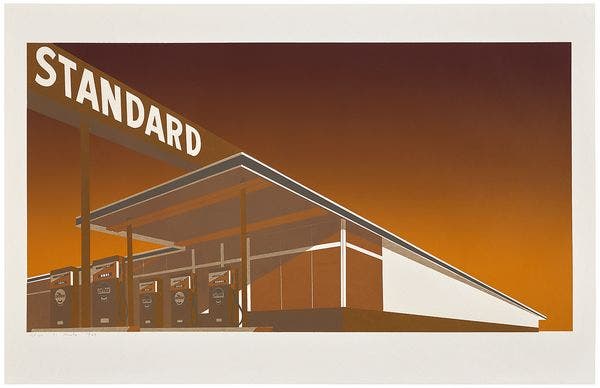
Ed Ruscha, Mocha Standard, 1969. Editions & Works on Paper New York.
Picture this. It’s sometime in the middle of the last century, and you’re in a 1950 Ford sedan cruising the expansive stretch of Route 66 between Los Angeles and Oklahoma City. Your view along the way encompasses a myriad of topographies. You emerge from Southern California’s coast into the desert, scale some mountains, reaching the blistering reddish-orange high-altitude deserts of Arizona and New Mexico. Then you ebb and flow with the Rockies before falling grille-first into the Great Plains. Along the way, the repetitive presence of Standard Oil Stations would be more constant than a single type of tree or air, nearly as pervasive as speed limit signs. Their presence in this way suggests the rhythm of mid-century American life, of the freedom afforded by automobiles, of highway shops, motels, and neon lights between vast stretches of spacious nothingness that give you so much room to daydream.
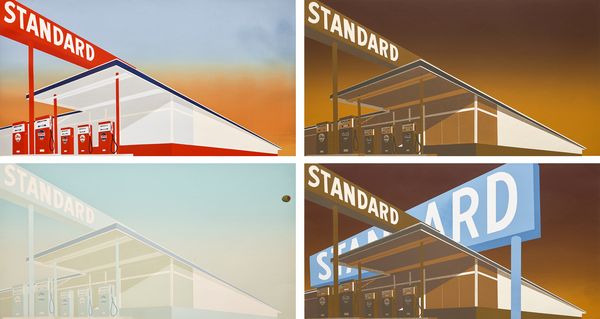
Ed Ruscha, Standard Station; Mocha Standard; Cheese Mold Standard with Olive; and Double Standard, 1966 & 1969. Editions & Works on Paper New York.
This is Ed Ruscha’s America. And though we can imagine thousands of people must have noticed this aspect of Standard Stations before the advent of accessible air travel, only Ruscha’s eye grasped these stations as such a deeply resonant symbol of American culture that he found an iconography he could explore fruitfully for decades, just as naturally as he might intone — deadpan — something like, “I don’t hardly disbelieve it.”
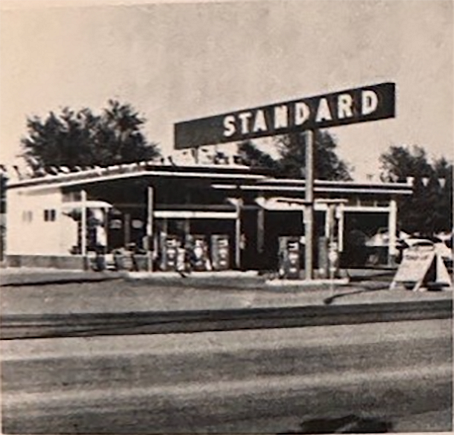
Standard Station, Amarillo, Texas, 1967.
And that’s what we love most about Ruscha’s works — that his eyes and ears are open to noticing things we feel, but that our awareness might miss. His sensibilities capture an expansive sense of space and time, a moment in our history we now long for — one where artists had more time and space to look for the unexpected in the familiar.
Ed Ruscha, Standard Station; Mocha Standard; Cheese Mold Standard with Olive; and Double Standard, 1966 & 1969. Editions & Works on Paper New York.
Looking across the six Standard Station prints in the upcoming sale, we find Ruscha’s varied approach captivating, at times insightfully humorous, and somewhat cinematic. His imagery plays with themes of American life, art, and consumption in various ways. There’s the “Mocha” and brownish-orange tints that call to mind the glow of the southwest and associations with coffee and chocolate, the wordplay of the “double standard” and the image’s almost Hitchcockian use of contrasting perspectival diagonals, or the faded moldy gradient tones shining as bright as a Rocky Mountain summer’s day in Cheese Mold Standard with Olive, with its rogue, floating olive that places the idea of a quick lunch right in the middle of nowhere. And on the spiritual tactility of Ghost Station, we might imagine David Lynch out front these days, on a smoke break from wherever his spirit is along the lost highway.
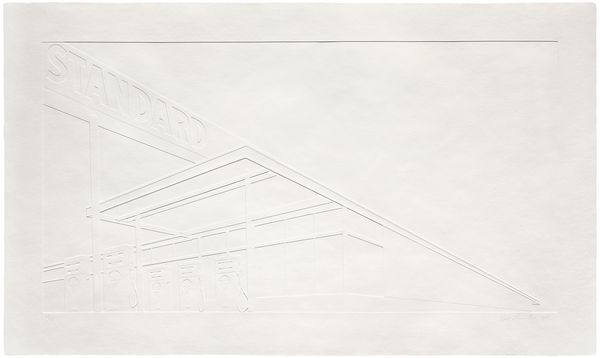
Ed Ruscha, Ghost Station, 2011. Editions & Works on Paper New York.
But across these works, there is also undeniable invention in printmaking, as to be expected from an artist well-known for experimental prints that use unconventional inks, from cherry pie filling to raw egg, axle grease, or Pepto Bismol. But there’s more to his experimental nature as a printmaker than the materials alone — Ruscha often collaborates with printers to explore the medium at its core. In the works offered in this sale, we see everything from the “split foundation” screenprinting technique in Cheese Mold Standard with Olive, to the Mixografia® process in Ghost Station print, which removes ink entirely, executing a three-dimensional print by means of wet cotton pulp, a brass plate, and a high-pressure press. What’s more, after decades of collaboration with Tamarind master printer Ed Hamilton, the pair established Hamilton Press in 1990, focusing on traditional lithography, and we see the fruits of their efforts in Wall Rocket while also uncovering another bit of iconic Ruscha imagery to consider — mountains with text.
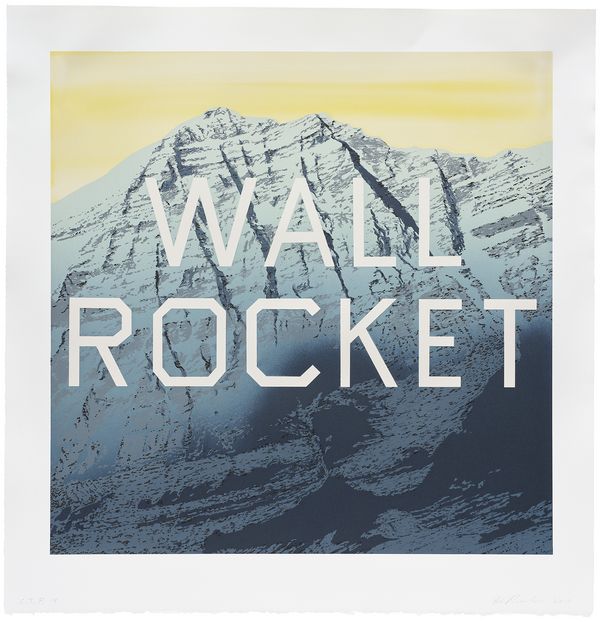
Ed Ruscha, Wall Rocket, 2013. Editions & Works on Paper New York.
Here, Ruscha perhaps takes a cue from the scenery he would have regularly driven through, but paints these images based on photographs before making prints. By juxtaposing almost cliché nature images with the characteristic vernacular phrases he calls “hot words,” Ruscha plays on American visual culture, ranging from advertising imagery to kitschy home décor, the Romantic canvases of the Hudson River School, the photographs of Ansel Adams, and beyond.
“Words have temperatures to me. When they reach a certain point and become hot words, then they appeal to me. Sometimes I have a dream that if a word gets too hot and too appealing, it will boil apart, and I won’t be able to read or think of it.” —Ed Ruscha
Above all, these works not only spark an instant sense of visual pleasure but also unveil layers of meaning that help us make sense of our culture. To that end, sometimes standing before a work by Ed Ruscha feels like looking in an unfamiliar mirror in an unfamiliar light and catching glimpses of ourselves we hadn’t realized were there all along. But the positivity we sense in his works ultimately stems from Ruscha’s unique ability to capture a distinct sense of American idealism, and perhaps to remind us that we haven’t lost it yet.