Article | The More You Know Modern And Contemporary Art Auction Highlights London April 2026
The More You Know
Hunting for art world Easter eggs in our April Modern & Contemporary Art auction in London.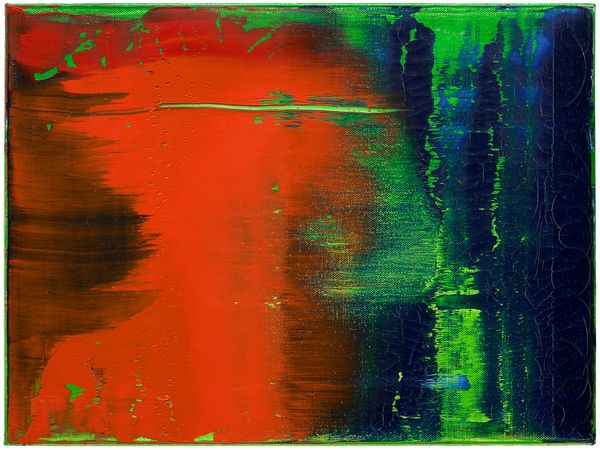
Gerhard Richter, Green-Blue-Red, 1993. Modern & Contemporary Art London.
Spring is in the air, and as we prepare for our April Modern & Contemporary Art auction in London, we’re reminded that we must get through an English Easter season first. But given the recent news cycle about our dearest Banksy, we find that lore is in the air too. This has us primed to hunt down all the fandom-style Easter eggs we could find in the sale, facts so obsessive the robots might not even know them yet.
So, grab your basket, open your eyes, and join us as we go loremaxxing through the gallery at 30 Berkeley Square.
Andrew Cranston once put a painting in a washing machine
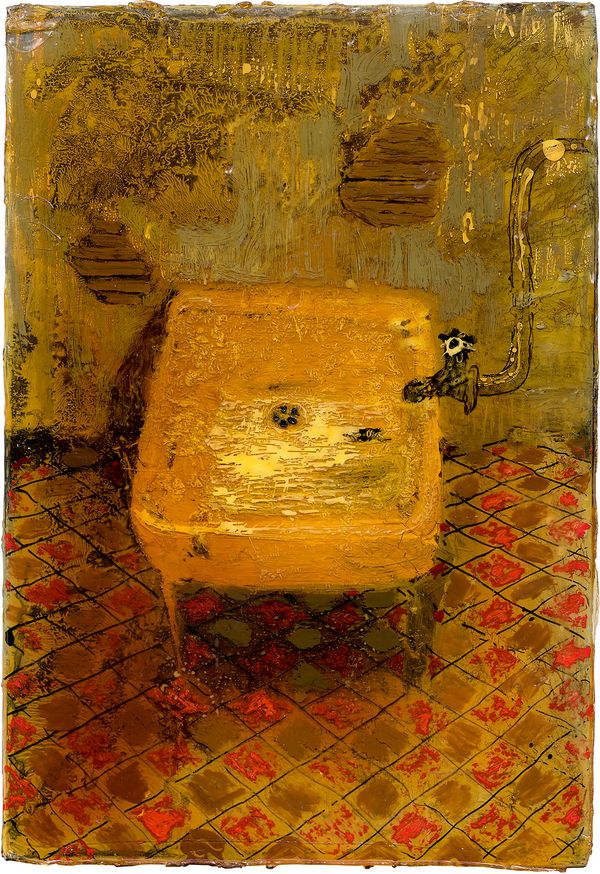
Andrew Cranston, Sink - Osborne Street, 2005. Modern & Contemporary Art London.
The deep cut:
The Scottish artist Andrew Cranston’s works often possess a haunting, faded quality, but for his 2021 work Echoes, he took this to the extreme by running a completed canvas through a household washing machine.
But there are secrets to the present work as well. What appears at first to be a straightforward study of a domestic scene is set at a location on Glasgow’s Osborne Street. This street was the site of one of the original Miss Cranston’s Tea Rooms, and though the artist is not related to the famous temperance movement pioneer Catherine Cranston, he has been fascinated by the coincidence of their shared name. Here, by presenting us with a utilitarian sink located on this opulent street, he’s making a self-deprecating reference to the type of “Cranston” he is.
The basics:
Currently represented by Karma, Modern Art, and Ingleby Gallery, Cranston’s work has been on the rise as of late. Karma presented his first U.S. West Coast solo exhibition in 2024, and his work has been acquired by the Tate and the ICA Miami.
2005 was one of the “strangest” years Tracey Emin ever had
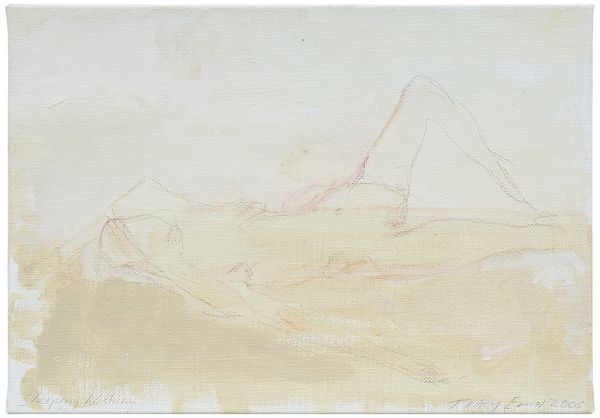
Tracey Emin, Sleeping Wishing, 2005. Modern & Contemporary Art London.
The deep cut:
“Farewell to 2005, one of the strangest years I've ever had — difficult beyond belief,” wrote Tracey Emin in her column for The Independent on the eve of 2006. ”But I've learnt so much. Full of highs and lows, at times crashing dangerously out of control. An intense year, from extreme bouts of loneliness to the unbreakable desire to just want to be alone.” The atmosphere the artist describes helps contextualize our experience of Sleeping Wishing, executed in the same year.
The basics:
Currently the subject of a landmark exhibition at Tate Modern, Tracey Emin is widely regarded as one of the most significant and influential contemporary artists of her generation. Represented by White Cube, Xavier Hufkens and Galleria Lorcan O’Neill, Tracey Emin is a trustee of the British Museum, and in 2024, was honored with a Damehood for her services to art. Emin has also established the TKE Studios and Residency in Margate to provide teaching and studio spaces for the next generation of artists.
Jemima Murphy looks to her own mistakes for new ideas
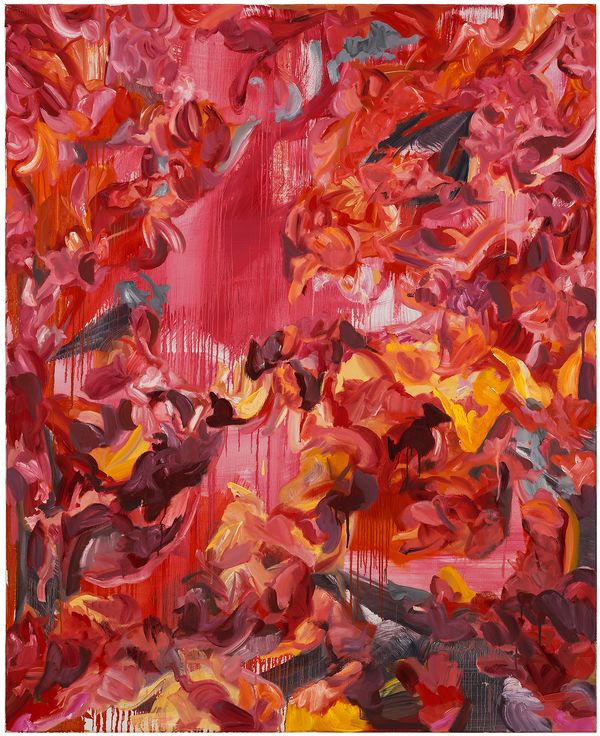
Jemima Murphy, Invincible Blooms, 2023. Modern & Contemporary Art London.
The deep cut:
Intuitive, quick, and erratic, Jemima Murphy often jumps from one canvas to another while working, returning to a canvas to find unintentional drips and splashes that become the impetus for the painting’s direction. As the artist explains, “A lot of my work comes out of material mistakes… part of the process is about speed. It can stay in a certain phase for a while, and I don’t know what’s wrong until I come back to fix and finish it.”
The basics:
Born in 1992, London-based painter Jemima Murphy is hot on the rise. Drawing on her background in theatre performance, she creates large-scale abstract works she calls “reimagined landscapes.” Her current momentum is highlighted by her first New York solo exhibition, Wild Reveries, at Anat Ebgi’s Tribeca space, which ran from January through February of this year. Her work has recently entered prestigious collections, including the UBS Art Collection.
Emily Kam Kngwarray’s dots are age-coded
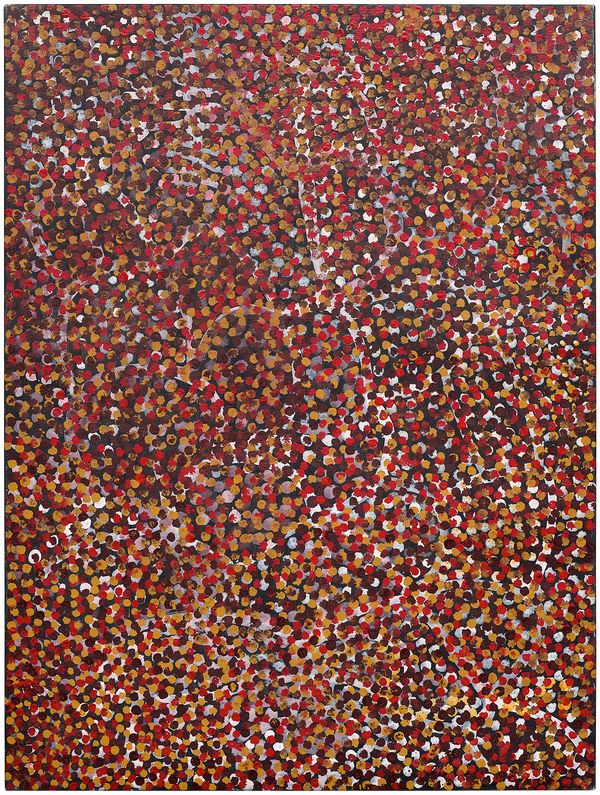
Emily Kam Kngwarray, Wandering Emu, 1991. Modern & Contemporary Art London.
The deep cut:
One of Australia’s most influential Indigenous artists, Emily Kam Kngwarray’s abstract language maps the ancestral identity of her people’s Land. In a sense, her work was a lifelong search for the Altyerr (the creation force), but it was rooted in the pencil yam. The shifting colors of her dots, moving from white to yellow to reddish-brown, trace the lifecycle of the yam’s seedpods, known as kam, from which the artist’s name is derived. Each painting is both a record of the Land’s rhythms and an assertion of her identity within them.
The basics:
Having risen to the heights of the art market in recent years, Kngwarray is the first Indigenous Australian artist whose works have crossed the million-dollar threshold — a high mark for an artist who didn’t begin painting until her 70s. Among the three Aboriginal women selected to represent Australia at the 1997 Venice Biennale, Kngwarrey’s exhibition at the Tate Modern that closed in January 2026 marked the artist’s first major solo presentation in Europe.
Lygia Pape was allergic to oil paint
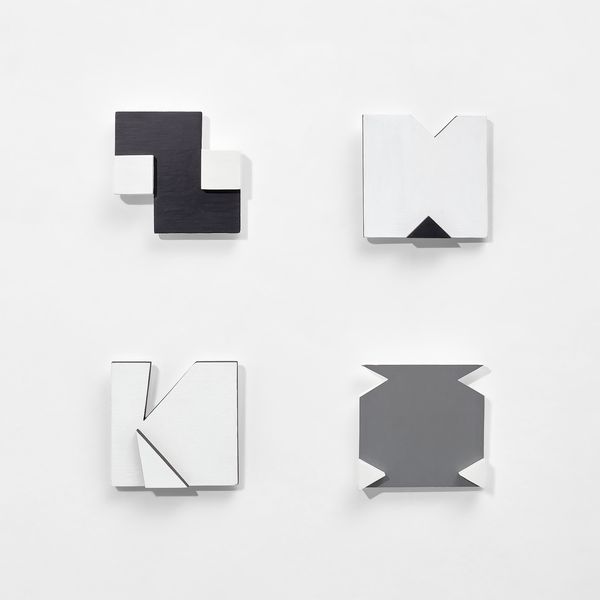
Lygia Pape, Book of Night and Day I, 1963–1976. Modern & Contemporary Art London.
The deep cut:
Early in her career, Lygia Pape discovered she suffered from an allergy to oil and automotive paint. The physical irritation she experienced early on led her to turn her artistic practice towards a broader range of media, including woodcuts, performance, and, as seen here, tempera and acrylic. Created between 1963 and 1976, Book of Night and Day also fuses mural painting, relief, and bookmaking.
The basics:
This work is best understood in the context of Pape's role in founding the Neoconcrete movement, established in 1959 in Rio de Janeiro alongside artists such as Hélio Oiticica and Lygia Clark. Rejecting the rigid formalism of Concrete art, the Neoconcretists sought a more open and expressive engagement with geometric abstraction, expanding the notion of the artwork by dissolving boundaries between object and space, and foregrounding the role of the viewer. Pape's contribution to this movement was instrumental in shaping the emergence of contemporary art in Brazil from the mid-twentieth century onward. Phillips holds the two most recent auction records for Lygia Pape, both achieved by works from this series.
Cildo Meireles’ work is dissent hiding in plain sight
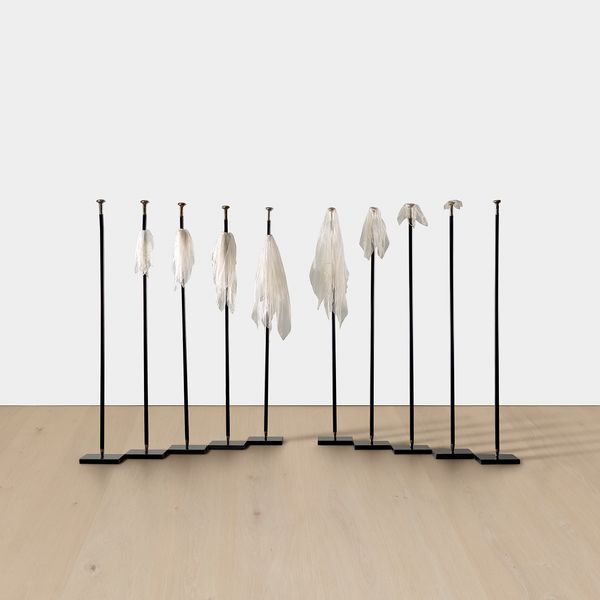
Cildo Meireles, Desaparecimentos (Disappearances), 1982. Modern & Contemporary Art London.
The deep cut:
Living through the Brazilian military dictatorship, Cildo Meireles created subversive works that were subtle enough to evade censorship. This striking work, coming from the late stages of the dictatorship, explores the disappearance of people with a visual reference to magic tricks. As the government sought to suppress dissident voices through strict censorship, Meireles used his art to undermine their grip on information distribution. For his Insertion into Ideological Circuits series in the 1970s, Meireles stamped banknotes and emblazoned Coca-Cola bottles with covert messages that challenged draconian policy. In Desaparecimentos (Disappearances), Meireles would again surreptitiously conceal his critique of injustice.
The basics:
Born in 1948, Meireles is a leading figure of Brazilian Conceptualism, lauded for his politically charged, multisensory works now in the collections of prominent institutions, including the Tate Modern, MoMA, and the Centre Pompidou. This work was included in the traveling group show This Will Have Been: Art, Love & Politics in the 1980s held at the Walker Art Center, Museum of Contemporary Art Chicago and the Institute of Contemporary Art, Boston (2012–2013), Desaparecimentos (Disappearances) was also exhibited in Meireles’ landmark solo presentation Entrevendo at the SESC Pompéia in São Paulo (2019–2020).
Richard Long’s marble is god-tier
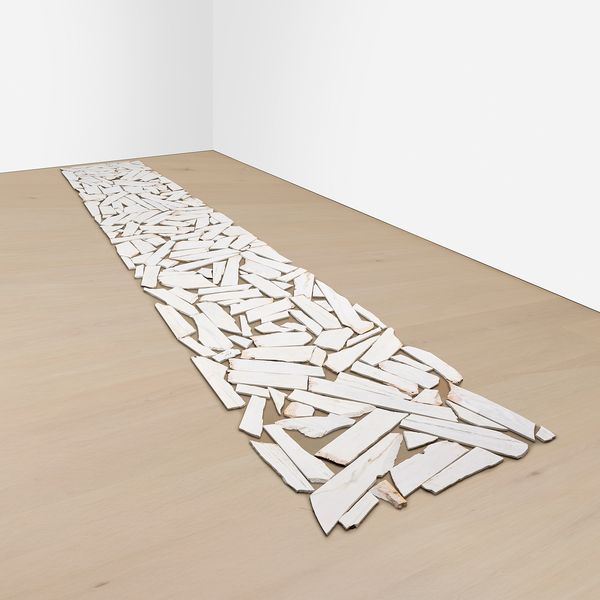
Richard Long, Pendeli Marble Line, 1992. Modern & Contemporary Art London.
The deep cut:
Richard Long uses marble that’s as close to the material of the Parthenon as you can get — sourced from Mount Pentelicus (pendeli), the very same quarry that was used to construct the iconic building. What’s more, he uses the highest quality grade of stone that was traditionally reserved for the Gods. Utilizing this material in a simple line, he not only grounds a sacred material but also poses questions about democracy, myth, and the trajectory of cultural influence.
The basics:
English sculptor Richard Long is a pioneer of Land Art, whose experiential works transcend easy categorization. His work is held in the collections of the Tate Modern, MoMA, and Guggenheim, among others. In 2025, he was commissioned by London’s National Gallery to create the permanent installation Mud Sun, marking the institution’s bicentennial.
Gerhard Richter’s underpainting is almost like a green screen
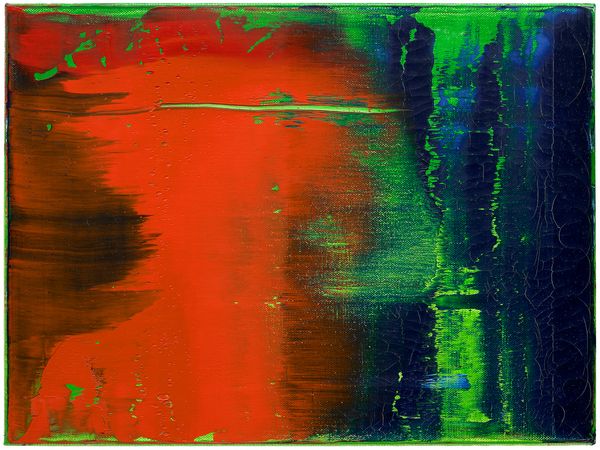
Gerhard Richter, Green-Blue-Red, 1993. Modern & Contemporary Art London.
The deep cut:
Beginning with a layer glowing of acid green — reminiscent of a radar bitmap or green screen — Richter explores the confluence colors that define digital image representation. The squeegeed layers of red and blue reveal the green hue beneath the surface, which mimics the green of digital chroma keying. But while the digital RGB method uses these colors to construct an image, Richter uses them to deconstruct one, playing into his obsessive interest in the interrelationships between the physical and the digital, the original and the reproduction. This is an obsession we see across nearly all of his abstract and representational works.
The basics:
Recently the subject of a landmark retrospective at the Fondation Louis Vuitton in Paris, featuring 275 works spanning over six decades of his career, Richter is celebrated for a prolific and varied oeuvre. His output ranges from celebrated photo-paintings, with their characteristic blurring and sense of arrested memory, to expansive and commanding abstract canvases. Of particular renown are his abstract paintings, known as Abstraktes Bild, which consistently command record-breaking prices at auction.
Bernard Buffet used a Rolls-Royce as a mobile studio
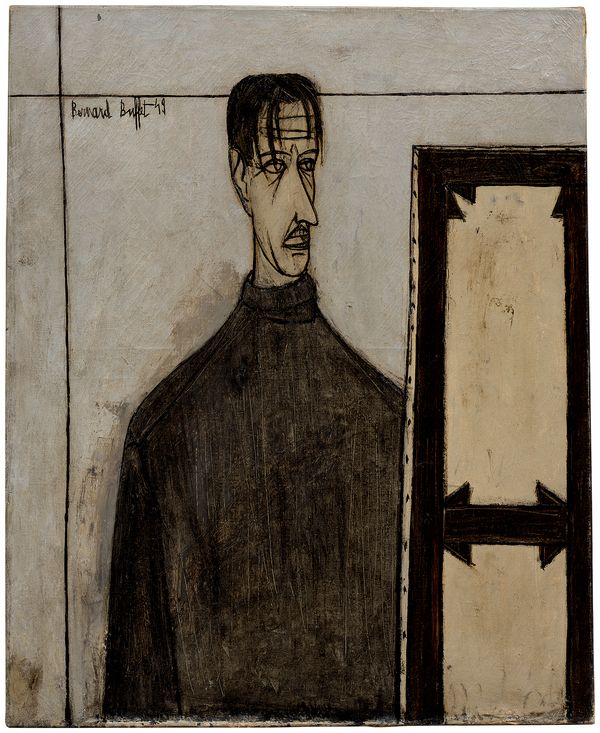
Bernard Buffet, Autoportrait, 1949. Modern & Contemporary Art London.
The deep cut:
In a Paris decimated by the war, a young and poor Bernard Buffet expressed the misery and torment surrounding him through his paintings. But these works were so impactful that he quickly rose to prominence, becoming one of the first financial success stories of Post-War artists. So much so, in fact, that by the 1950s, he purchased a Rolls-Royce Silver Wraith, and would paint landscape scenes en plein air from its backseat in the countryside — though we’d imagine the air was a bit more grand luxe than plain. The image of the artist in his Rolls was featured in a 1956 issue of Paris Match, which documented his lavish lifestyle. He could never shake the associations afterward.
This early 1949 self-portrait comes from a time when the artist hadn’t yet struck it big, and showcases his miserabilist, expressionist style, executed with bold, graphic lines and a muted palette. It is a highly emblematic work that captures a crucial moment in the significant artist’s life.
The basics:
French Expressionist artist Bernard Buffet (1928–1999) is widely considered to be the first mega-artist of the Post-War era, capturing the existential zeitgeist of the 1950s in Europe. Though he was commercially successful, his critical reception was lukewarm in an era dominated by Abstract Expressionism. His legacy began to shift a decade ago amid increased market and institutional interest, highlighted by a prominent retrospective in 2016 at the Musée d’Art Moderne de Paris. His work is held at Tate Modern, MoMA, the Centre Pompidou, and in the dedicated Bernard Buffet Museum in Japan, among others.
Robert Mapplethorpe’s deal with the devil
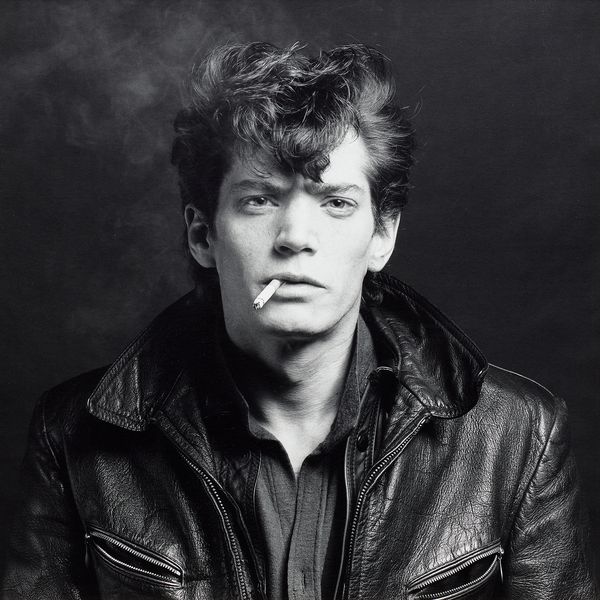
Robert Mapplethorpe, Self Portrait, 1980. Modern & Contemporary Art London.
The deep cut:
Many who knew Robert Mapplethorpe have recounted him explaining he made a deal with the devil at a young age, and he seems to have incorporated such stories into both his personal and private persona. This sense of a constructed identity is on full display in this captivating 1980 self-portrait. He owned many personal talismans adorned with satanic or occult imagery, fascinated as he was by mysticism. But at the end of the day, these are just a few lines of lore in a practice that is largely celebrated for its formal precision — a groundbreaking marriage of classical aesthetics with often challenging subject matter.
The basics:
Offered in this season’s ULTIMATE selection, this work is number 13 from the edition of 15 + 3 APs. Other prints from the edition are held in various collections, including The Museum of Modern Art, New York; the Solomon R. Guggenheim Museum, New York; The Getty Museum/LACMA, Los Angeles; the Walker Art Center, Minneapolis; Tate/National Galleries of Scotland, UK; Musée national d'Art moderne - Centre Pompidou, Paris; and Museo Reina Sofía, Madrid.