Article | Seven Things To Know About Yayoi Kusama Hong Kong Auction March 2026
Seven Things to Know About Yayoi Kusama
Enter the infinite with eight emblematic works by one of the most iconic artists of our time.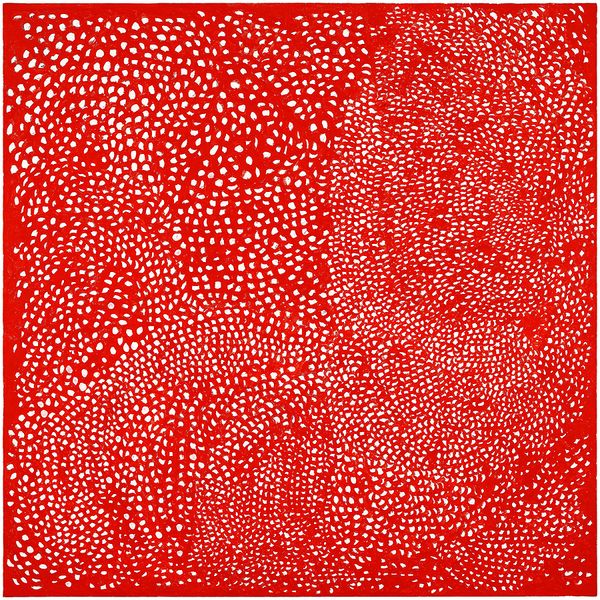
Yayoi Kusama, Sunset Afterglow inside My Heart, 2020. Modern & Contemporary Art Evening Sale Hong Kong.
Editor’s note: 27 August 2026.
The world has learned of the passing of Yayoi Kusama in Tokyo at the age of 97. Phillips joins the world in mourning this singular artist, whose iconic imagery has captured the global imagination like few other artists in history. Though we mourn her loss, her infinite spirit lives on through the vibrant universe she created. As she once said, “I will keep on making my art until the day I die, and even after I die, my spirit will keep creating new art.”
Born in 1929, Kusama dreamed of being an artist from childhood, making drawings of pumpkins inspired by the ones being sold at her family plant nursery and seed farm from age 10. After successfully exhibiting in her homeland in the 1950s, she fled Japan’s wartime patriarchy for new opportunities in the United States. Living and showing work in Seattle, she corresponded with Georgia O’Keeffe, who encouraged Kusama to move to New York in 1958, during the height of the Abstract Expressionist art movement and on the cusp of its emerging Pop art scene. After seven decades of honing her own brand of counterculture, feminism, and visionary art, Kusama is considered the most successful living female artist in the world.
Ahead of Phillips Hong Kong’s upcoming Modern & Contemporary Art Sales, we offer seven things to know about one of the most important artists of our time.
Yayoi Kusama was the most expensive living female artist
Kusama was considered one of the most successful female artists of all time. Her work at auction reflects it, often selling for above pre-sale estimates.
In May of 2022, Phillips New York set a new world auction record for Kusama’s 1959 painting Untitled (Nets). Part of the artist’s coveted early series of white Infinity Net canvases, Untitled (Nets) hammered sold for $10,496,000 USD against estimates of $5–7 million USD.
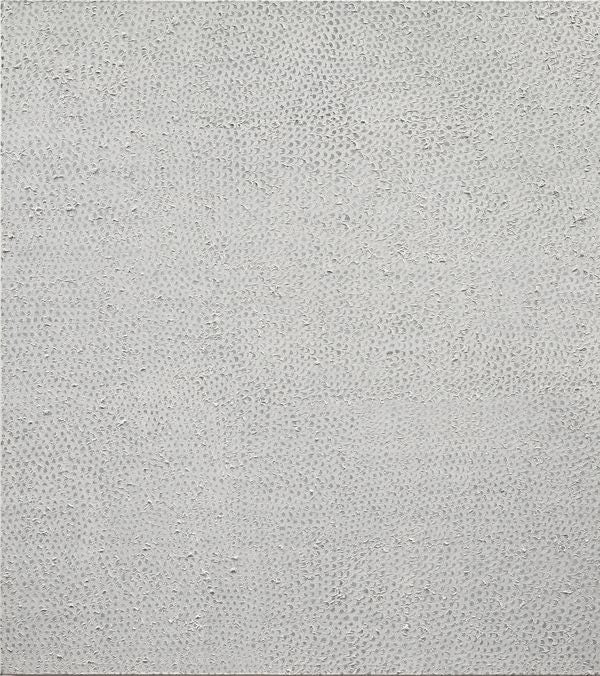
Yayoi Kusama, Untitled (Nets), 1959. Sold for US$10,496,000 at Phillips’ 20th Century & Contemporary Art Evening Sale. May 2022, New York.
Internationally known for her extraordinary and otherworldly sculptures and installations, Kusama is also well-respected and widely collected as a painter. Originally anticipating the minimalist art movement, her Infinity Nets paintings now reside in notable institutional collections, including the Solomon R. Guggenheim Museum, New York, Museum of Modern Art, New York, Los Angeles County Museum of Art, and Museum of Contemporary Art in Tokyo, among others.
She lived in a psychiatric facility in Tokyo, voluntarily
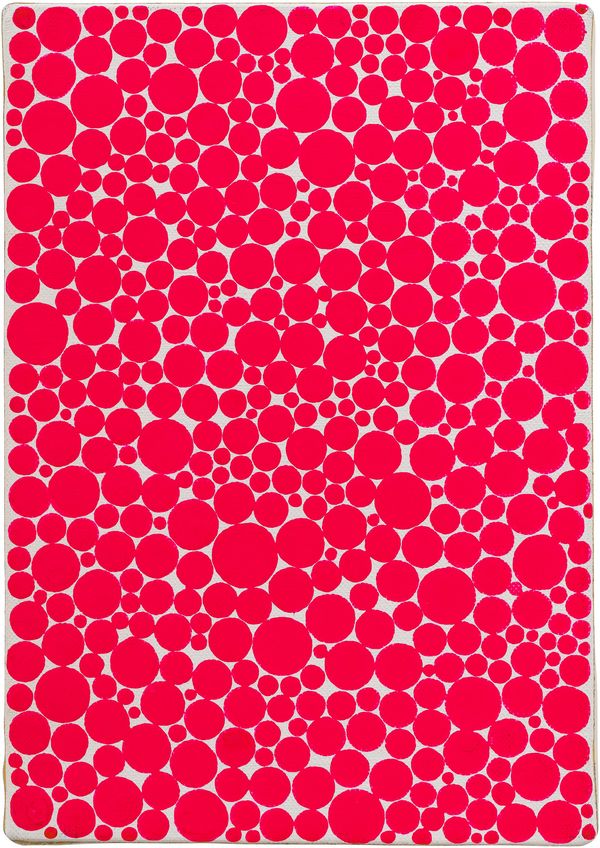
Yayoi Kusama, Infinity Dots, 1992. Modern & Contemporary Art Hong Kong.
“I fight pain, anxiety, and fear every day, and the only method I have found that relieved my illness is to keep creating art.” —Yayoi Kusama
From early childhood, Kusama suffered from visual and aural hallucinations, as well as obsessive neuroses, which she meets head-on in her work.
In her later years, she resided in a psychiatric institute in Tokyo, after voluntarily checking herself into the facility in 1977. She worked daily with a team of assistants at her studio, just across the street from the institute, and returned by dinner.
Inspired by her hallucinatory experiences, Kusama's Infinity Nets series is the artist's longest-running body of work (made public when she first exhibited in New York in 1959). Its rhythmic motion and sense of infiniteness, "without beginning, end, or centre", has a relationship to her works with repetitive dots, which together have become her form of art therapy.
She had a lifelong aversion to sex — but represented free love
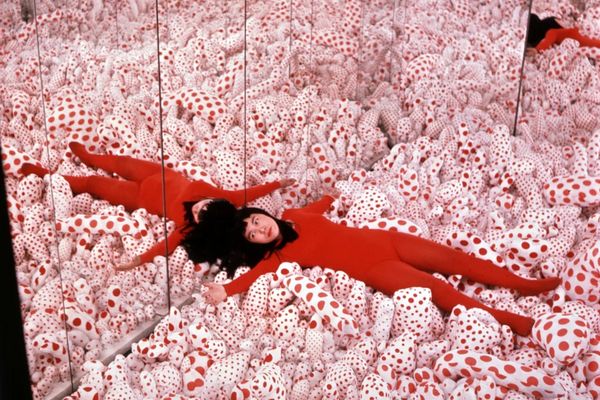
Yayoi Kusama in her Phalli's Field infinity room in 1965.
Image: Eikoh Hosoe/Courtesy of Ota Fine Arts, Tokyo/Singapore; Victoria Miro, London; David Zwirner, New York
“I began making penises in order to heal my feelings of disgust towards sex. Reproducing the objects, again and again, was my way of conquering the fear. It was a kind of self-therapy, to which I gave the name ‘Psychosomatic Art’.” —Yayoi Kusama
Kusama developed an aversion to sex as a child, after her mother forced her to spy on her father while he was with his lovers. She identifies as asexual, although her work often explores phallic forms and sexuality juxtaposed with elements of humour, like her soft sculptures in Phalli's Field Infinity Room.
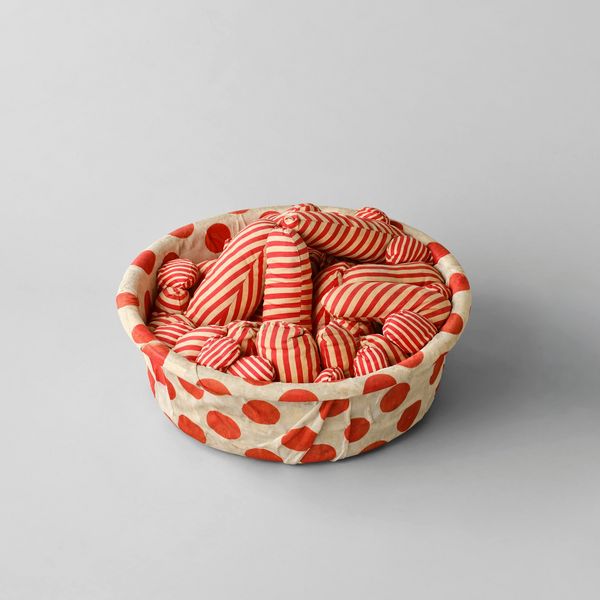
Yayoi Kusama, Untitled, 1965. Modern & Contemporary Art Hong Kong.
When it comes to Kusama's own relationships, the artist describes her relationship with the American visual artist Joseph Cornell as romantic yet platonic. The pair remained close until his death in 1972, an event that deeply affected Kusama.
Kusama’s pumpkins give Warhol’s soup cans a run for their money
“The first time I ever saw a pumpkin was when I was in elementary school and went with my grandfather to visit a big seed-harvesting ground…and there it was: a pumpkin the size of a man’s head… It immediately began speaking to me in a most animated manner” —Yayoi Kusama
Kusama and Andy Warhol were not only peers in New York’s thriving pop art scene; her repeated motifs reportedly inspired some of his famous works. Other New York artists also took note of her innovative works, as she made her first Infinity Mirror Room before Lucas Samaras conceived his room with wall-to-wall mirrors and created soft fabric sculptures in advance of Claes Oldenburg.
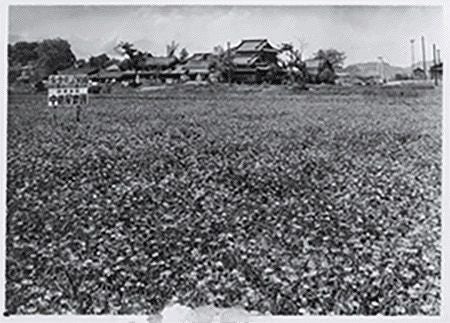
A flower field in the seed nursery owned by Yayoi Kusama’s family in Matsumoto, Japan.
Image: © YAYOI KUSAMA
Kusama's diet of pumpkins during World War II, however, may partly explain her attachment to the colourful gourd, but the artist's pumpkin motif truly came to harvest through vivid hallucinations in her youth. The artist remembers accompanying her grandfather to a nursery, where she saw a pumpkin the size of a man’s head. When she reached down to pick it up, she recalls that it spoke to her. The pumpkin motif first appeared in Kusama’s travelling exhibition in Nagano and Matsumoto, Japan, 1946, when she presented Kabocha (Pumpkin).
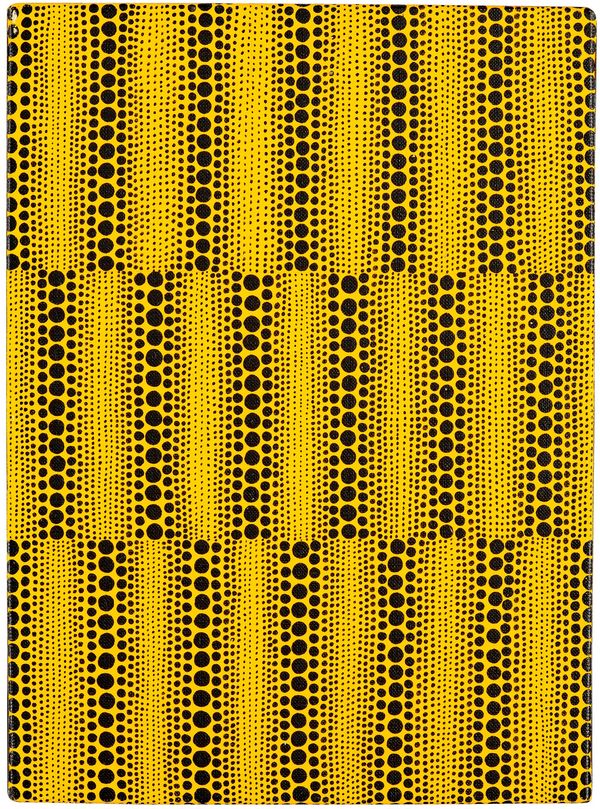
Yayoi Kusama, River, 1994. Modern & Contemporary Art Hong Kong.
She was a fashionista well before her Louis Vuitton collaborations
“When you understand the beauty of fashion, and the beauty of small planets, you realise that fashion is a marvellous form of expression.” —Yayoi Kusama

Yayoi Kusama, Macaroni Dress, 1963. Modern & Contemporary Art Hong Kong.
In 2012, Kusama collaborated with French fashion house Louis Vuitton and its Creative Director Marc Jacobs to reveal the Infinity Dots capsule collection. The fashion house and artist topped that collaboration in 2023 with its worldwide CREATING INFINITY: THE WORLDS OF LOUIS VUITTON AND YAYOI KUSAMA campaign, which produced a series of new creations adorned in original motifs, such as Pumpkins and Figurative Flowers, inspired by Kusama’s iconic works.
But Kusama spoke of her long-standing fondness for fashion through her art, often employing mannequins in her individual artworks and installations.
She uses polka dots to get out of her head
"Our earth is like one little polka dot, among millions of other celestial bodies." — Yayoi Kusama
Kusama’s polka dots date back to hallucinatory experiences in her youth and became her signature as she navigated the New York art scene. A stark contrast to the dramatic marks popularised by abstract expressionist Jackson Pollock, Kusama's polka dots are comparatively calm, collected and offer a rhythmic optical sensation.
Her repetitive strokes also help her to eliminate the intrusive thoughts brought on by mental struggles. They are considered a means for her — and vicariously for the viewer — to “obliterate the self” and become one with the universe.

Yayoi Kusama, Flower (A), 1985. Modern & Contemporary Art Hong Kong.
She grew up on a massive plant nursery and seed farm in Japan

Yayoi Kusama, Shinanoji, 1984. Modern & Contemporary Art Hong Kong.
Kusama’s family farm provided the backdrop for her first hallucinations. As a child, she would wander into the fields of flowers, and it was there she experienced her first episodes of “self-obliteration” — where the patterns of the flowers seemed to come to life, multiply infinitely, and swallow her whole. Looking across her body of work, this is easy to see.
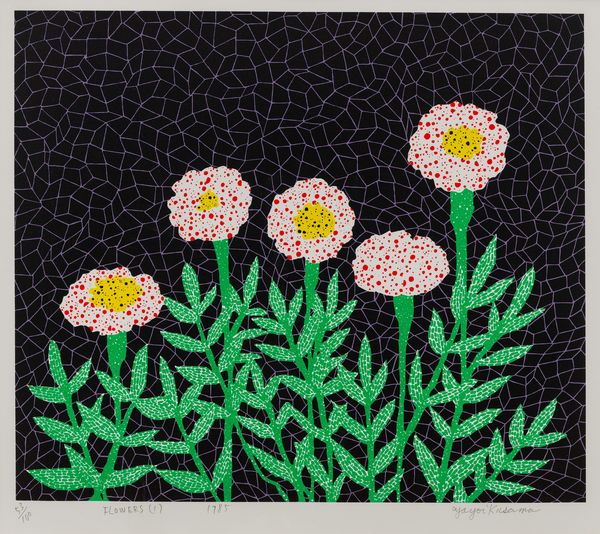
Yayoi Kusama, FLOWERS (1), 1985. Modern & Contemporary Art Hong Kong.