Article | Shifting Forms Memory And The Contemporary Condition Hong Kong Auction March 2026
Shifting Forms: Memory and the Contemporary Condition
Across portraiture, landscape, abstraction, and architecture, a selection of works from Phillips’ Modern & Contemporary Art Sales in Hong Kong reflects on memory, transformation, and the visual language of the present.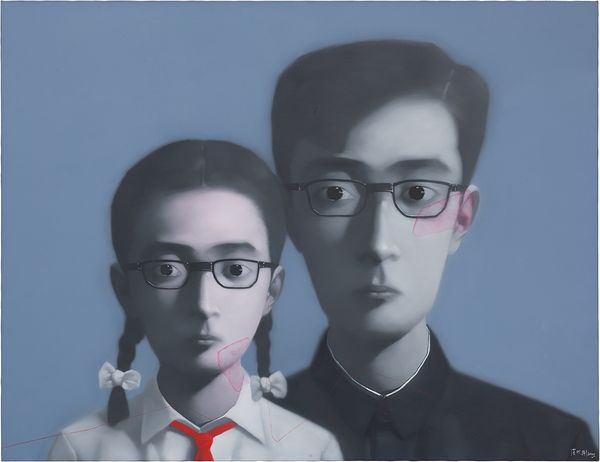
Zhang Xiaogang, Bloodline Series - Father and Daughter, 2005. Modern & Contemporary Art Evening Sale Hong Kong.
As Phillips presents its Modern & Contemporary Art Sales in Hong Kong on 29 March 2026, this selection brings together key voices in Chinese contemporary art whose practices span painting, abstraction, and architectural form.
From Zhang Xiaogang’s psychologically charged portraiture to Huang Yuxing’s luminous landscapes, Ding Yi’s disciplined abstraction, and Cui Jie’s fragmented urban environments, these works trace the evolving relationship between personal memory and collective experience.
Zhang Xiaogang
Zhang Xiaogang stands among the most internationally influential figures in Chinese contemporary art, with his Bloodline: The Big Family series marking a defining moment in his career. Painted in 2005, Bloodline Series - Father and Daughter draws on the visual language of old Chinese photographs, transforming them into images marked by emotional distance and a striking absence of domestic intimacy.
I gradually realised that in those standardized 'family portraits,' what moved me—beyond the historical background—was precisely that stylised sense of 'retouching.' It contains an aesthetic consciousness unique to Chinese folk culture for ages, such as the blurring of individuality and a 'poetic,' neutralised beauty.
– Zhang Xiaogang
Rendered in muted blues and greys that evoke black-and-white photography, Zhang uses extremely fine brushwork and multiple layers of thin glaze to create a glowing effect similar to lens flare; on the other hand, he applies a final treatment to the dry paint to construct a mottled texture reminiscent of aged photographs. The absence of the mother figure introduces a metaphor for missing emotional interaction, while the signature red-threaded “bloodlines” suggest both familial connection and the more elusive tensions of troubled memory, questionable history, and the fragile collective experience.
In 1995, 13 large Big Family paintings were exhibited at the Venice Biennale, marking the beginning of Zhang’s distinguished and prolific career. His works were later cemented in permanent collections of global institutions, including: HOW Art Museum, Shanghai; Long Museum, Shanghai; M+ Sigg Collection, Hong Kong; Solomon R. Guggenheim Museum, New York; Fondation Louis Vuitton, Paris; National Museum of Modern and Contemporary Art, Seoul; Okinawa Prefectural Museum and Art Museum, Japan; and National Gallery of Australia, Canberra, amongst others.
Huang Yuxing
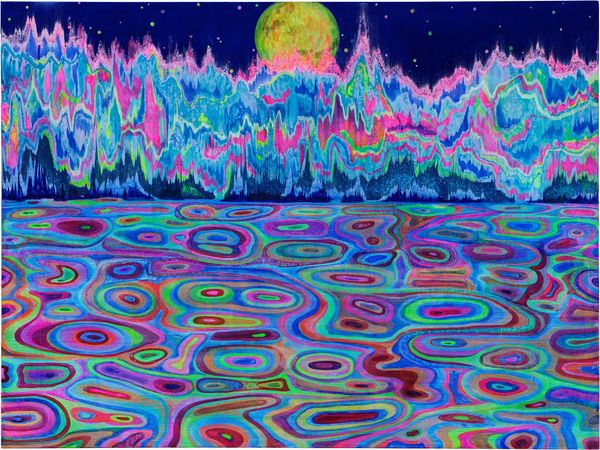
Huang Yuxing, Full Moon, 2017–2018. Modern & Contemporary Art Evening Sale Hong Kong.
The Himalayas are where I begin to discover and understand myself — and, by extension, the world around me. I visit the same place at different times and in different ways. Because every three or five years, I can sense how both the place and I have changed. It’s like a milestone or a point of reference.
—Huang Yuxing
Full Moon represents a highly mature moment in Huang Yuxing’s practice, bringing together his central motifs of fluorescent colour, mountains, rivers, and bubbles. The work translates the spirit of traditional Chinese landscape painting into a contemporary “neon landscape”, one that resonates with the visual and psychological experience of the present.
Constructed through a shifting, layered perspective, the composition moves upward from shimmering rivers and floating bubbles to luminous mountain forms and finally a deep blue sky crowned by a full moon. While visually intense and psychedelic, the painting resolves in a sense of stillness, balancing energy and calm within a radiant, immersive landscape.
Huang Yuxing (b. 1975) is currently the leading figure among China’s ‘post-70s’ contemporary artists. His market performance has been explosive in recent years, making him highly sought after by collectors and institutions across Asia, Europe, and the Americas. In 2021, he shattered the auction record for a Chinese post-'70s artist, cementing his position as a leading figure in contemporary art.
Ding Yi
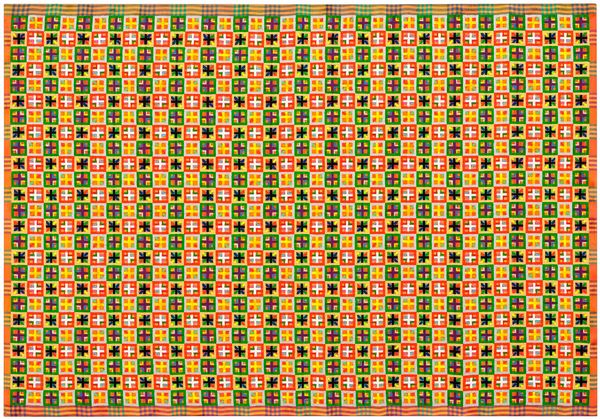
Ding Yi, Appearance of Crosses 99-9, 1999. Modern & Contemporary Art Evening Sale Hong Kong.
Since establishing his “+” cross system in 1988, Ding Yi has developed a sustained abstract language grounded in repetition, structure, and the rejection of narrative. Appearance of Crosses 99-9, created in 1999, marks a key moment in this evolution, as his practice began to engage more directly with material and context.
Here, Ding works with industrial tartan fabric, onto which he applies his cross motif. Once associated with Western identity, the material had by the 1990s entered everyday circulation in China. Within this altered context, Ding constructs a precise visual system that reflects the rhythms and density of urban life, translating broader social conditions into a disciplined formal language.
As one of the leading figures in Chinese contemporary art, Ding Yi’s works are held in the collections of numerous public and private institutions, including: the British Museum, the Centre Pompidou, the Metropolitan Museum of Art, the UBS Art Collection, the Leeum Samsung Museum of Art, the Hamburg City Collection, the M+ Collection, the National Art Museum of China, the Guangdong Museum of Art, the Power Station of Art (PSA), the Museum of Contemporary Art Shanghai (MOCA Shanghai), the Long Museum, and the He Art Museum.
Cui Jie
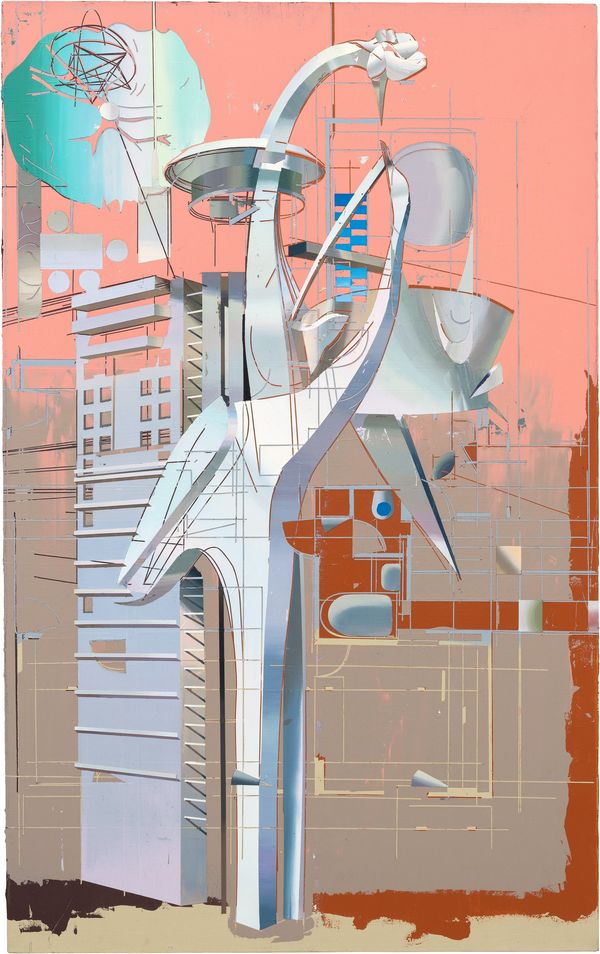
Cui Jie, Escape #2, 2017. Modern & Contemporary Art Sale Hong Kong.
What I paint is not merely architecture, but emotions and the inner feelings one experiences when confronting urban life.
—Cui Jie
Born in Shanghai in 1983, Cui Jie stands as a significant representative of China’s post-'80s female artists. Having grown up amidst the rapid urban transformations following the Reform and Opening-up era, she inquires relentlessly into the development of modernisation, urban landscapes, and the uniform, monotonous style of contemporary architecture, which constitute the core themes in her urban series of paintings.
Her practice centres on the emotional and psychological dimensions of urban life, using architecture as both subject and metaphor. The cities depicted in her work are intimately linked to her personal experiences: from Bauhaus principles and the ideological aesthetics of Chinese propaganda art to Soviet communist aesthetics and the Japanese Metabolism architectural movement. By depicting specific cities, buildings, and landscapes, Cui Jie examines the history embedded within visual perspectives, astutely raising questions about the political implications of distance, angle, and time.
In Escape #2, she employs layered collage and multiple perspectives to construct a fragmented spatial field in which geometric forms and schematic lines evoke both architectural drawings and imagined structures.
By collaging buildings from different cities and eras, Cui creates a geographically displaced urban landscape. The work captures the density and speed of contemporary urbanisation, while its rigid lines and fractured forms reflect the tension between ordered systems and dislocated, fragmented lived experiences.
The austere straight lines, rigid planes, and sharp cutting relationships position the composition between Bauhaus-inspired rational geometry and the robust texture of Soviet art, revealing the alienated and tense relationship between humanity and the city.
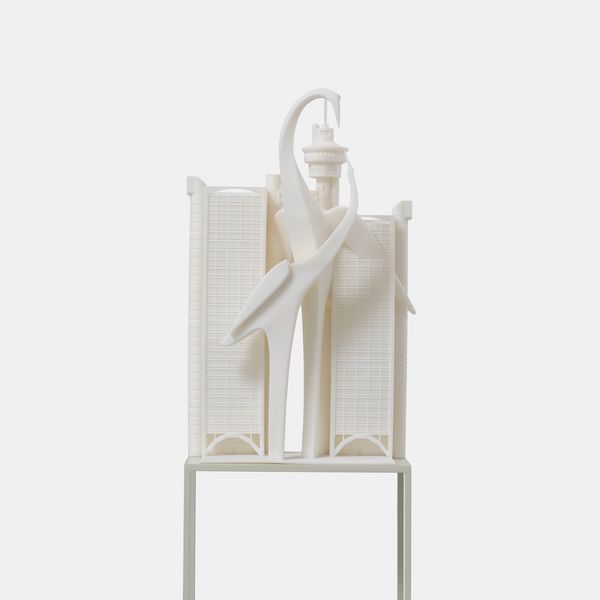
Cui Jie, Western City Gate, 2017/2021. Modern & Contemporary Art Sale Hong Kong.
Extending her architectural inquiry into three dimensions, Western City Gate is based on the 1970s Belgrade landmark of the same name. Reconstructed through photopolymer resin 3D printing, the work preserves the building’s mass and geometry while introducing a subtle sense of estrangement.
At once recognisable and displaced, the structure appears as something that could have existed elsewhere, perhaps in Beijing or Shanghai, yet no longer does. In the context of rapid urban transformation, the work reflects how memory becomes unstable — no longer fixed, but reconstructed through imagination.
Cui Jie’s works are held in the collections of institutions including the Centre Pompidou, Paris; the Museum of Modern Art, New York; the Art Institute of Chicago; the Astrup Fearnley Museum of Modern Art; the Rubell Art Foundation; the Kistefos Museum; and M+ in Hong Kong. Her recent major exhibitions include: Tai Kwun Contemporary, Hong Kong (2019); Singapore Biennale 2025: Pure Intent, Singapore Art Museum, Singapore (2025); West Bund Museum, Shanghai, China (2025) and PoMo Museum, Trondheim, Norway (2025).
Discover More
Further works in the sale continue this exploration of image, memory, and material across contemporary Chinese practice.
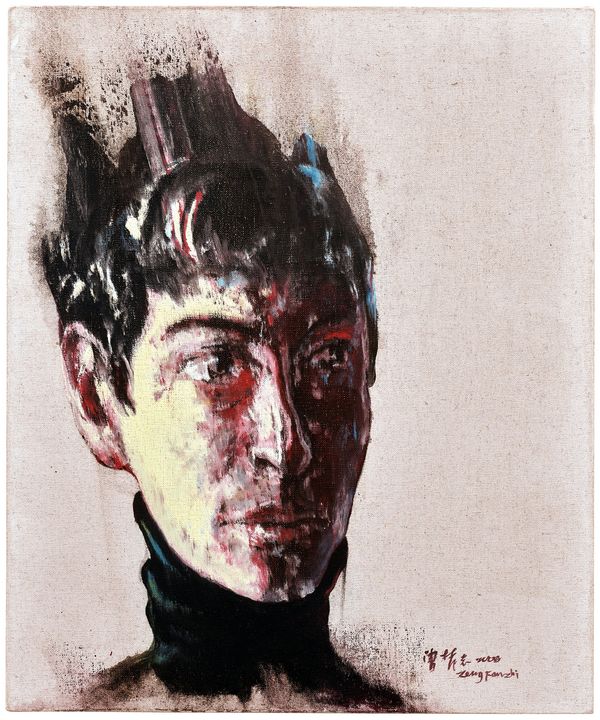
Zeng Fanzhi, Portrait 08-12-4, 2008. Modern & Contemporary Art Hong Kong.
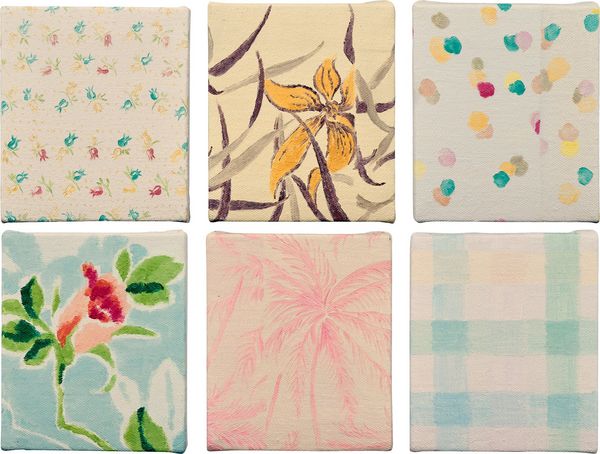
Liang Yuanwei, 6 works: Piece of Life, 2006–2007. Modern & Contemporary Art Hong Kong.