Article | Chen Yifei Memories In The Water Villages Hong Kong Auction March 2026
Chen Yifei: Memories in the Water Villages
Two works from the artist’s Water Village series reflect a pivotal shift, from collective history to private vision.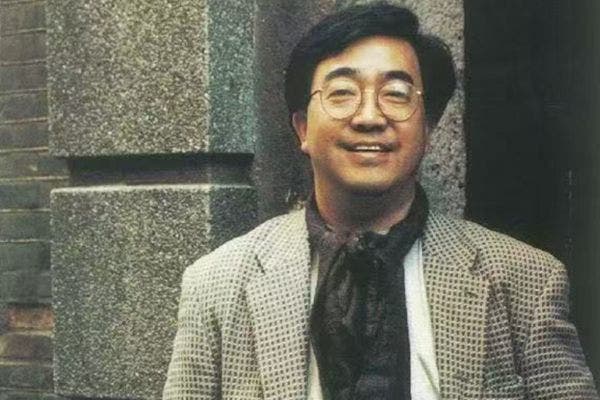
Chen Yifei, 1946–2025.
As Phillips presents its Modern & Contemporary Art Sales in Hong Kong on 29 March 2026, two works by Chen Yifei offer a glimpse at a defining moment in the evolution of Chinese contemporary painting. Created in 1984, they belong to a period in which the artist turned away from monumental historical narratives towards a quieter, more introspective visual language shaped by memory, atmosphere, and place.
Trained within the realist tradition of the 1960s, Chen first gained recognition for works aligned with the modes of his time — precise, dramatic, and grounded in collective experience. He moved to New York in 1980 to study at Hunter College, becoming its first student from China. While exposure to Western painting broadened his technical and aesthetic range, the decisive shift in his practice came from a return to his own cultural landscape. In the early 1980s, scenes of Jiangnan — bridges, waterways, and quiet streets — became the foundation of a new body of work.
His work humanises the land for us and helps us to close the gap between our two nations.
—Michael Botwinick, Director of the Corcoran Gallery of Art
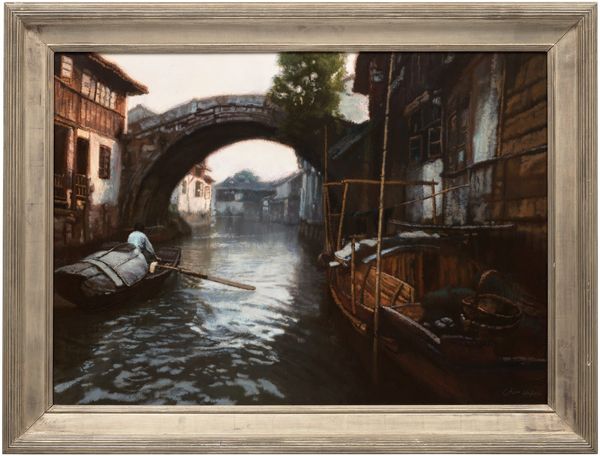
Chen Yifei, Late Afternoon (Suzhou), 1984. Modern & Contemporary Art Hong Kong.
Recalling his first encounter with Zhouzhuang, the artist described it as a “mundane place untouched by the mundane,” an atmosphere defined by quiet and light:
“At that time, Zhouzhuang's streets were quiet. Every family was cooking, and you could see smoke curling from the chimneys. The setting sun cast its glow over the town, beautifully illuminating the flagstone streets. The light came from the side, and the distant fields were also bathed in the afterglow. It was full of charm.”
To convey this lingering atmosphere, Chen developed a distinctive technique of layering oil paint and sanding the surface to soften edges and blur boundaries. Deep greens and warm yellows merge gradually, creating a soft-focus effect that evokes the warmth of twilight, as if the scene were suspended within memory.
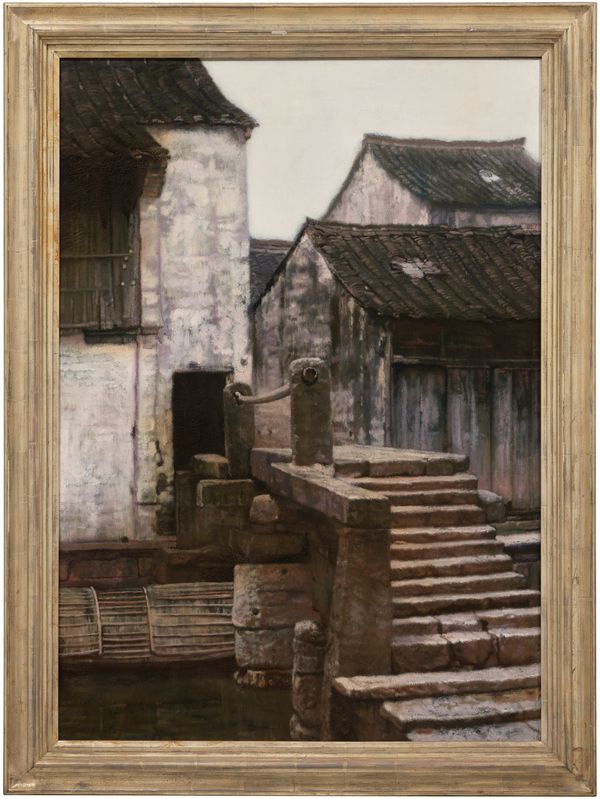
Chen Yifei, The Ancient Stone Bridge (Suzhou), circa 1984. Modern & Contemporary Art Sale Hong Kong.
If Late Afternoon is atmospheric, The Ancient Stone Bridge (Suzhou) is architectural. The composition centres on a fragment of white wall, overlapping grey tiles, and a solitary stone bridge extending diagonally through the scene. Narrative recedes, replaced by an emphasis on spatial relationships and balance.
Eschewing vibrant colours in favour of a restrained, almost monochromatic palette, he distilled the rhythmic arrangement of architectural forms. This highly condensed approach avoids slipping into cold formalism through subtle tonal variation and softened surface texture.
Drawing on the traditional principle of liubai (the use of empty space), Chen creates a composition that feels both contained and expansive. The bridge functions not only as a visual anchor but also as a directional force. Through its rhythmic progression of stone steps and directional form, it gently guides the viewer's gaze, leading it beyond the white walls into the silent, empty depths of the lane.
First exhibited at Hammer Galleries in 1984, the motif of the bridge was understood as more than architectural and as a symbol of connection and exchange, bridging cultures. As Dr. Hammer noted:
“These bridges, many of them over 1,000 years old, are architectural symbols for the ancient culture of China... In a broader sense, they symbolise free exchange between eastern and western cultures.”
Within this restrained composition, the bridge becomes both a passage and a pause, holding together memory, structure, and the quiet continuity of place.