Article | The Light And The Landscape
The Light and the Landscape
Marsha Ribeiro on her father's legacy and the South Asian artists who blur the distinctions between modern and contemporary art today.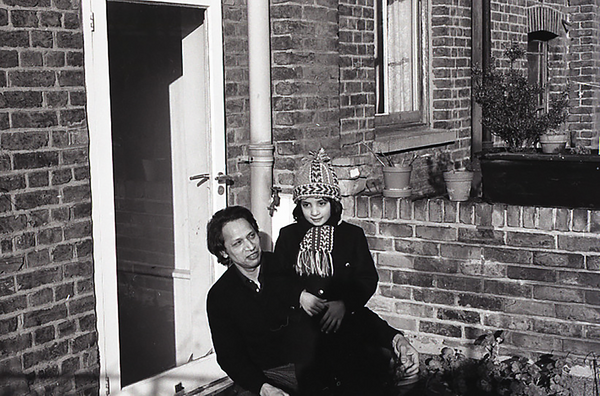
Lancelot Ribeiro with daughter Marsha, 1974. Image courtesy of the Ribeiro Collection Archive.
Phillips sat down with Marsha Ribeiro to discuss our selection of South Asian works being presented in the Modern & Contemporary Art sale on 7 March. Marsha curated the Lancelot Ribeiro: A Risen Voice Symposium on her father’s legacy at the Victoria and Albert Museum and collaborated on the new edition of Lancelot Ribeiro: An Artist in India and Europe, published by Francis Boutle Publishers. She is the custodian of the Ribeiro Collection, dedicated to documenting her father’s practice. She has conceived exhibitions, special events, publications, and talks in the UK, US, and India, collaborating with museums, galleries, and educational institutions. The following is an excerpt from the conversation.
Did your father have a relationship with any of the South Asian artists we are presenting in the auction?
M.F. Husain is a painter who had a close connection to my father. He [Husain] would regularly meet his [Ribeiro’s] brother [F. N.] Souza at the family home in Hira Building in then-Bombay. Husain’s name often crops up in family correspondence. In one, my grandmother, Lily, wrote that Husain offered to help her bring items from India to her artist sons in 1950s London.
Husain was known to favor going around barefoot — [grandmother Lily] wrote to my teenage father: "Mr. Husain [sic] who was good enough to come over & ask us if we were sending any articles he would willingly take… If you are in want of shoes just send your exact paper cutting of the outside of your shoe sole… I am sending you some mango sweet (mangade) with Husain."
— Marsha Ribeiro
My father’s path would cross with M.F. Husain and Ram Kumar again in 1966, when they were among 11 contemporary artists exhibiting at the Towner Art Gallery in Eastbourne.
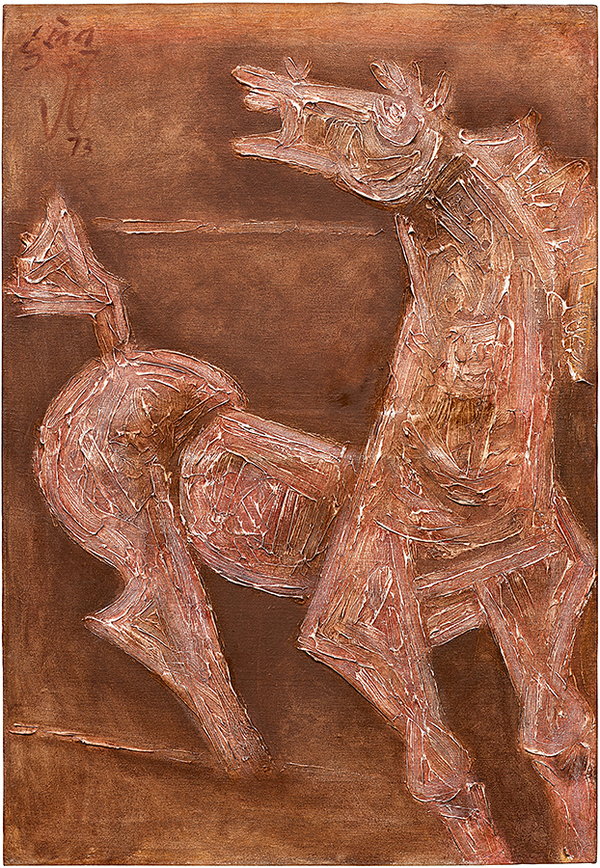
Maqbool Fida Husain, Untitled (Galloping Horse), 1973. Modern & Contemporary Art London.
What immediately struck me in M.F. Husain’s Untitled (Galloping Horse) was the way movement is conveyed through energized brushstrokes. There is a Cubist touch to the contorted, somewhat agitated pose of the subject, perhaps trying to flee from some unknown threat.
Ram Kumar’s work intrigued me, and I found my eye immediately drawn to the jagged contours of a landscape. The thick impasto and a fiery array of color suggest to me an active landscape, carved out by geological forces that come through in the sheer scale of the piece. Carved valleys, erratic rocks, and weather-beaten trees are brought into sharp focus against a pale, muted sky.
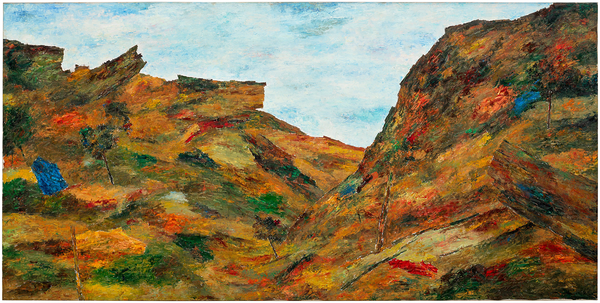
Ram Kumar, Untitled, 2004. Modern & Contemporary Art London.
An artist we have never offered before and are very excited to include is Jagdish Swaminathan, who is experiencing a renaissance in the art market. What are your impressions of this work?
There is an immediacy to the composition that commanded my attention. His use of intense red drew me in before I detected the subversion of conventional perspective and the surreal marrying of objects — the placing of a tree, a bird upturned in flight, etc. I find the piece mesmerizing and oddly calming despite the imminent threat of destruction implied by the collision of an asteroid-mountainous form heading towards a lone tree.
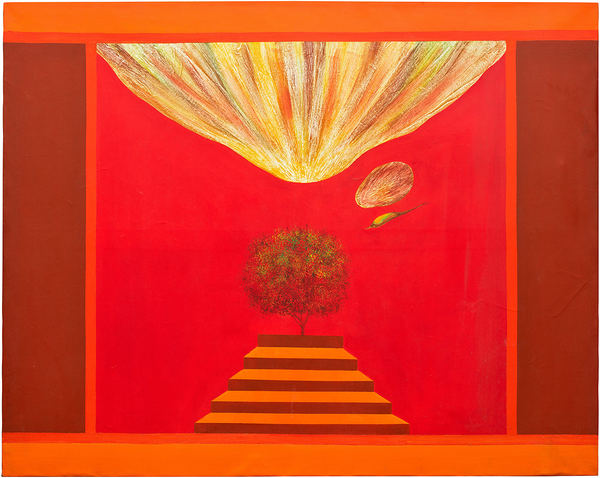
Jagdish Swaminathan, Untitled, 1980. Modern & Contemporary Art London.
Could you tell us more about your father’s townscapes?
My father’s early townscapes, dating from 1958, were usually painted with conventional oils with a dark palette. He combined deeply rooted buildings, frequently referencing church architecture, lit by the deliberate placement of a sun or moon, or by the implied existence of light.
The 1964 Landscape at Noon is unusual because it is the largest example of a landscape predominantly executed in PVA paint that he made in his studio. It comes at a time when he moved away from structured forms to develop an embryonic style of visual expression, which he reserved more commonly for miniature works. It stands out in scale as one of three large canvases that dwarf all other townscapes I have seen to date. Its discovery — over sixty years after it was painted — placed me squarely back in the Six Indian Painters exhibition held at India House in 1964.
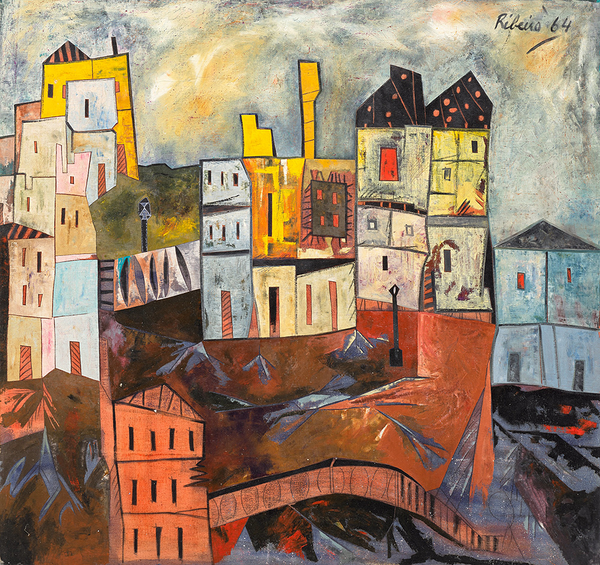
Lancelot Ribeiro, Landscape at Noon, 1964. Modern & Contemporary Art London.
Several of his early townscapes sit in notable museum collections, including the Kiran Nadar Museum of Art, Tate, Ashmolean, the New Walk Museum, and the Victoria and Albert Museum, among others. It has always been a favored form among private and corporate collectors, most notably with Tata Industries’ 1961 commission of Urban Landscape.
What do you think about contemporary South Asian art and its development, having come from a Modern tradition?
Perhaps, as the daughter of an artist, it matters less to me whether someone is classed as modern or contemporary. For me, the more interesting angle is how we are encouraged to look at the placement of works — as in this auction — to explore how different artists approach similar themes and apply their materials. Moreover, it is the development within an artist’s practice that excites me most — where a work challenges, inspires, and excites, regardless of whether it is modern or contemporary.
What are your impressions of the Subodh Gupta work?
Gupta’s choice of angle instantly places the viewer within the scene, while his color palette and play with light bouncing off the objects are delightful in conveying the warm, intimate setting.
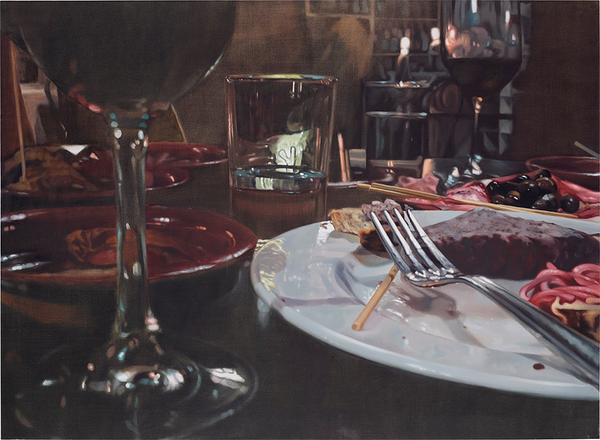
Subodh Gupta, Untitled, 2010. Modern & Contemporary Art London.