Article | Subtraction By Addition
Subtraction by Addition
Minimalist masterworks and the artists who reimagined conventions in the form.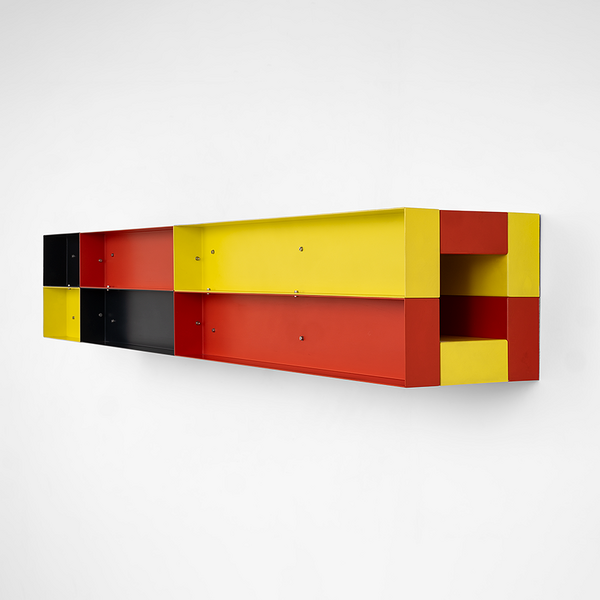
Donald Judd, Untitled, 1987. Modern & Contemporary Art Evening Sale, London.
It can be easy to think of Minimalism as a process of simplification; of removing physical and conceptual layers until the resulting work retains only its distilled elements, its fundamental essence. This formation, however, presents an obstacle: if only so much can be removed, only so much can be created. It is here that the great artists working in this form understand that, to find innovations, they must expand their scope and discover new ways to add vitality to each piece. Below, we examine three works from our upcoming Modern & Contemporary Art auctions in London and discover how there is so much more than meets the minimalist eye when it comes to keeping things uncomplicated.
Donald Judd: A hands-off approach
Exploring the aesthetic logic and conceptual framework of the Color Field movement two decades prior, Untitled stands as a prime example of Donald Judd’s essentialist renderings in the 1980s. Stripped of pictorial connotations, Judd’s work from this period made extensive use of pure abstraction to deconstruct the touchpoints of the earlier movement while navigating color and its capacity for meditative engagement. Judd went further to enlist industrial production to remove the illustrative dimension of painting, and indeed, even the artist’s hand: the aluminum sections were fabricated by a specialist Swiss manufacturer and folded rather than welded together, with visible elements of its construction balanced by the Barnett Newman-inspired palette.
Brice Marden: Organic rhythms
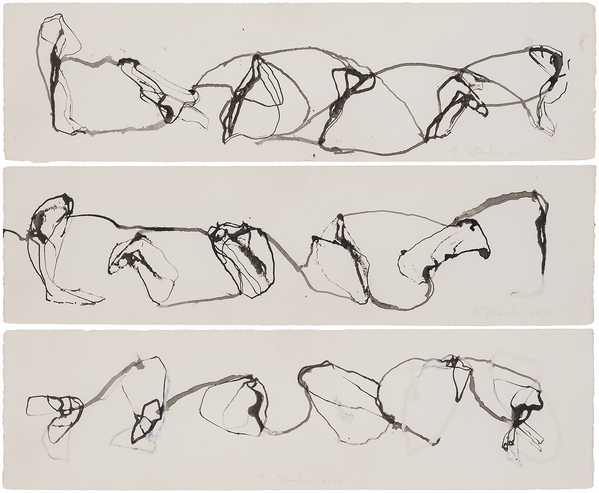
Brice Marden, Three Works: (i) Nevisian Story 17/Garden 1; (ii) Nevisian Story 18/Garden 2; (iii) Nevisian Story 19/Garden 3, 2004-2007. Modern & Contemporary Art Evening Sale, London.
Created between 2004 and 2007, while Brice Marden’s major retrospective took place at MoMA, New York, Nevisian Story 17/Garden 1; Nevisian Story 18/Garden 2 and Nevisian Story 19/Garden 3 are marked by the artist’s calligraphic approach to capturing the movement of the natural world. The series was inspired by Marden’s hotel in Nevis, where he and his wife, Helen, embraced the landscape as a “living canvas.” The lush rhythms of the Caribbean island combined with the artist’s studies of Asian calligraphy opened new possibilities for his practice. These disparate influences blend fluidly in the works, showcasing the power of movement to give life to the forms, with organic lines blurring the space between drawing and painting in Marden’s signature tense style. The washes of sinuous ink give the works a painterly dimension, evoking the physicality of midcentury Action Painting, and the increasingly dense webs that stand out against the areas of white in each sheet like an illuminated thicket in the morning light.
Joel Shapiro: Working the room
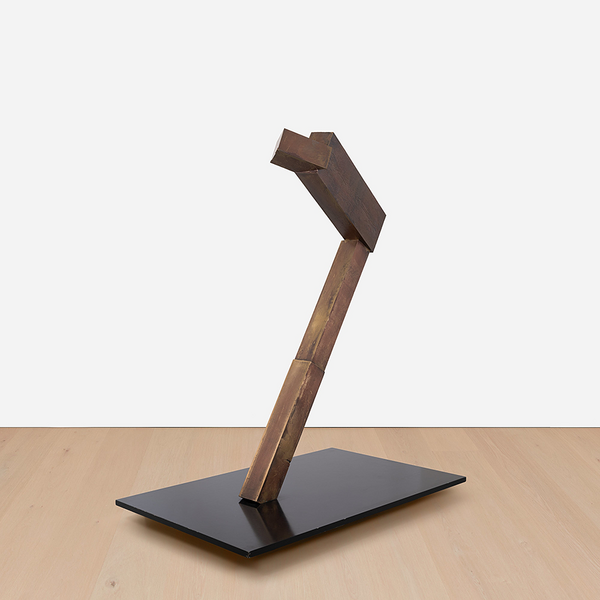
Joel Shapiro, Untitled, 1983-1987. Modern & Contemporary Art, London.
Throughout his career, Joel Shapiro’s minimalist geometry and focus on material and spatial relationships yielded an expansive body of work that carried enduring psychological weight. Shapiro began producing larger bronze sculptures in the 1980s, and while the artist maintained an emphasis on clean, spare shapes, the works began to take on a bodily presence and gesture. Rather than aiming for machine precision, Shapiro used bronze as a dynamic medium and, as seen in Untitled, found in the metal a capacity for movement. Its rectangular forms balance, lean, and evoke a corporeal interpretation of space, inviting the viewer to move around the work as if it were a dance partner. It is precisely in this reduction of form to its suggestive components that we see how much Shapiro was adding to the totality of the work, incorporating space as a supplementary element of structure to invite the viewer into the world of the sculpture, showing that, ultimately, minimalism can be a soliloquy and a dialogue all at once.
Discover more from Modern & Contemporary Art >
Recommended Reading