Article | Artists To Watch New York
Artists to Watch: New York
A midwinter afternoon's hottest artists.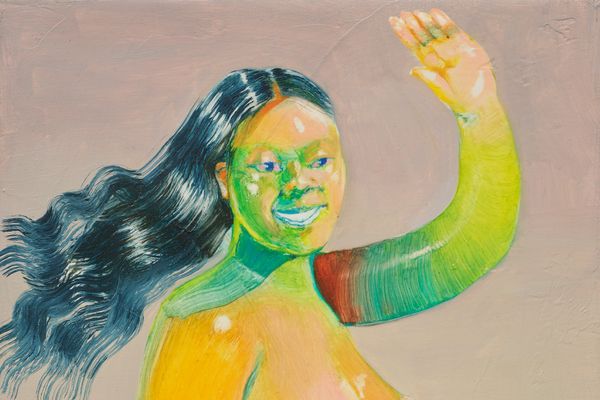
Sasha Gordon, American Girl (detail), 2019. Modern & Contemporary Art New York.
Sasha Gordon
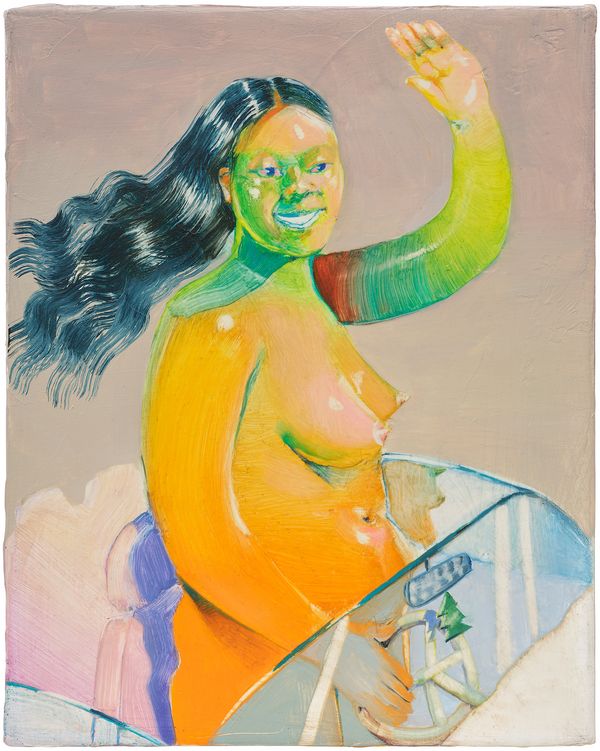
Sasha Gordon, American Girl, 2019. Modern & Contemporary Art New York.
Standing tall inside a convertible and awash in glowing, vibrant colors, a lone female figure smiles and waves beyond our line of sight. This dreamlike work is yet another unexpected and intriguing image by Sasha Gordon, a young artist whose meteoric rise in the art world is only just beginning. Gordon often utilizes her own likeness to explore themes of otherness and the Asian-American experience, employing a distinctly hyper-surrealist approach that is on full display in American Girl. As the youngest artist represented by David Zwirner, she presented her first solo exhibition with the gallery in New York in 2025, and her work has already been acquired by institutions including the Whitney Museum of American Art and the Brooklyn Museum. Lingering before the present lot makes it clear why she is among the most in-demand young artists working today — this strangely distant yet evocative painting is remarkably inviting, a reminder that encountering “the other” is a profoundly resonant experience.
Alexis Ralaivao
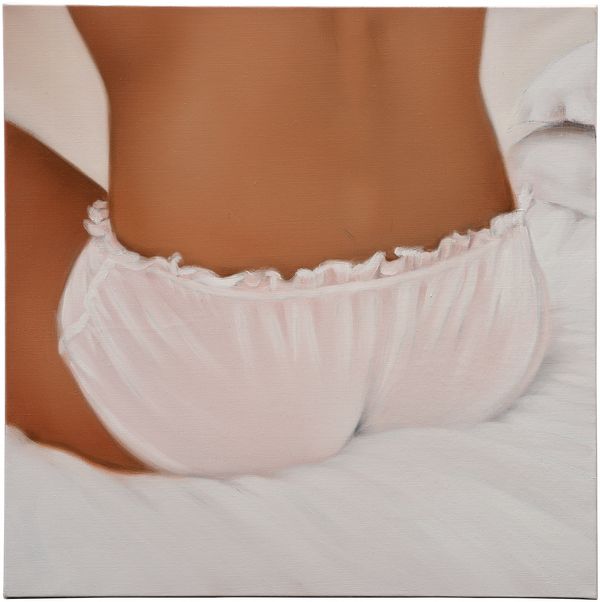
Alexis Ralaivao, Roma, 2021. Modern & Contemporary Art New York.
Drawing from his own autodidactic training and explorations of Dutch Golden Age genre painting, contemporary francophone society, and his own French-Malagasy heritage, Alexis Ralaivao (b. 1991) focuses on cropped depictions of gestures, objects, and, in the case of Roma, flesh in moments of quiet seclusion. The artist’s scenes balance subtlety and implication, mood and sensitivity, elevating quotidian moments into allusive spaces where the subject is at once immediate and formalized. Ralaivao’s keen sense of light and domesticity play off one another: we must look our best from all angles, including close-up.
Naudline Pierre
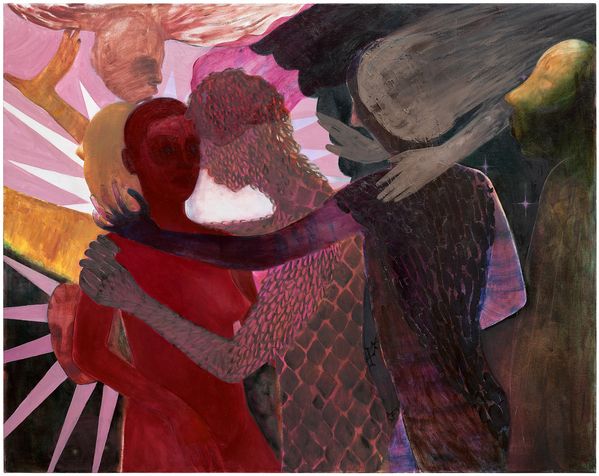
Naudline Pierre, A Kiss Three Times, 2018. Modern & Contemporary Art New York.
Naudline Pierre’s (b. 1989) otherworldly oil paintings weave personal mythology with religious iconography through her syncretic, transformative vision. Channeling the spiritual influences of her Haitian-American upbringing, Pierre composes works populated by ethereal subjects, often with distorted or hidden features, whose spiritual intimacy draws the viewer into an alternate reality through art-historical narratives associated with transcendent encounters, mysterious visions, and corporeal transformation. Case in point, A Kiss Three Times evokes the traditional devotional scene, yet its cosmic wash of colors and embracing figures suggest a greater, more universal resonance than any individual doctrine. In this way, Pierre reimagines the conventions of immaterial sanctity by way of figurative intimacy.
Genesis Belanger
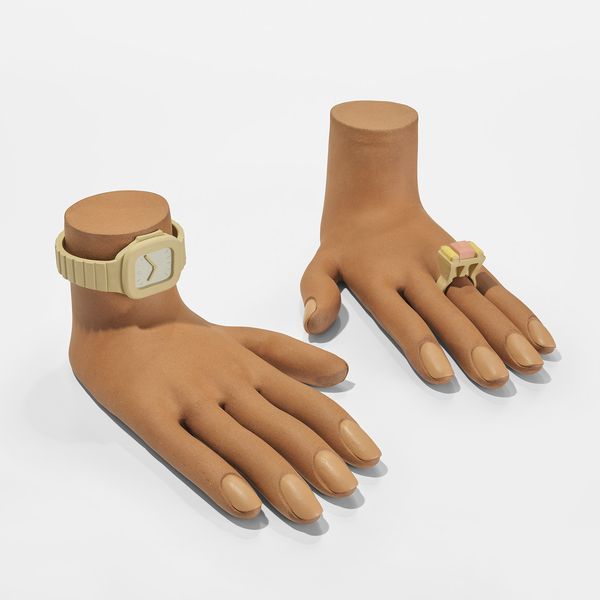
Genesis Belanger, His and Hers, 2020. Modern & Contemporary Art New York.
Genesis Belanger’s uncanny works offer a surreal critique of consumer culture, gender, and advertising. Having worked in fashion prior to her art career, Belanger’s background lends itself to the peculiarity of His and Hers, which is comprised of two stoneware hands with oil-painted nude manicures. The works recall the impossible angles of fashion editorial photography: 90-degree wrists, post-production skin, and not a cuticle in sight. The signifiers of social rituals, the just-made-partner watch and the not-just-partners engagement ring, are structured no differently than the ankle monitor and the splint, creating an unsettling fragmentation of body parts and ornaments. We can easily picture these perturbing digits wandering one of the artist’s tablescapes and contorting just so to show off the wares while complementing the canapés.
Dindga McCannon
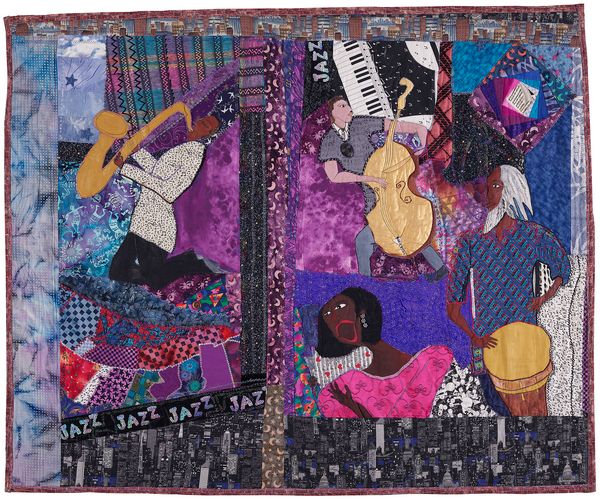
Dindga McCannon, JAZZMOBILE!, 2001. Modern & Contemporary Art New York.
Born in 1948 in Harlem, Dindga McCannon has been creating mixed-media textile-based works since the 1960s, drawing on a fusion of fine art training and traditional needlework passed down by her mother and grandmother. A pioneer, she co-founded the collective of Black women artists, Where We At, in 1971, and has participated in group exhibitions in New York since the 1960s, when she was associated with the Weusi Artist Collective. This remarkable 2001 quilt assemblage JAZZMOBILE!, captures the vibrancy and motion of Harlem jazz culture through a lens of personal and collective memory. McCannon engages our full sensory capacity, inviting us to not only see these scenes, but to hear, feel and read their layered history.
Following a record auction result in 2020, the depth of McCannon’s practice began to come into full scope within the global art world. The following year, Fridman Gallery presented In Plain Sight, the artist’s first major solo exhibition, and in 2024, she completed a major mural commission for Rikers Island. Her works are now in several prominent institutional collections, including The Whitney Museum of American Art, The Brooklyn Museum, The Studio Museum in Harlem, The National Gallery of Art, The Hirshhorn Museum and Sculpture Garden, and The Phillips Collection.
Emily Kame Kngwarreye
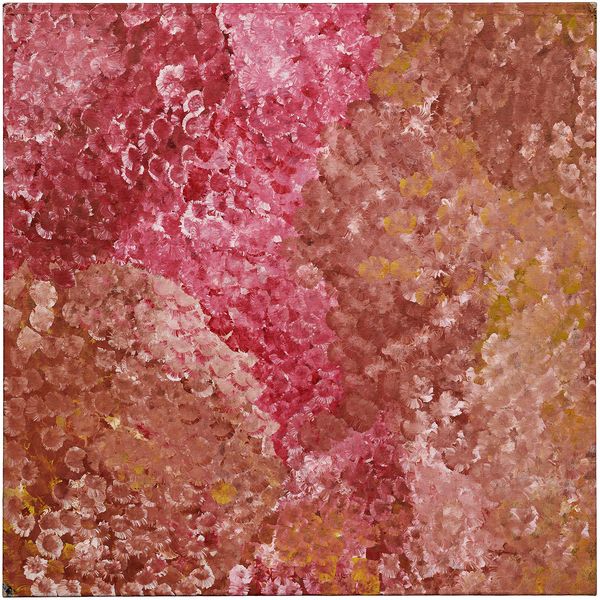
Emily Kame Kngwarreye, My Country, 1995. Modern & Contemporary Art New York.
Upon first glance, the sensuous texture and dimensionality of this work by Emily Kame Kngwarreye (1910–1996) invite a deeper look. These colorful and airy forms seem to float against one another as if in motion, settling only when observed. A member of the Anmatyerr people, Kngwarreye developed a singular style that bridged traditional ritual forms with innovative mark-making, forging a profound spiritual connection between her canvases and her ancestral lands. Since her first major retrospective in 1998, Kngwarreye’s work has garnered global acclaim, featured in landmark surveys such as Women in Abstraction at Centre Pompidou (2021), a 2023 retrospective at the National Gallery of Australia, and major solo exhibitions at Gagosian Paris (2022) and Tate Modern (2025).