Article | Landscape Modern Contemporary Art Online Auction New York December 2025
The Language of Landscape
Seven works in our New York Modern & Contemporary Art Online Auction showcase approaches to landscape that are as varied as nature itself.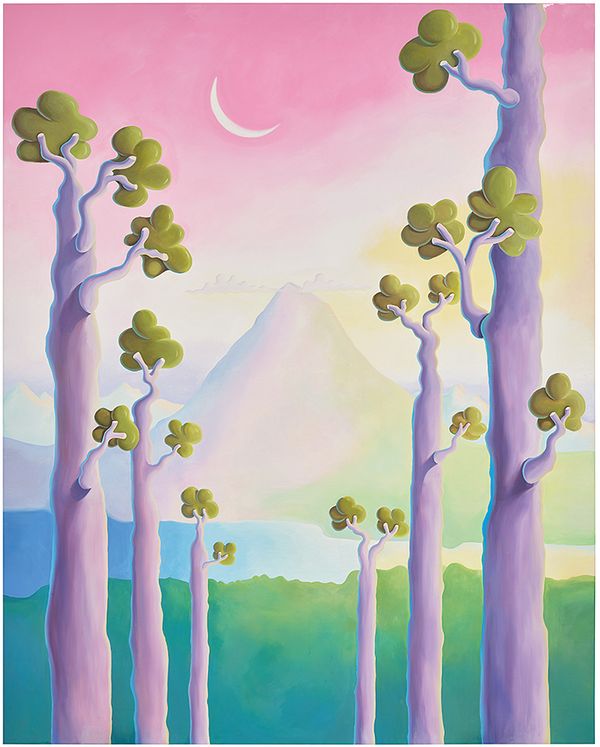
Daisy Dodd-Noble, Burabay, 2021. Modern & Contemporary Art Online Auction, New York.
Daisy Dodd-Noble
British painter Daisy Dodd-Noble crafts dream-like landscapes that invite the viewer into a space of alternate consciousness. While her work draws on a Surrealist lineage, Dodd-Noble’s paintings speak to a contemporary moment of climate crisis, and she has discussed her interest in highlighting the mutual dependence and shared energies between people and the natural world. Through a precise and vitalist use of color, Dodd-Noble calibrates an animated, singing celebration of the beauty present in the world around us, if only we could see it that way. In this particular work, Dodd-Noble’s twin lines of receding trees seem to deliberately disrupt the history of the repoussoir — instead of a tree placed in the foreground to direct the eye to what lies beyond, the trees themselves are subjects who seem to walk the viewer toward the horizon.
Soumya Netrabile
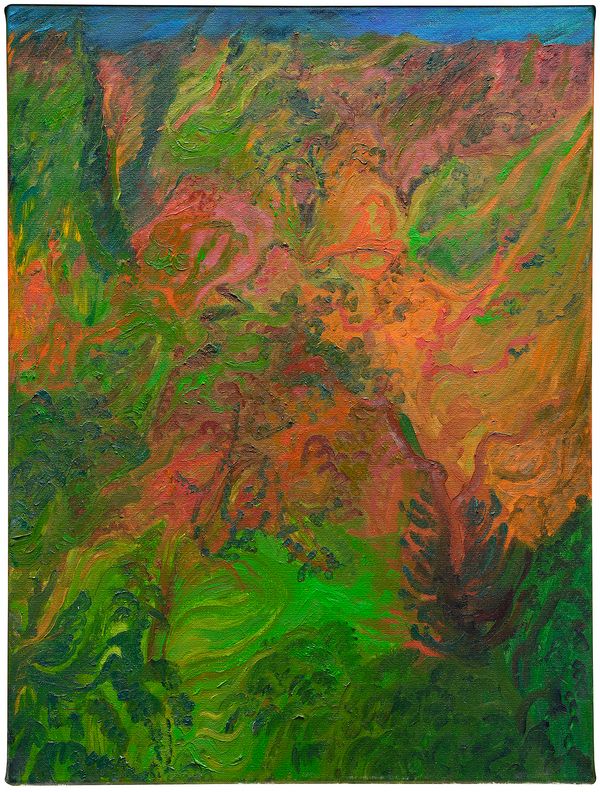
Soumya Netrabile, Fever Dream, 2023. Modern & Contemporary Art Online Auction, New York.
Soumya Netrabile’s powerful paintings emerge from a rich tension between the recognizable conventions of landscape — see that blue band of sky that structures Fever Dream — and the material pull of paint’s abstract qualities. The viewer’s eye might wish to search for knowable forms in the short, green strokes of Netrabile’s foliage, but the painter’s brilliant use of color envelops us in the less-sensical, or, that is to say, the purely sensory. Where one passage seems to suggest brushy undergrowth, another finds color streaming toward the edge of the canvas, as if showing a landscape from above. Netrabile’s training as an electrical engineer might be relevant to the way these shifts of scale bring condensed energy to the work, as if the painter were skillfully wielding a current.
Joseph E. Yoakum
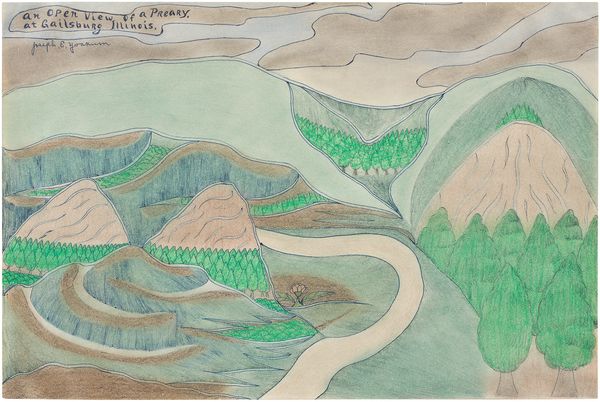
Joseph E. Yoakum, Open View of a Preary at Gailsburg, Illinois, n.d. Modern & Contemporary Art Online Auction, New York.
Self-taught American artist Joseph Yoakum created a distinctive visual language when he began drawing landscapes in the 1960s. Each drawing includes the name of the place pictured, but the landscapes themselves are far from literal. In Open View of a Preary at Gailsburg, Illinois, neatly ordered trees function as detail and almost as color field, their size and arrangement dictated by Yoakum’s compositional interest rather than by any sense of realism. Yoakum’s hand offers both strong lines — the curving strokes that indicate mountains, a road, clouds — and soft gradients of color. These forms seem almost to swirl outward from a point near the center of the drawing, as if the landscape is a kind of spiritual emergence.
Roger Brown
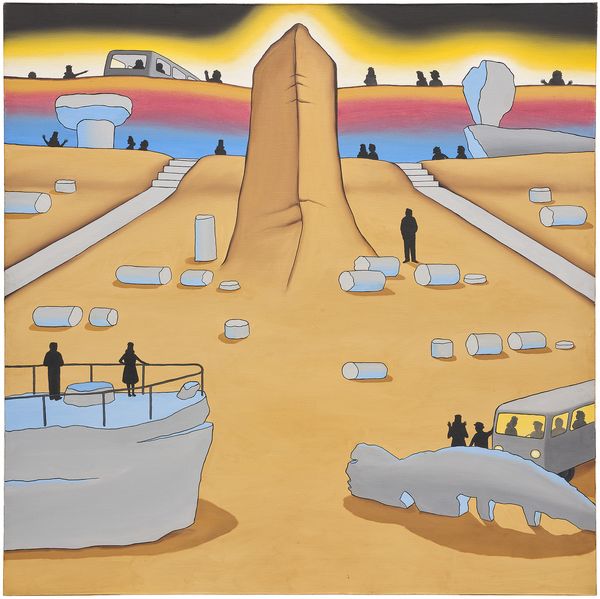
Roger Brown, Painted Desert (Including Monument Rock, Mushroom Rock, Ship Rock, Lion Rock, Balance Rock, and Petrified Forest with Tourists), 1971. Modern & Contemporary Art Online Auction, New York.
Raised in rural Alabama by a religious family, Roger Brown trained at the School of the Art Institute of Chicago and became a prominent member of the Chicago Imagists. Like other Imagists, Brown’s ouevre uses vibrant colors, references to pop culture, and an often irreverent sense of humor to plumb the absurdities of American life. Brown frequently painted landscapes, which in his hands become rather starkly regimented compositions that press on our assumptions about the difference between landscape and the built environment. In Painted Desert, stone appears in multiple iterations: as rock formations that look like other objects (“Mushroom Room, Ship Rock, Lion Rock,”), as a symbolic material basis for civilization (“Monument Rock”), and as the calcification of time itself (“Petrified Forest”). This playful slippage hints at the folly of the human “Tourists” whose silhouettes populate the landscape.
William Nichols
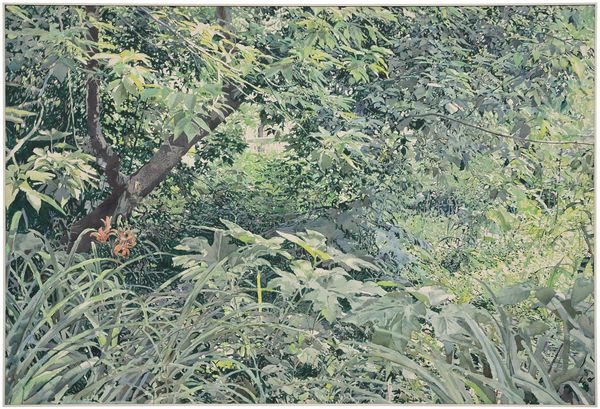
William Nichols, Lichtner’s Back Yard, 1980. Modern & Contemporary Art Online Auction, New York.
Chicago-born William Nichols is known for detailed, almost photorealistic paintings that bring the viewer into an immersive view of the natural world. More than creating a realistic depiction of landscape, Nichols seeks to create the sensation one experiences when plunged into the immense density and vibrancy of nature. He achieves this in part through his signature close-up compositions on large-scale canvases. Nichols’ careful treatment of light and color produces a surface whose variation is extremely subtle — on first glance, Lichtner’s Back Yard might overwhelm the viewer’s eye. That initial apparent flatness gives way to delicate gradations and plays of light and shadow, offering a meditative revealing of detail.
Brice Guilbert
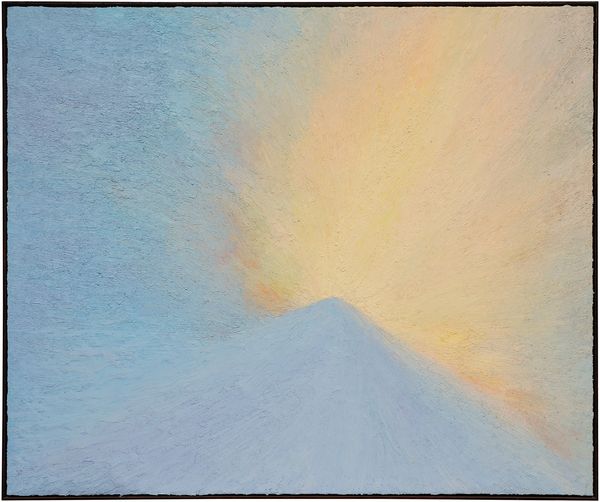
Brice Guilbert, Fournez, 2022. Modern & Contemporary Art Online Auction, New York.
For many years, Brice Guilbert’s paintings have concerned a single subject: a volcano called Piton de la Fournaise on Réunion Island, where the artist lived as a child. Fournez, as many of these paintings are titled, is the local, Creole name for the volcano. This motif, which he renders in colored oil sticks, becomes a weighted symbol of memory as well as a vehicle of pure sensation. In this painting, the warm yellow radiating from the volcano’s top suggests daybreak as much as it does fire, and the irregular texture of the layered oils produces a simultaneous sense of movement and stillness — a transformation briefly suspended. This is a psychological and even metaphysical vision of landscape, one whose apparent simplicity rewards sustained engagement.
Jessie Homer French
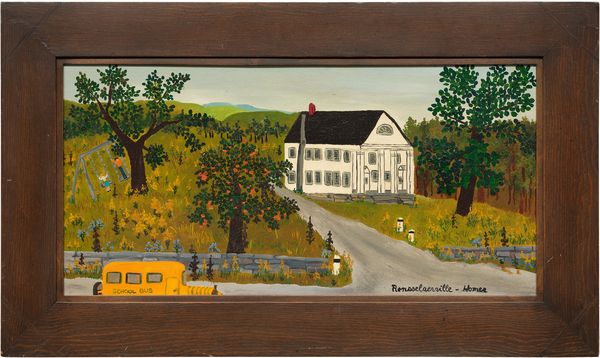
Jessie Homer French, Rensselaerville, School Bus, n.d. Modern & Contemporary Art Online Auction, New York.
Jessie Homer French, New York-born but based in California, calls herself a “regional narrative painter.” Self-taught, Homer French’s style brings an almost mythical quality to the places she depicts, in this case, a scene from the rural town of Rensselaerville, New York. While many of Homer French’s works deal in symbols of death and destruction, especially fire, this painting captures an everyday moment of rural life. Yet the image presents an intrigue beyond its charming skin: through her masterful use of color and narrative, Homer French draws together a host of philosophical, even ideological concerns. The bright school bus and the imposing white building together become an almost ominous institutional presence, while the playing children and highly saturated oranges on the tree seem ready to fall, existing only briefly on this side of mortality.
Discover more from Modern & Contemporary Art Online Auction >