Article | Sheung Koon Siu Bo On Comics Art And The Spirit Of Hong K
Sheung-Koon Siu Bo on Comics, Art, and the Spirit of Hong Kong
The legendary comic artist speaks with Phillips as some of his most iconic works come to auction in Hong Kong.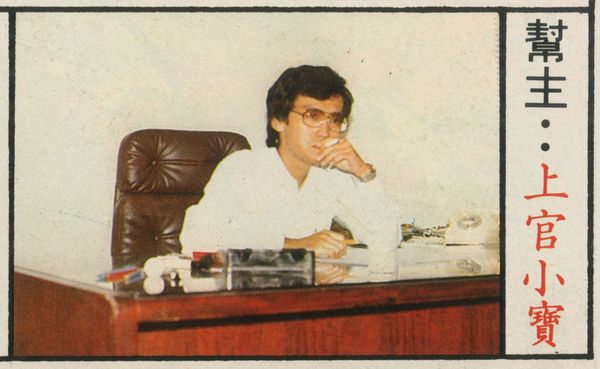
Sheung-Koon Siu Bo, published in Bruce Lee #283, 1982.
In commemoration of the 85th anniversary of Bruce Lee’s birth, Phillips is pleased to present Collection of Kwong’s Comics - Masterpiece of Sheung-Koon Siu Bo, Bruce Lee, Comic Manuscripts at its upcoming Modern & Contemporary Art & Design Sale in Hong Kong on 12 December.
These manuscripts are not only an important chapter in the history of Hong Kong comics but also a testament to the evolution of local culture. They accompanied the city’s growth, inspired countless comic creators, and became a symbol of modern culture.
Bruce Lee by Sheung Koon Siu Bo is one of the longest-running comic series in Hong Kong’s history. It ushered in the golden age of Hong Kong comics in the 1970s and, with its distinctive narrative style and martial arts spirit, profoundly influenced Asian pop culture during its more than 30-year serialization. These original manuscripts are exceptionally rare and making their auction debut at this December’s auction.
Here, the artist behind these legendary works speaks with Phillips about his artistic journey in Hong Kong.
PHILLIPS: Could you please briefly introduce yourself?
KWONG: I am Sheung-Koon Siu Bo, born Kwong Tung Yuen (鄺東源), though most people know me simply as Yin Gor (Brother Yin / 然哥). My elder brother was a professional comic artist, and when our parents returned to Macau during my childhood, I remained in Hong Kong under his care. It was during those formative years that I entered the studio as his apprentice. The structure of apprenticeship then was much as it is now, though it also encompassed a full spectrum of supporting tasks that defined daily studio life. In time, I grew into a principal artist in my own right, building a substantial catalogue across various genres. My early works were predominantly standalone stories, but as my interpretation of the Bruce Lee character gained popularity, it naturally evolved into a sustained and long-running series.
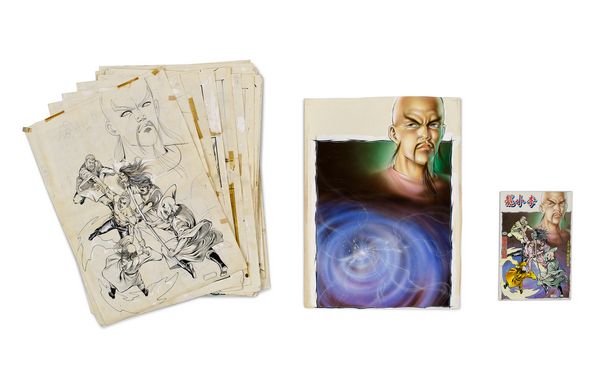
Sheung-Koon Siu Bo (Kwong Tung Yuen), A set of Nine-Pronged Feline Kill Formation: (i) comic manuscripts; (ii) coloured cover draft; & (iii) published comic book #543, 1987. Modern & Contemporary Art & Design Sale, Hong Kong.
P: Where do you usually find inspiration?
K: Books and film were my greatest wells of inspiration. I was especially captivated by detective fiction. Cinema, too, was wonderfully accessible — evening screenings cost just twenty cents, and each day brought a new genre to explore. I found myself at the theatre almost every other evening, absorbing a remarkably broad palette of styles, rhythms, and storytelling approaches.
P: Please share your creative process with us.
K: My process has always been highly intuitive, driven by spontaneity rather than calculation. Once I begin, ideas arrive in a continuous stream. I start with the drawing itself. After completing the artwork, I lay the original on the ground, photograph it, and take the film into the darkroom. From exposure to development to finishing, I carry out every step with my own hands.
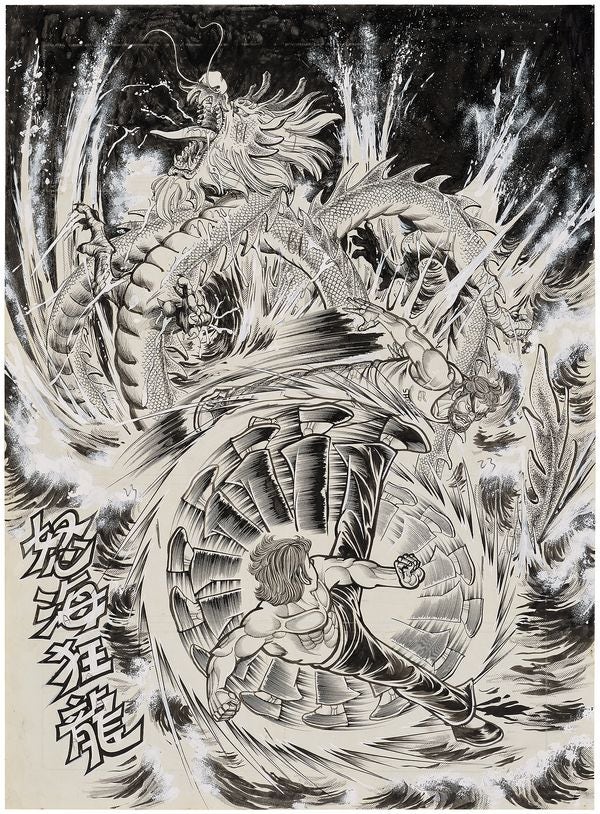
Sheung-Koon Siu Bo (Kwong Tung Yuen), Divine Leg's Battle (comic manuscript page 8), 1978. Modern & Contemporary Art & Design Sale, Hong Kong.
P: What were some indispensable creative tools back then, and are they no longer commonly seen today?
K: Fountain pens and Chinese brushes, certainly. It has become increasingly difficult to find high-quality fountain pen nibs now. Most contemporary comic artists work digitally. I’ve even heard of some who create entirely on an iPad. For me, though, tools have never been a strict concern. Even with the simplest, most ordinary Chinese brush, I can create the work I envision.
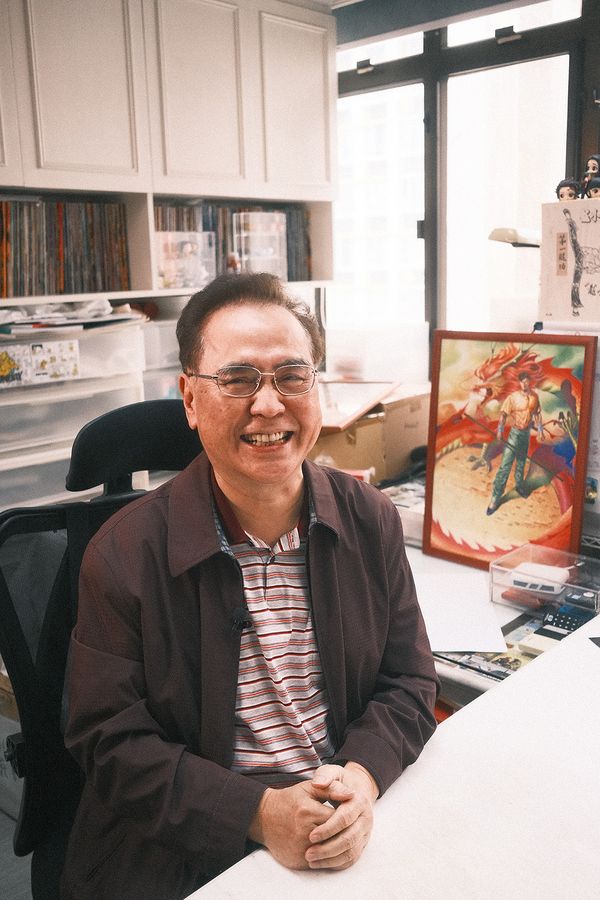
Sheung-Koon Siu Bo.
P: How was the bestselling Bruce Lee (李小龍) series created?
K: The inspiration for my Bruce Lee comics first emerged from the Wong Fei Hung films, particularly in the way the personalities of the disciples were portrayed. Later, when Bruce Lee’s The Big Boss (唐山大兄)was released, I began to consider how his unmistakable speed, rhythm, and almost dance-like physicality could be translated onto the static plane of comics. To capture those qualities with integrity, I dedicated a significant period to intensive practice and study.
P: In the Bruce Lee comics, which character is your favourite?
K: My favourite has always been Sha Dan Zaai (Mr. Fearless / 沙膽仔). His personality is wonderfully exaggerated and humorous, inherently suited to the expressive nature of comics. I have never been particularly drawn to characters who are overly serious.
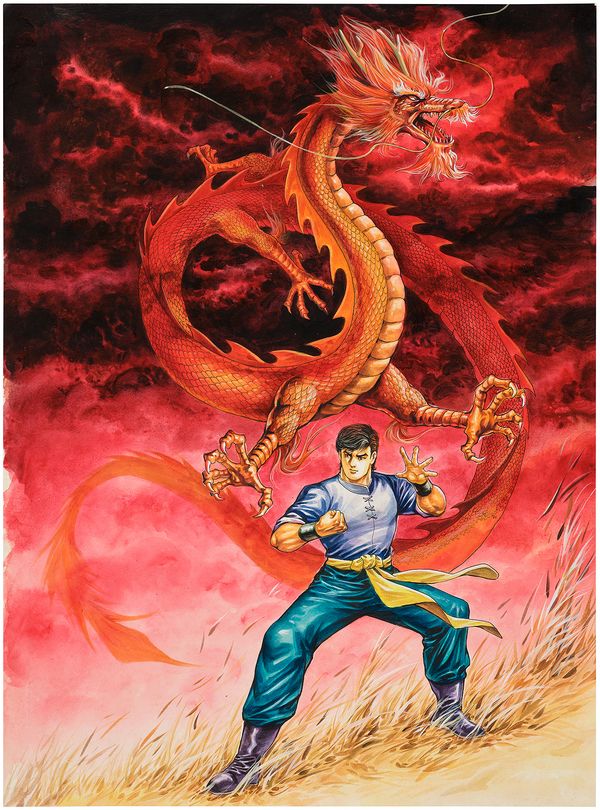
Sheung-Koon Siu Bo (Kwong Tung Yuen), The Blood Dragon's Vital Point, 1993. Modern & Contemporary Art & Design Sale, Hong Kong.
P: How did you manage to break through when Japanese manga dominated the market at the time?
K: Japanese manga held the Hong Kong market for an extended period, and translated editions consistently outsold local creations. We also “learned by observing” — studying their strengths while leveraging our own distinct advantage: the ability to engage directly with local readers. We listened to what they hoped for, understood their preferences, and shaped our stories around experiences they could truly relate to. Through this ongoing dialogue, a dedicated readership gradually formed. In essence, we succeeded by staying authentically, unmistakably local.
P: Today, comics continue to play a major role in markets such as the United States and Japan. What elements of their success can also be applied locally?
K: In the U.S. and Japanese industries, the roles of cartoonist and investor are clearly delineated. In Hong Kong, however, these roles often overlap. Many company owners are themselves comic artists. When the business falters, creativity inevitably suffers. I believe the separation of these roles is essential, and the lack of such distinctions is one reason long-term success stories are relatively rare in Hong Kong’s comic landscape.
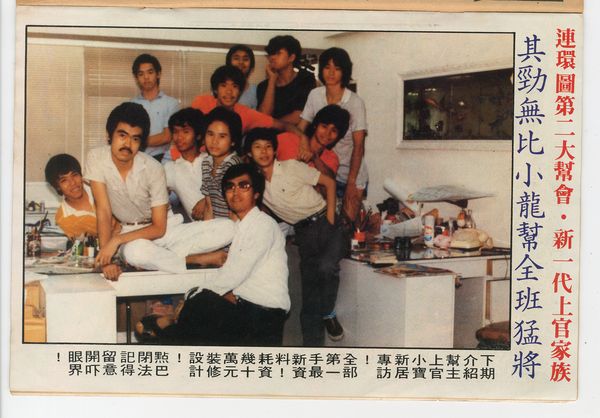
Sheung-Koon Siu Bo and his team, published in Bruce Lee #283, 1982.
P: What, in your view, is the relationship between comics and art?
K: For me, comics are undeniably a form of art. Anything that cannot be perfectly duplicated is art; even I myself cannot reproduce an identical comic work twice.
P: What advice would you give to newcomers interested in this field?
K: Begin with short stories. Exceptional technical skill is not a prerequisite, but a strong conceptual framework is. Ideas — clear, compelling concepts — are the heart and soul of comic creation.
P: The “Hong Kong Nostalgia” has become a much-discussed notion in recent years, and Hong Kong comics are seen as an important expression of local culture. What does this spirit mean to you?
K: I believe the spirit of Hong Kong lies in our unstructured, intuitive approach to life and work. It is about pursuing what you love with genuine dedication, free from imposed constraints. That, in its purest form, is the Hong Kong spirit.
Discover more from Modern & Contemporary Art & Design, Hong Kong >