Article | Around The House New Now London
Around the House: New Now London
Experts from across Phillips meditate on their favorite works from our upcoming London auction.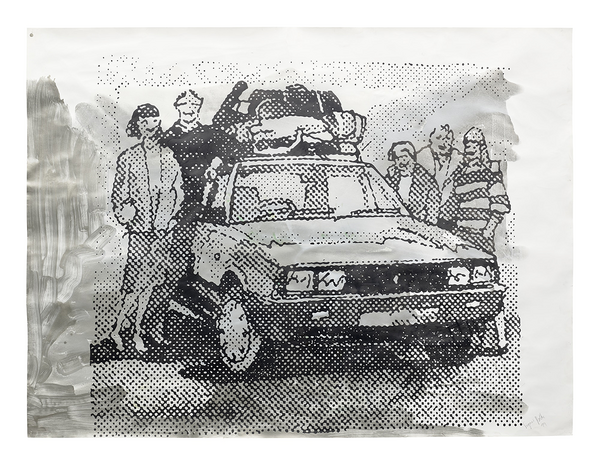
Sigmar Polke, Untitled, 1999. New Now: Modern & Contemporary Art London.
Sigmar Polke
Christopher Mahoney, Senior International Specialist, Photographs
My admiration for Sigmar Polke’s intelligence has no end. He was so smart about process and perception, and his seemingly machine-made works are actually the handwork of a highly skilled painter. Polke was fascinated with the look of the halftone printing process (the halftone dot was the foundation of newspaper, magazine, and book illustrations for most of the 20th century), and he painstakingly constructed his paintings by mimicking the halftone’s variably sized dots with daubs of paint meticulously applied to canvas. Can we call it Postmodern Pointillism? We probably shouldn’t, but I like the alliteration.
And then there’s that happy family gathered around what I’m guessing is a 1980s-era Volkswagen Passat, probably sourced from an advertisement. Polke has translated this mass-market illustration (low culture) into a brilliantly executed painting (high culture), performing a nice feat of artistic alchemy. It’s almost like he hit the “reveal codes” function laying bare the functions of post-World War II image-delivery systems. We would never mistake Polke’s painting for the ad itself; to remind us we’re looking at a painted work, he’s laid the happy family and their car over a network of loosely elegant brush strokes — a wash of gray that grounds the work.
This layering of imaging types recalls my grad-school reading of Walter Benjamin’s The Work of Art in the Age of Mechanical Reproduction. And while I’m not running back to Benjamin text for fun weekend reading, it is nonetheless very satisfying to see a work of art that conveys so many of his crucial ideas and does so in a way both deft and shrewd.
Etel Adnan
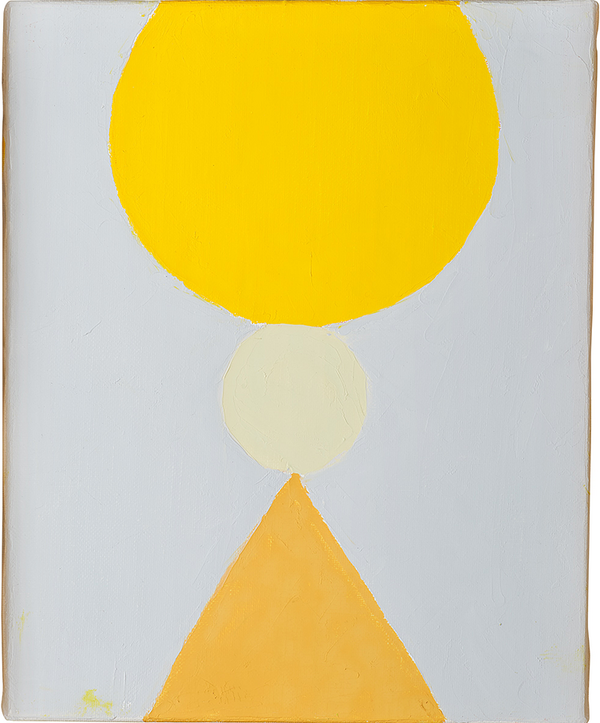
Etel Adnan, Le poids du monde 2, 2016. New Now: Modern & Contemporary Art London.
Yassaman Ali, Regional Director Middle East, Director Client Advisory
I’m going to have to be greedy and choose both Etel Adnan works coming up for sale with us next week. Etel Adnan is one of my all-time favorite artists, and it’s wonderful to see her receiving the recognition she truly deserves. both institutionally and in the international collecting sphere. Her works play with colour intelligently yet so playfully; they’re whimsical in execution, exuding positivity and a strong sense of nostalgia. Her practice is expansive, and these two works offer just a small glimpse into her extensive oeuvre. In Le poids du monde 2, you can see the yellow sun anchoring the composition; bold, luminous, and utterly characteristic of Adnan. She never uses bright colours ornamentally; yellow, for her, carries memory, warmth, and light, illustrating the clarity found in her poetry writings. The pale orb and rising triangular form below create a gentle balance that speaks to the emotional depth she conjures using the simplest shapes.
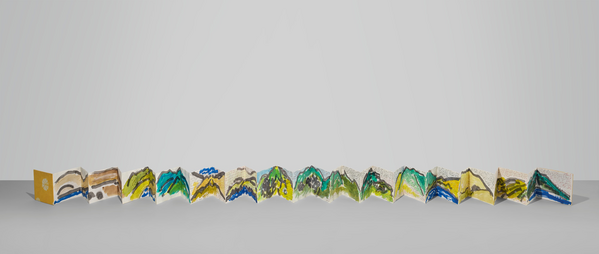
Etel Adnan, Adonis, 1984. New Now: Modern & Contemporary Art London.
The leporello Adonis reveals another facet of her practice entirely, unfolding a secret story through energetic brushstrokes of ink and watercolor that reflect the same joy, immediacy, and openness found in her writing. Le poids du monde 2 was included in Adnan’s well-received retrospective at the Serpentine in 2016, alongside works similar to Adnois, which propelled her firmly into the consciousness of collectors who had not previously been acquainted with her work. I have been following her for the past 20 years and still feel there is room for growth within her market as more and more collectors turn toward her practice. The happiness and lightness in her work, in both her paintings and poetry, form a universal language that can be accessed and appreciated by all.
Bernar Venet
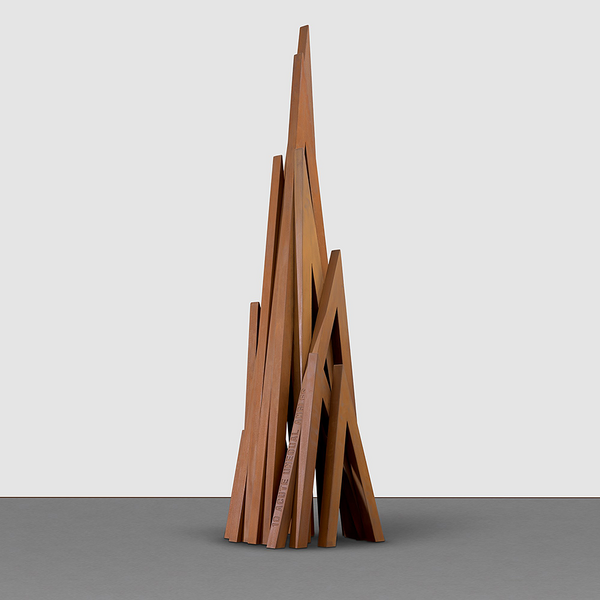
Bernar Venet, 10 Acute Unequal Angles, 2018. New Now: Modern & Contemporary Art London.
Christopher Phang-Lee, Cataloguer
Abstract in form yet concrete in presence, 10 Acute Unequal Angles is pure Venet. Spiky shards rise and fall with dynamic energy, with each angular point conveying force and directional movement. A monumental, towering outdoor sculpture, it exemplifies Bernar Venet’s career-long exploration and manipulation of steel into sharp angles or flowing arcs with a distinctive sensitivity to form, volume, material, and geometry. For me, the work is a powerfully physical yet conceptually calming ode to process and production. Inhabiting and complementing its environment, it is literally anchored to a physical reality without embellishment or ambiguity. Elegant and totemic, it is what it is.
Georg Wilson
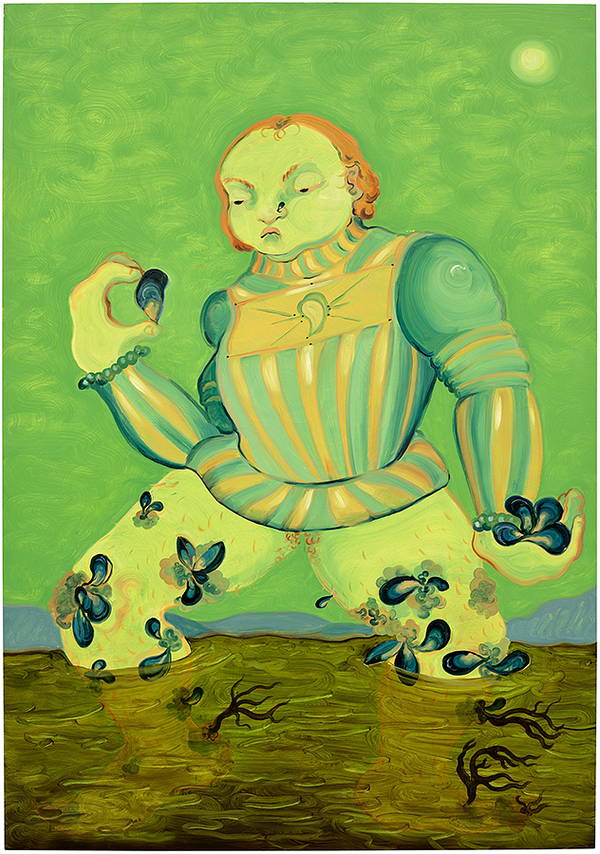
Georg Wilson, The Wader, 2022. New Now: Modern & Contemporary Art London.
Isobel Hallam, Cataloguer
Beautifully painted with a glowing fluorescence, Georg Wilson’s The Wader is my favorite work in the sale. The viewer is suspended in narrative tension; where did the creature come from, where are they wading to? Wilson’s imagined landscapes, inspired by English folklore and poetry, set the scene for her figures that are beyond gender and more animal-like than human. In the present work, the figure is in total harmony with the landscape, seemingly emerging from a body of water where they’ve been for so long that muscles have begun to grow! Wilson’s pastoral visions are void of human hierarchy or exploitation, presenting a vision of a world in harmony, allowed to flourish when left to its own devices — a refreshing idea in today’s world.
Otto Piene
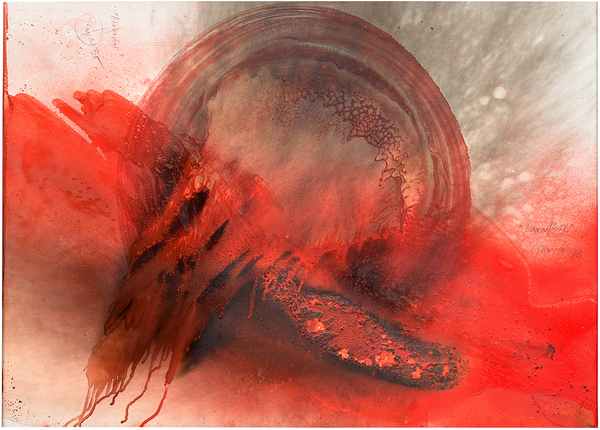
Otto Piene, Lavafluß, 1976. New Now: Modern & Contemporary Art London.
Logan Baker, Senior Editorial Manager, Watches
I was immediately drawn to Otto Piene’s Lavafluß for how alive it feels.
The charred surface, made of pigment, gouache, and soot, feels both violent and meditative. It almost seems to breathe, radiating a heat you can nearly feel.
I’ve always been fascinated by how artists capture motion and energy — there’s a reason I have Brancusi’s Bird in Space tattooed on my arm — and Lavafluß expresses that in such a physical, elemental way. I also appreciate that it comes from a period when Piene was experimenting with new ideas in the U.S., yet it still retains the rigor of postwar European abstraction. It’s raw, but also incredibly peaceful once you sit with it.