Article | Rolex Daytona Moonraker Dial 116520 Transitional
What is a ‘Moonraker’ Rolex Daytona?
The Daytona went in-house in 2000. But a handful of watches slipped through with dials from the previous era.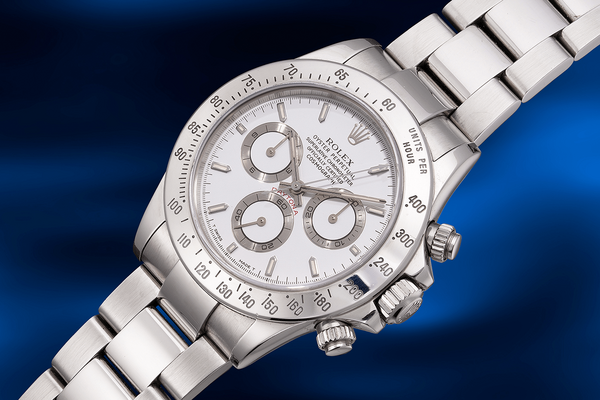
The PHILLIPS Hong Kong Watch Auction: XXI takes place on 21-23 November 2025, at our West Kowloon headquarters. The auction includes more than 300 of the world's finest watches – and though we are loath to boast, we truly think it's one of the best catalogues we've ever put together. We'll be highlighting a number of the most interesting lots and stories featured in the sale right here, including the unusual transitional Rolex Daytona seen below.
– By Logan Baker
When Rolex launched the Cosmograph Daytona ref. 116520 in 2000, it marked a turning point.
After more than a decade of relying on a modified Zenith El Primero movement, Rolex introduced its first fully in-house automatic chronograph calibre, the 4130. It was cleaner, simpler, and more efficient – typical Rolex engineering, but reimagined for the 21st century.
What many collectors didn’t know at the time is that a few early examples of this new generation would carry over details from the past.
These rare transitional pieces are now known as the “Moonraker” Daytona – a name that feels fitting, likely referencing the 1979 James Bond film. Like the movie’s improbable space mission, the “Moonraker” dials seem to belong to another world.
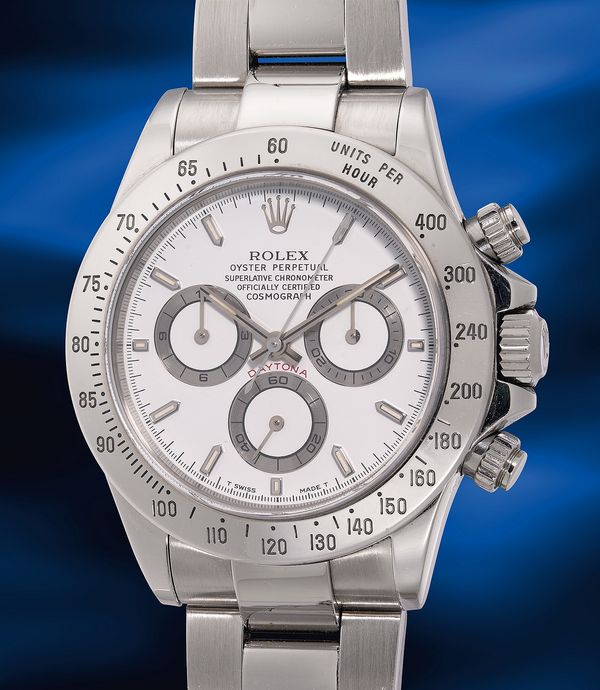
Lot 1002: A circa 2000 Rolex Cosmograph Daytona 'Moonraker' Ref. 116520 in stainless steel that's included in the Phillips Hong Kong Watch Auction: XXI. Estimate: HKD $220,000 - 440,000
At a glance, the "Moonraker" examples of the ref. 116520 look like the Daytona we all know and love: stainless steel, screw-down pushers, and the familiar three-register layout. But look closer, and the differences become apparent. The “Moonraker” features a white matte dial with a fine-grained texture, tritium hour markers, and a dial signature that aligns with the previous generation’s layout. The sub-dials sit unusually close to the text, with extra space between the "ROLEX" script and the coronet at 12 o'clock – an immediate tell for those who know what they’re looking for.
Why the odd placement? It all comes down to the new calibre 4130. Rolex redesigned the entire chronograph architecture, introducing a vertical clutch and rearranging the sub-dials: the running seconds moved from 9 o’clock to 6, while the hour counter swapped positions. The minute counter at 3 o’clock shifted slightly upward. These changes required an entirely new dial layout.
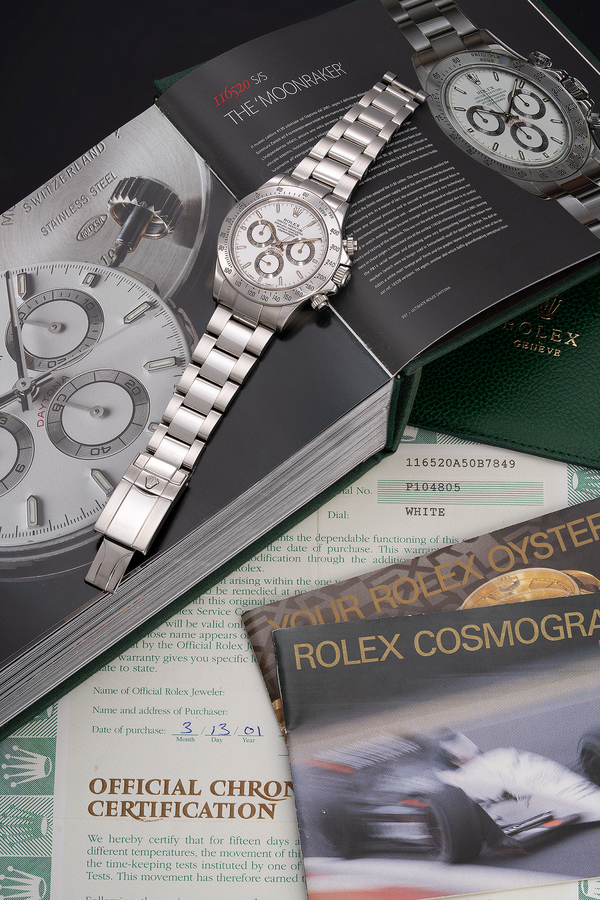
Lot 1002: A circa 2000 Rolex Cosmograph Daytona 'Moonraker' Ref. 116520 in stainless steel that's included in the Phillips Hong Kong Watch Auction: XXI. Estimate: HKD $220,000 - 440,000
But before the final production dials were ready, Rolex produced a small batch that combined the old text arrangement of the predecessor ref. 16520 with the new sub-dial spacing of the ref. 116520. The result was the “Moonraker,” a hybrid of old and new – the last breath of the Zenith-era and the first of the modern in-house age.
The typography on the sub-dials matches that of the 16520, but the rings are now metal with an azurage finish, as seen on the later 116520s. The tritium-lumed markers, indicated by the “T Swiss Made T” signature at 6 o’clock, confirm that these dials predate Rolex’s switch to LumiNova in 1998. In other words, they were developed at least two years before the calibre 4130 made its debut.
Collectors know these watches are extraordinarily scarce – only a handful have surfaced publicly, including the example illustrated in Pucci Papaleo’s Ultimate Rolex Daytona. Their significance lies in representing a transitional moment, when Rolex bridged two eras of chronograph production.
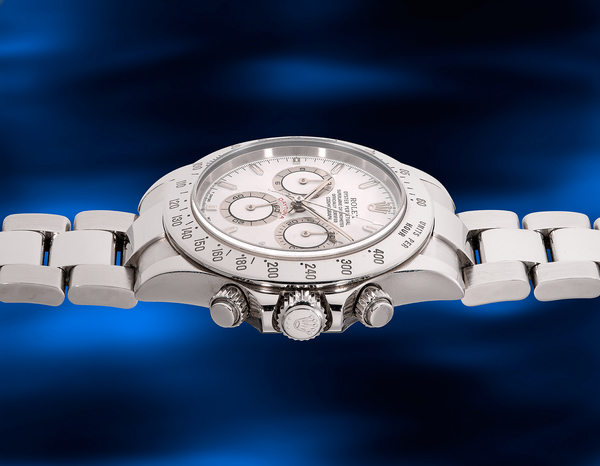
Lot 1002: A circa 2000 Rolex Cosmograph Daytona 'Moonraker' Ref. 116520 in stainless steel that's included in the Phillips Hong Kong Watch Auction: XXI. Estimate: HKD $220,000 - 440,000
The present example, a “P” serial watch from circa 2000, encapsulates this transition. It comes with its original warranty and instruction manual, and remains in excellent condition.
The “Moonraker” Daytona highlights the tiny inconsistencies that reveal a larger story, when one chapter of Rolex history closed, and another began.
You can view the complete Phillips Hong Kong Watch Auction: XXI auction catalogue here.