Article | J Player And Son Hyper Complication Pocket Watch 11901 Phillips Decade One British
Understanding the J. Player & Son 'Hyper Complication' Pocket Watch
A monumental pocket watch from 1907, this J. Player & Son masterpiece unites a tourbillon, carillon repeater, split-seconds chronograph, equation of time, alarm, and more in one of the most complicated English timepieces ever made.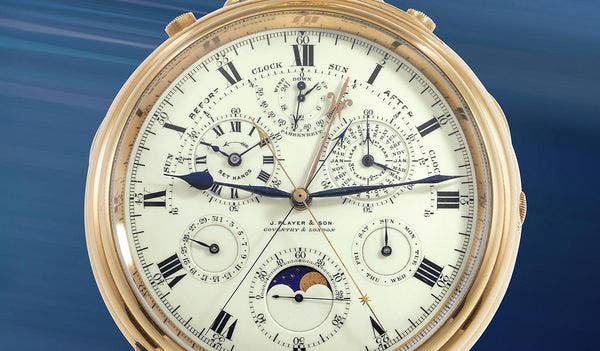
This November, Phillips in Association with Bacs & Russo will celebrate a decade of watch auctions with the Decade One (2015-2025) thematic sale at the Hôtel Président in Geneva. This landmark sale marks the successful first 10 years of the Phillips Watches department, reflecting on the remarkable watches, record-breaking results, and new scholarship that have shaped Phillips Watches since its inaugural auction in 2015.
– By Logan Baker
By any measure, the J. Player & Son pocket watch coming to auction at Phillips this season is an extraordinary object. Made in 1907 and measuring a monumental 77mm in diameter, this open-face yellow gold masterpiece combines almost every complication known to watchmaking at the turn of the 20th century. It is, without exaggeration, one of the most complex vintage pocket watches ever built – and a rare surviving example of English horology operating at its absolute peak.
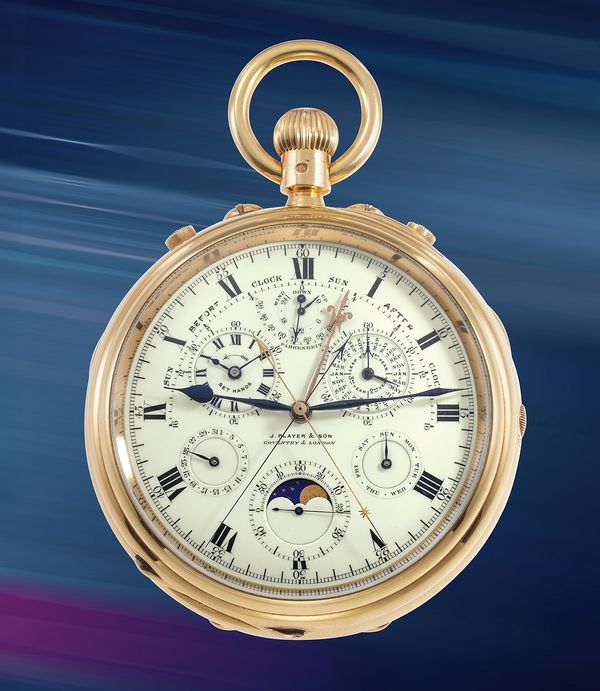
Lot 39: The 1907 J. Player & Son Hyper Complication in 18k Yellow Gold, included in the Phillips Decade One (2015-2025) catalogue. Estimate: CHF 400,000 - 800,000
J. Player & Son might not have had the name recognition of London’s great houses, but in their day they were revered among connoisseurs for pushing the limits of mechanical watchmaking. Founded by Joseph Player in Coventry in 1858, the firm earned a reputation for precision instruments that rivaled anything coming out of Switzerland. They built timepieces with astronomical indications, alarms, thermometers, and other rare complications, culminating around 1909 in a “Super Complication” pocket watch commissioned by banker J.P. Morgan – the most complicated English watch ever made at the time.
The watch offered here, produced in 1907, belongs firmly in that lineage. Its complexity and ambition stand as a statement of what English watchmaking was capable of when it set its sights on the very top.
Lot 39: The 1907 J. Player & Son Hyper Complication in 18k Yellow Gold, included in the Phillips Decade One (2015-2025) catalogue. Estimate: CHF 400,000 - 800,000
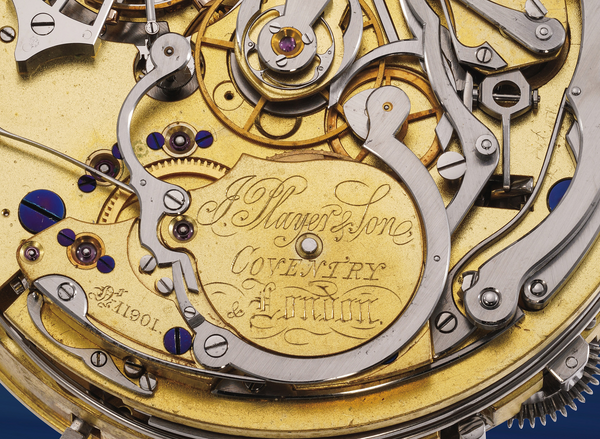
At the heart of this remarkable watch is a movement by Nicole, Nielsen & Co., London’s preeminent maker of complicated watch movements in the late 19th century. Founded in 1840 by Adolphe Nicole – the same Nicole behind the invention of the modern chronograph reset mechanism – the firm supplied ébauches to the most respected English makers, including Frodsham, and built a reputation for uncompromising precision. By 1888, it had evolved into Nicole, Nielsen & Co., and continued to produce some of the finest complicated movements in the world.
Into that movement, J. Player & Son packed an almost dizzying array of functions, many of which are rarely found together in a single watch. The full list reads like a collector’s fantasy:
- Grande and petite sonnerie striking on three gongs
- Carillon trip minute repeater
- Split-seconds chronograph with 60-minute register
- Perpetual calendar with leap-year indication
- Moon-phases and age of the moon
- Equation of time
- Alarm
- Bimetallic thermometer
- Power reserve indicator
- Tourbillon
Each of these features is a significant achievement on its own. Together, they create a timepiece that is not just complicated but conceptually ambitious – a complete expression of watchmaking as science and art.
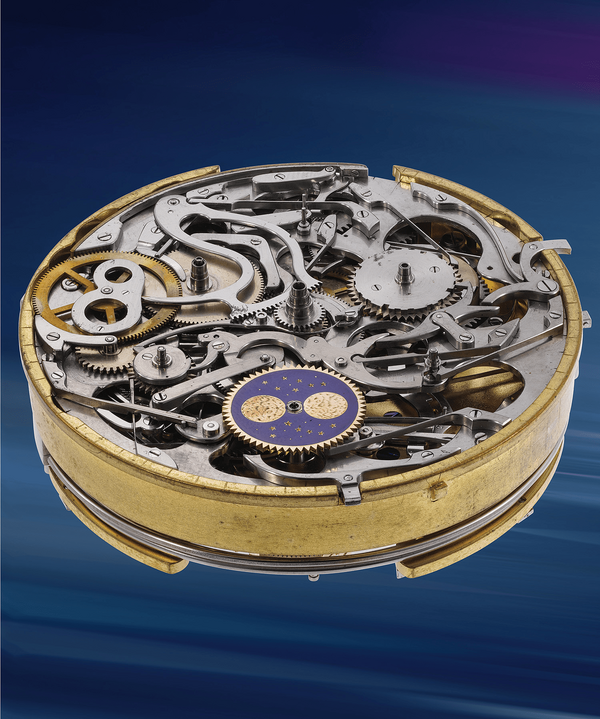
Lot 39: The 1907 J. Player & Son Hyper Complication in 18k Yellow Gold, included in the Phillips Decade One (2015-2025) catalogue. Estimate: CHF 400,000 - 800,000
Despite its extraordinary complexity, the dial – crafted by Frederick Willis – remains remarkably legible and beautifully composed. At 12 o’clock, a power reserve display is framed by a Fahrenheit thermometer. Near 10 o’clock sits the alarm sub-dial, which can be set to the minute, while the month and leap-year indications balance the composition near 2 o’clock. An elegant arc stretching from 9 to 3 o’clock shows the equation of time – the difference between solar and mean time – while the moon-phase appears at 6 o’clock, with the date at 8 o’clock.
The harmonious layout is a reminder that great watchmaking is not just about mechanical achievement but also about clarity and proportion. Even amid this wealth of information, the dial reads as ordered and thoughtful.
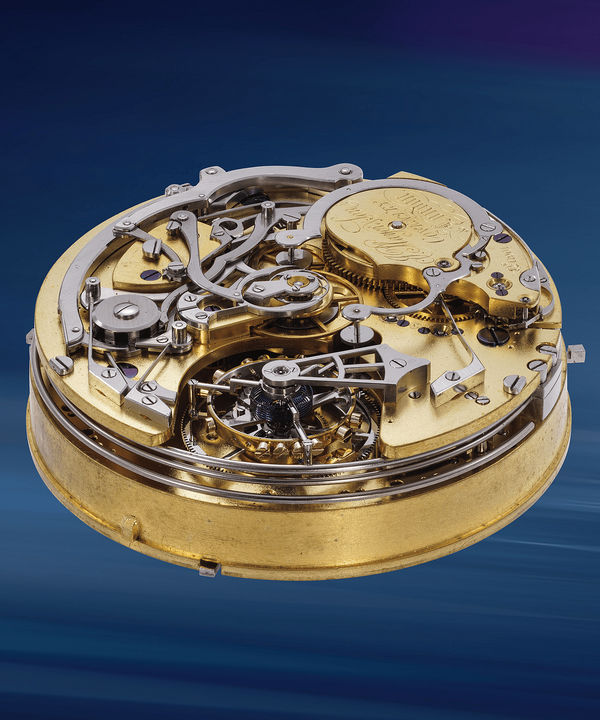
Lot 39: The 1907 J. Player & Son Hyper Complication in 18k Yellow Gold, included in the Phillips Decade One (2015-2025) catalogue. Estimate: CHF 400,000 - 800,000
The early 20th century marked a turning point for English horology. Swiss watchmakers were beginning to dominate global production, but in workshops like J. Player & Son and Nicole, Nielsen & Co., British craftsmanship continued to produce mechanical marvels that pushed the limits of what was possible. This watch is proof. Combining a carillon repeater and tourbillon – both hidden within the movement – with more visible complications like an equation of time and alarm, it captures the intellectual curiosity and technical creativity that defined the best English watchmaking of the era.
However, the appeal of this watch goes beyond its list of complications. It represents a moment when British horology, though often overshadowed by its Swiss counterparts, still stood at the forefront of innovation. It is a piece of mechanical history – one that demands to be appreciated not just as an object, but as a testament to the ambition and ingenuity of its makers.
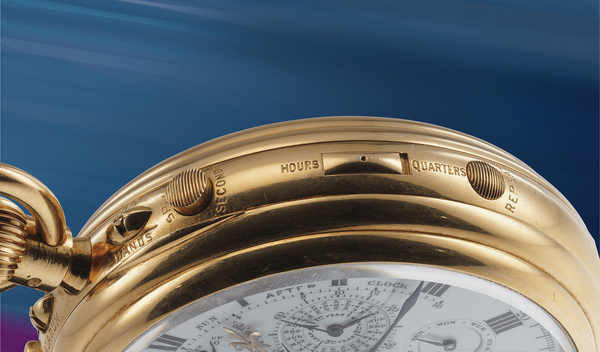
Lot 39: The 1907 J. Player & Son Hyper Complication in 18k Yellow Gold, included in the Phillips Decade One (2015-2025) catalogue. Estimate: CHF 400,000 - 800,000
The J. Player & Son hyper complication pocket watch, movement and case numbered 11’901, will be offered at Phillips with an estimate of CHF 400,000 to 800,000. More than a century after it was made, it remains one of the most technically accomplished and historically significant English watches ever created – a singular example of what happens when craftsmanship, science, and imagination converge.
You can view the complete Phillips Decade One (2015-2025) auction catalogue here.