Article | In Depth The Lederer Central Impulse Chronometer
In-Depth: The Ingenious Central Impulse Chronometer by Bernhard Lederer
Two gear trains, twin remontoires, and one radical escapement – here's why this watch earned the GPHG Innovation Prize and a place on serious collectors’ lists.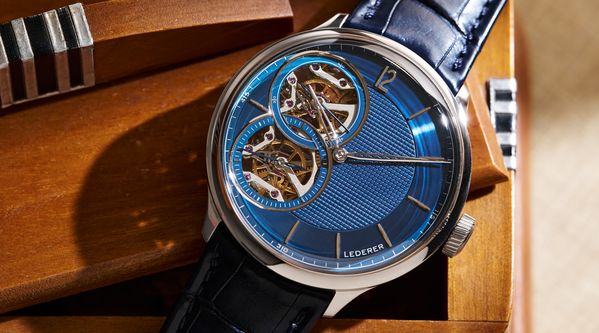
Phillips in Association with Bacs & Russo is thrilled to welcome you to The New York Sessions, Fall 2025, Online Auction, running from 12:00 PM ET, Thursday, 2 October, to 12:00 PM ET, Friday, 10 October. The sale features more than 70 high-end luxury wristwatches, covering a range of brands, including A. Lange & Söhne, Richard Mille, Audemars Piguet, and Patek Philippe, as well as the Lederer Central Impulse Chronometer, highlighted below.
– By Logan Baker
Bernhard Lederer is not a household name among watch collectors. That’s partly by choice.
For most of his career, the German-born watchmaker worked quietly behind the scenes, building complex mechanisms for other brands and collectors. Now in his mid-sixties, Lederer recently stepped into the spotlight with a watch that captures both his technical imagination and his devotion to solving old horological puzzles: the Central Impulse Chronometer.
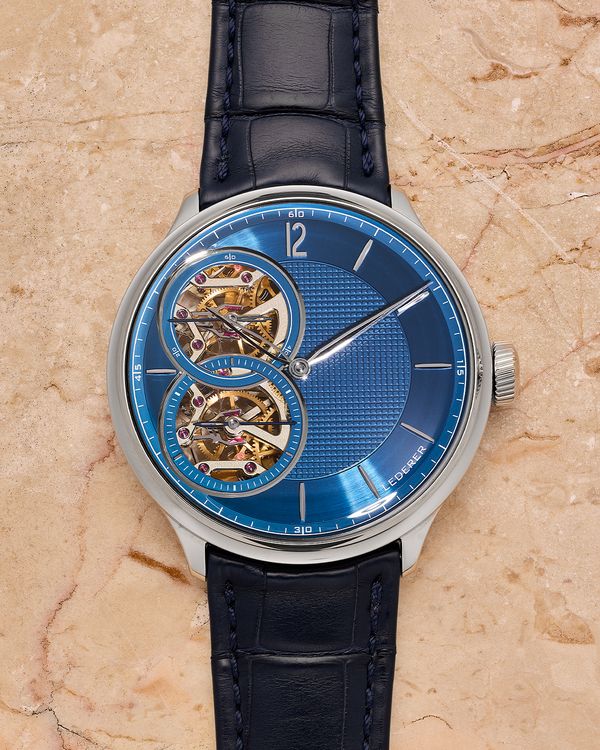
A Bernhard Lederer Central Impulse Chronometer in 18k white gold with blue dial that's available in the Phillips New York Sessions, Fall 2025, Online Auction. Estimate: USD $70,000 - 140,000
Introduced in 2020, the Central Impulse Chronometer (CIC) is a modern wristwatch built around one of the most elusive ideas in mechanical watchmaking – the independent double-wheel escapement first proposed by George Daniels, itself an answer to the failed promise of Abraham-Louis Breguet’s natural escapement. The watch went on to win the Innovation Prize at the 2021 Grand Prix d’Horlogerie de Genève (GPHG), and for good reason. It represents decades of accumulated knowledge distilled into one of the most technically ambitious timepieces of the 21st century.
The Phillips New York Sessions, Fall 2025, Online Auction includes a particularly attractive example: a white-gold CIC with a striking blue dial, one of just 25 produced. It comes with its full set of boxes and papers, including a chronometer certificate, and carries an estimate of USD $70,000–140,000.
The story starts in the early 1800s, when Abraham-Louis Breguet developed the natural escapement. His goal was simple but daring: deliver energy to the balance wheel directly, with no oil and no sliding friction. He achieved this by placing two escape wheels on a single gear train, each transmitting impulses to the balance in alternating fashion. In theory, it was elegant. In practice, it didn't work.

Bernhard Lederer, after winning the Innovation Prize for the Central Impulse Chronometer at the 2021 GPHG. Image credit, GPHG.
The problem was inertia. Doubling the escape wheels meant quadrupling the energy required to keep them moving at the right pace. Worse still, the tiny tolerances between meshing teeth introduced backlash and instability. Even Breguet himself seemed to recognize its flaws, tinkering with prototypes but never finding a truly reliable solution.
The natural escapement remained a fascinating failure – an idea ahead of its time, waiting for better materials and sharper minds.
Fast forward to the 1970s. George Daniels, the great British independent watchmaker, revisited Breguet’s concept. Instead of forcing a single gear train to drive two wheels, Daniels built two completely separate trains, each powered by its own mainspring barrel and ending in its own escape wheel. A delicate detent mechanism ensured that only one wheel delivered an impulse at a time.
This Independent Double Wheel Escapement solved Breguet’s energy problem and brought the natural escapement closer to viability. Daniels himself used it in his famous Space Traveller pocket watches, but he believed the system couldn’t be scaled down to wristwatch size. For decades, no one proved him wrong.
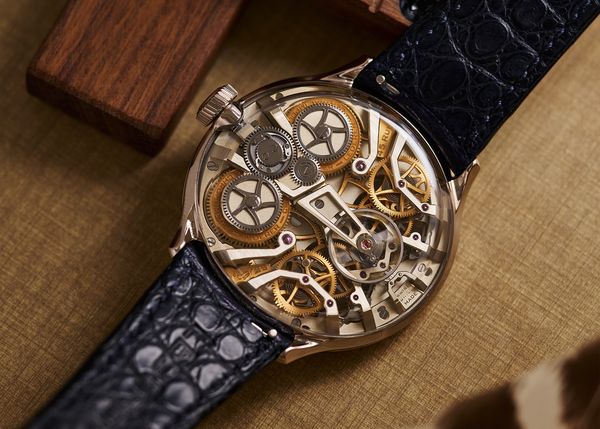
A Bernhard Lederer Central Impulse Chronometer in 18k white gold with blue dial that's available in the Phillips New York Sessions, Fall 2025, Online Auction. Estimate: USD $70,000 - 140,000
Bernhard Lederer took up that challenge. After years of development – and drawing on personal conversations he’d had with Daniels before the latter’s death in 2011 – he unveiled the Central Impulse Chronometer.
At its heart is a refined version of Daniels’ architecture: two independent gear trains, two escape wheels, and a central pallet/detent that controls the impulses to the balance. But Lederer added critical innovations that make the CIC unique.
Each gear train incorporates a remontoire d’égalité, a constant-force mechanism that evens out the flow of energy. Positioned between the fourth and fifth wheels, each remontoire spring recharges every ten seconds. Because they alternate, the balance receives a perfectly regulated burst of energy every five seconds.
This dual-remontoire setup ensures that the balance always sees consistent torque, regardless of the state of the mainsprings. The inspiration traces back to John Harrison’s H4 marine chronometer of 1759, which also used a remontoire to stabilize power delivery.
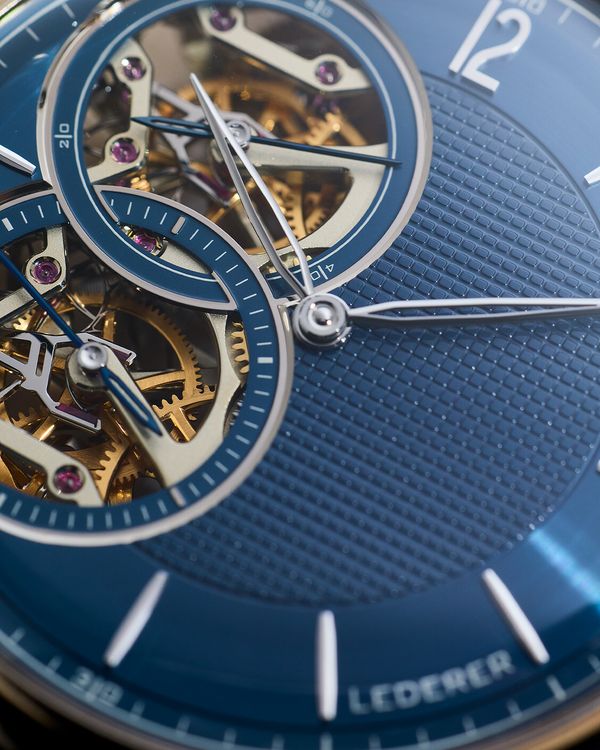
A Bernhard Lederer Central Impulse Chronometer in 18k white gold with blue dial that's available in the Phillips New York Sessions, Fall 2025, Online Auction. Estimate: USD $70,000 - 140,000
Lederer rebuilt the escapement geometry with an obsession for minimizing inertia. The escape wheels and detent are made of hardened titanium, incredibly light yet durable. He also adjusted the geometry so the balance and escape wheels interact at a smoother 120-degree angle, rather than the 100 degrees used by Daniels.
The balance itself is a variable-inertia design with four regulating weights and four balancing weights, tuned for stability. Every component of the caliber 9012 is designed to waste as little energy as possible.
One of the biggest challenges with the double-wheel escapement is what happens at low amplitude, when the mainsprings wind down. In Daniels’ design, the escapement could slip or miss teeth, causing a loss of precision.
Lederer solved this with a component he calls the “waiting pallet.” It acts as a buffer, ensuring the impulse teeth of the escape wheel always line up correctly, even when the amplitude drops. In effect, the escapement transitions from a pure direct-impulse system at higher amplitudes to a hybrid with an indirect impulse at lower amplitudes.
This dual behavior gives the CIC a safety net, maintaining accuracy across its entire power reserve.
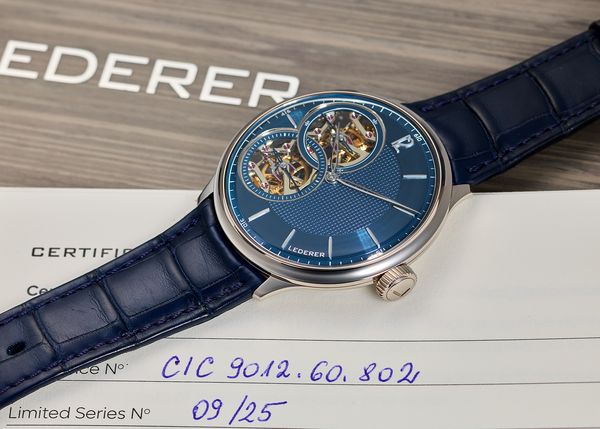
A Bernhard Lederer Central Impulse Chronometer in 18k white gold with blue dial that's available in the Phillips New York Sessions, Fall 2025, Online Auction. Estimate: USD $70,000 - 140,000
Even the way the CIC winds down is engineered for precision. If one gear train were to run out of energy before the other, the twin seconds hands (more on them shortly) would fall out of sync. To prevent this, Lederer designed the movement so that the remontoire driving the hour and minute hands always exhausts first, stopping the watch entirely before any desynchronization occurs.
Flip the watch over, and the architecture is breathtaking, but Lederer wanted the dial to show the mechanics, too. The CIC features two dial cutouts in a figure-eight pattern, revealing the escapement and remontoire action.
Two seconds sub-dials dominate the layout. Each is connected to one of the independent gear trains, which means each has its own seconds hand. They rotate in opposite directions – one clockwise, the other counterclockwise – creating a hypnotic mirror-image dance. They remain perfectly aligned, even though they’re powered by different trains.
The Central Impulse Chronometer checks off basically every criterion watchmakers set for the “ideal escapement.” It self-starts. It requires no lubrication. It delivers impulses close to the balance’s equilibrium point. It includes a robust safety system against shocks. And it interferes as little as possible with the balance’s natural oscillation.
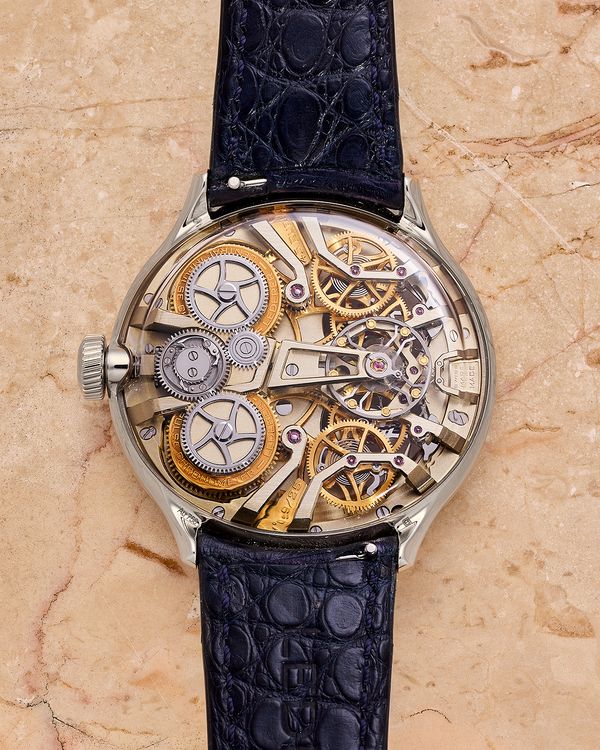
A Bernhard Lederer Central Impulse Chronometer in 18k white gold with blue dial that's available in the Phillips New York Sessions, Fall 2025, Online Auction. Estimate: USD $70,000 - 140,000
It also proves Daniels wrong – in the best possible way. His Independent Double Wheel Escapement can, in fact, work in a wristwatch. It just needed Lederer’s ingenuity, patience, and willingness to rethink centuries-old problems.
The white-gold, blue-dial CIC offered in the Phillips New York Sessions, Fall 2025, Online Auction is one of only 25 made in this configuration. The vibrant dial color plays beautifully against the technical seriousness of the design, adding a flash of modernity to a watch otherwise steeped in historical reference.
It comes complete with its original outer and presentation boxes, certificate of warranty, and official chronometer certificate. It carries an estimate of USD $70,000–140,000.
You can view the complete Phillips New York Sessions, Fall 2025, Online Auction catalogue here.