Article | Unexpected Pairings Photographs New York
Unexpected Pairings: Photographs New York
The surprising relationships between works in our upcoming auction.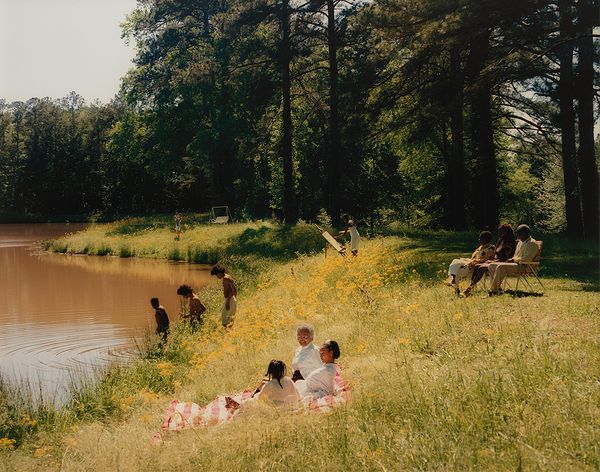
Tyler Mitchell, Riverside Scene from Dreaming in Real Time, 2021. Photographs New York.
Cindy Sherman and Countess Castiglione: Fashioning a self
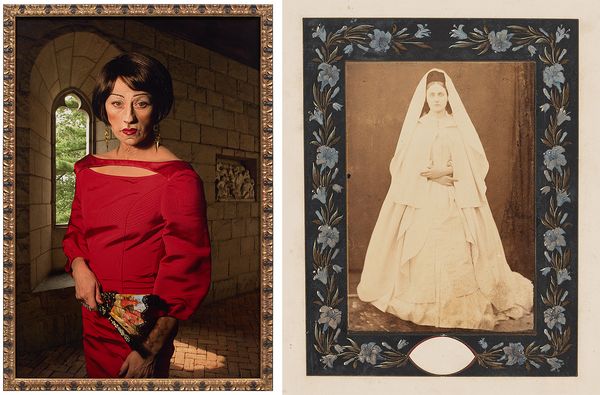
Left: Cindy Sherman, Untitled #470, 2008. Right: Pierre-Louis Pierson, One of a Pair of Images of the Countess de Castiglione, 2008. Photographs New York.
Two incredible women working about 150 years apart show us the different directions self-portraiture can take. For the Countess de Castiglione, a wealthy socialite who devoted her life to self-invention, this was serious business. Fueled by an innate desire to be photographed, she worked with a few Parisian photographers to create hundreds of carefully conceptualized images. In these tableaus, she is frequently costumed and cast as an archetype from literature, opera, or other sources, and seems to take her role very seriously. She was, perhaps, the very first high-society influencer.
Seen from the distance of more than a century, it's amazing that a woman working in the late 19th century had such a sophisticated sense of how photography could be used to invent a self — to tell a story in which she is the principal protagonist. This level of empowerment in women’s photography isn’t often found until later in the 20th century, as seen in the work of Cindy Sherman, and particularly in her Society Portraits series.
Sherman, though driven by a very different creative fire, also created a body of work almost entirely through self-portraiture. Though the inspiration and ultimate impact are very different, in a lot of ways, she’s doing the same thing: conceptualizing each photograph and then meticulously building the image using costumes, makeup, settings, masks, or photo-editing in post-production.
Sally Mann and Julia Margaret Cameron: Toward an idealized realm
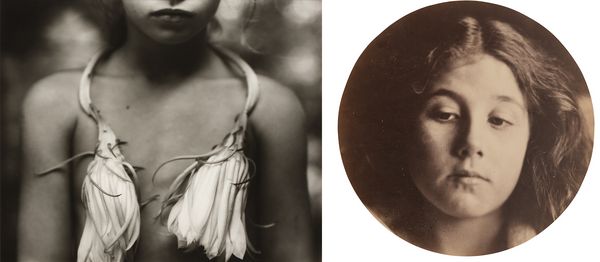
Left: Sally Mann, Night Blooming Cereus, 1988. Right: Julia Margaret Cameron, Kate Keown, 1866. Photographs New York.
These two works showcase the beauty and complexity of childhood across two centuries. Sally Mann, who recently published the book Art Work, looking back at her career, is well-known for her beautiful, keenly observed images of her children that capture the magic and weirdness of youth. As the children are often unclothed, the images seem to exist in a timeless, idealized domain, akin to Pre-Raphaelite art. Her vision presents a kind of exalted, though not entirely uncomplicated, take on childhood, and her three children were active participants in the work.
In the previous century, Julia Margaret Cameron also explored this approach, photographing people in her immediate surroundings, particularly children. Her photographs are sometimes allegorical, sometimes simple portraits, and she was inspired by the Pre-Raphaelite artists, though her works came from her own original viewpoint. Much like Mann, Cameron often photographed her own daughters and her neighbors’ children. Both artists show how they can leverage the fact that photography is inherently tied to reality, performing an alchemy that transforms flesh and blood into something more universal.
The Cameron comes from the collection of pioneering dealer and collector William L. Schaeffer, one of the very first photography dealers who helped establish the market for fine art photography in the 1970s. Focusing on 19th-century photography, he has a reputation as one of the most discerning eyes in the field. In 2020, The Metropolitan Museum of Art acquired 700 photographs from Schaeffer’s collection and celebrated the transformative gift this year with the exhibition, The New Art: American Photography, 1839–1910.
John Moran and Tyler Mitchell: Wilderness as a site of self-discovery
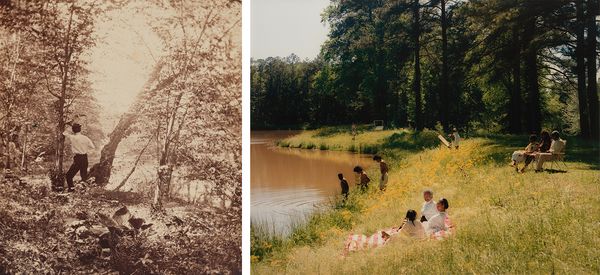
Left: John Moran, Frankford Creek, near Philadelphia, 1860s. Right: Tyler Mitchell, Riverside Scene from Dreaming in Real Time, 2021. Photographs New York.
In the above left work from Tyler Mitchell’s Dreaming in Real Time series, the artist explores the idea of a beautiful landscape peopled entirely by Black figures. Racial themes are a key aspect of Mitchell's work, which is certainly not the case with John Moran, a photographer and painter from Philadelphia. What ties these two works together is the idea of wilderness as a non-judgmental place where one can have an encounter with the self. In each, we find figures existing in open nature — in creation — without the social constructs that might otherwise constrain them.
John Moran, the only photographer among his more famous siblings, Thomas and Edward, who were celebrated painters, pushed photography beyond its primary 19th-century uses, such as documentation for government or industrial surveys. His works were focused on pure art and expression, reminiscent of Hudson River School painting, building upon the traditions of landscape painting in a very photographic way. He composed his images very deliberately but avoided making them look like paintings, embracing the descriptive power of the new medium.
In much 19th-century landscape photography, the focus was mostly on the land, with a figure often used only for scale. In Moran's work, however, though the figure is small in stature, he is equal to the land, humanizing the landscape in a way that hadn't been done before. Similarly in Mitchell's work, we feel as though these figures are an extension of the nature that holds them, not merely an ornament.
Robert Frank and Dorothea Lange: Motherhood and American crises
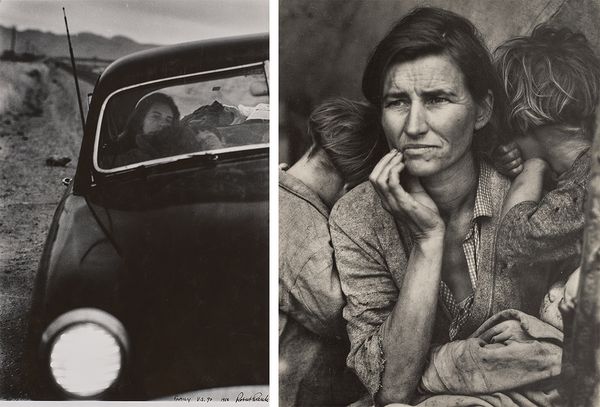
Left: Robert Frank, Family U.S. 90 (En Route to Del Rio, Texas), 1955. Right: Dorothea Lange, Migrant Mother, Nipomo, California, 1936. Photographs New York.
These two images are some of the most iconic representations of American motherhood as depicted in photography. Robert Frank’s image shows his wife and two children resting on the side of the road in rural Texas. The photo was taken while Frank was creating his celebrated body of work, The Americans (1959), during a series of cross-country trips. Funded by a modest Guggenheim grant, he was living out of his car and traveling from town to town according to a sort of personal script. This image comes from one of the rare moments his wife and children joined him on the road, a leg of the trip that proved difficult with young children.
The book is celebrated for showing the problematic and frenetic pace of American life, the tensions of a people always on the move. While many of the images are ambiguous or distant, this is one of the rare personal references in the series, offering a clearer glimpse into his own life.
Dorothea Lange, on the other hand, shows a mother in a very different sort of crisis. Her three children literally cling to her — she's all they have. Photographed in California, this migrant worker is in a desperate position: the promise of work has been taken away by a ruined harvest due to frost, and she now faces a very uncertain future with three children depending on her.
Josef Koudelka and Diane Arbus: It’s personal
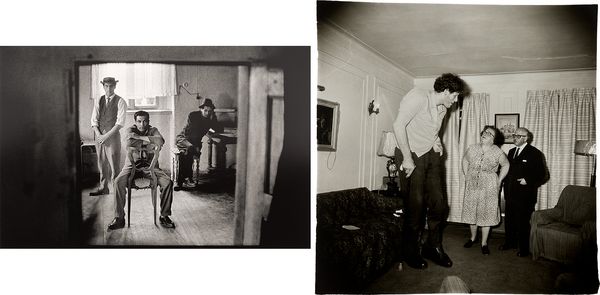
Left: Josef Koudelka, Gypsies (60 prints), 1962–1968. Right: Diane Arbus, A Jewish giant at home with his parents in the Bronx, N.Y., 1970. Photographs New York.
Both of these photographers had their first major books published by Aperture, and both works are highly significant — not just for their artistic importance, but for their impact on the entire field of photography. Gypsies and Diane Arbus are frequent entries on experts’ lists of top photography books. What's more, both artists adopted an immersive style of photographing in which they became close with their subjects, forming relationships and gaining their trust to create these remarkable images.
Diane Arbus’ first book was published posthumously, alongside her retrospective at MoMA. On the other hand, Koudelka’s book, Gypsies, showcased the incredible vision he possessed as a young photographer and hinted at his future trajectory. In contrast, Arbus’ book demonstrated how incredible she already was, leaving us to wonder how far she would have gone.
Arbus’ work here showcases Eddie Carmel, known as “The Jewish Giant,” whom she had photographed as early as the 1960s after encountering him near Times Square in a performance that billed him as “The World’s Largest Cowboy.” She got to know him very well, and this image represents the photographic culmination of their relationship. In both cases, these photographers insisted on taking the time to truly know their subjects in order to best capture their personality and presence.
Hiroshi Sugimoto and Anonymous: The enduring draw of the sea
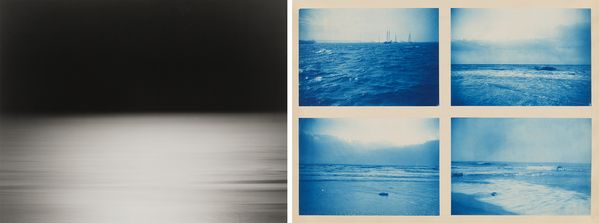
Left: Hiroshi Sugimoto, Bay of Sagami, Atami, 1997. Right: Anonymous, Selected Cyanotype Seascapes, late 1800s. Photographs New York.
It’s incredible to imagine an amateur photographer in the 19th century going down to the ocean and taking this series of photographs. Shooting with glass plate negatives and making contact prints with Cyanotype paper, the photographer achieved the wonderful blue tonality that perfectly complements the subject matter. These rare and incredible images, which also come from the William L. Schaeffer collection, encapsulate our enduring fascination with the water, the sky, and the feeling of being at the seashore. They represent just the sort of marvels Schaeffer would find.
In contrast, this Hiroshi Sugimoto work comes from his large body of seascapes, in which he photographs bodies of water in different ways, always placing the horizon line right in the middle. They are sometimes taken in daylight, sometimes at night; some are crisp, while others, like this one, are more enigmatic, offering little detail to latch onto.
The shared goal of these photographers is to capture the almost mystical significance of where the sky meets the water and the eternal nature of that relationship. Sugimoto is a highly technical photographer who approaches his work deliberately, whereas the anonymous images are more intuitive, casual, and less conceptualized — yet both share the same eloquent vocabulary. You don't have to know anything about photography to be captivated by these alluring works.
Find your own pairings
A visit to our Park Avenue gallery — where works from the auction are on view through October 8th — reveals further fascinating pairings. Striking relationships exist across the selection, from shared or divergent approaches to landscape, portraiture, the conceptual nature of photography, and art historical themes.
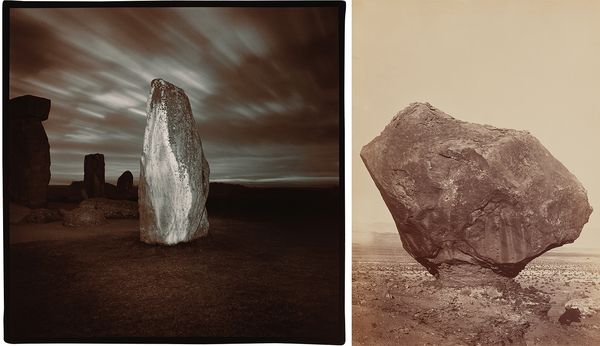
Left: Richard Misrach, Stonehenge #4, 1975. Right: William Bell, Perched Rock, Rocker Creek, Arizona, No. 55, 1872. Photographs New York.
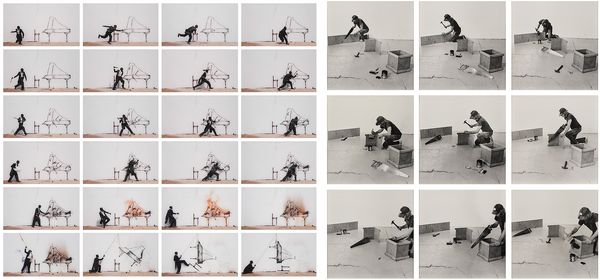
Left: Robin Rhode, Piano Chair, 2011. Right: William Wegman, Building a Box, 1972. Photographs New York.
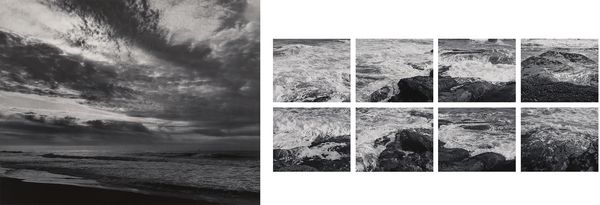
Left: Ansel Adams, Beach, Evening, Northern California Coast, 1964. Right: James Welling, Seascapes A-H, 1991–1993. Photographs New York.
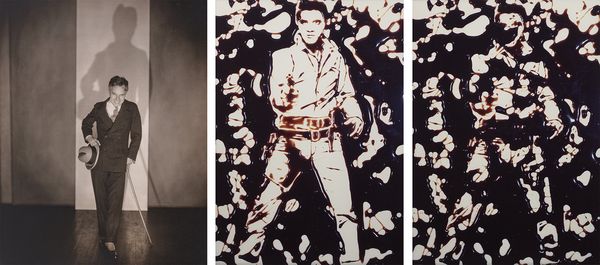
Left: Edward Steichen, Charlie Chaplin, 1925. Right: Vik Muniz, Double Elvis from Pictures of Chocolate, 1999. Photographs New York.
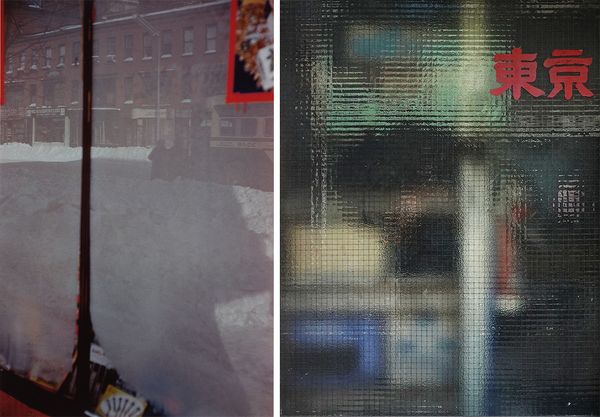
Left: Saul Leiter, Snowy Scene; 1/2 of Red Umbrella, 1957–1958. Right: Yoshiyuki Okuyama, windows #1, 2022. Photographs New York.