Article | Mai Trung Thus Compelling Imagery Of Family Leisure And Identity
Mai Trung Thứ’s Compelling Imagery of Family, Leisure and Identity
Four works from a private French collection illuminate key themes for one of the most significant Vietnamese artists.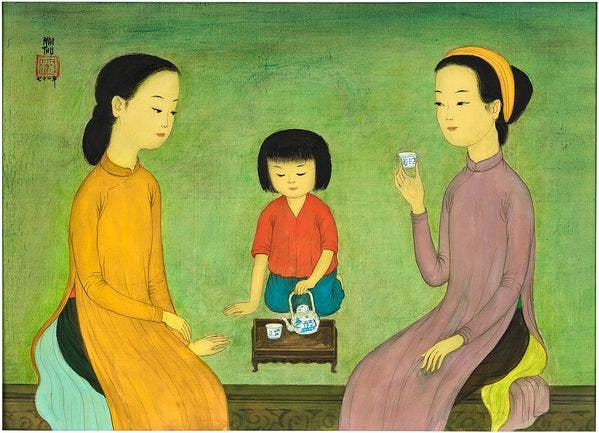
Mai Trung Thứ, Girl Serving Tea, 1971. Modern & Contemporary Art Day Sale Hong Kong.
Born in 1906 in Hai Phong, Vietnamese-French artist Mai Trung Thứ, also known as Mai Thu, was one of the most prominent figures in the history of Vietnamese modern art in the twentieth century. He belongs to the first generation of Vietnamese painters to receive formal training in Western art, attending the École des Beaux-Arts de l’Indochine between 1925 and 1930—alongside Lê Phô, Vu Cao Dam and Le Thi Luu. Under the tutelage of French painters Victor Tardieu and Joseph Inguimberty, Mai Thu explored not only Western methods of art but also expressions of Vietnamese tradition and identity.
Starting with oil on canvas, he transitioned to silk painting, combining traditional Vietnamese materials with foreign techniques. He developed a unique aesthetic built heavily upon Vietnamese subject matter — everyday moments of rural life, graceful women, and innocent children. In 1937, he participated in the International Exhibition of Decorative Arts in Paris, which prompted his lifelong exploration in this foreign land. This became a watershed moment in Mai Thu’s professional life, propelling him onto the global stage, where he perfected his craft and garnered interest among French collectors, becoming one of the first Vietnamese artists to achieve international success.
The works on offer come from a Parisian private collection, showcasing four exemplary works from a later period of Mai Thu’s oeuvre, dated between 1968 and 1971. Prior to the creation of the works, Mai Thu’s collaboration with the French gallerist Jean François Apesteguy catalysed his continual rise through the 1950s. With his 1963 exhibition at Galerie du Péristyle that followed, Mai Thu reached another pinnacle of his career in the French art world. Painted after the exhibition, the current four works illustrate Mai Thu’s distinctive visual language, which by then had achieved maturity and refinement.
Tea and ritual
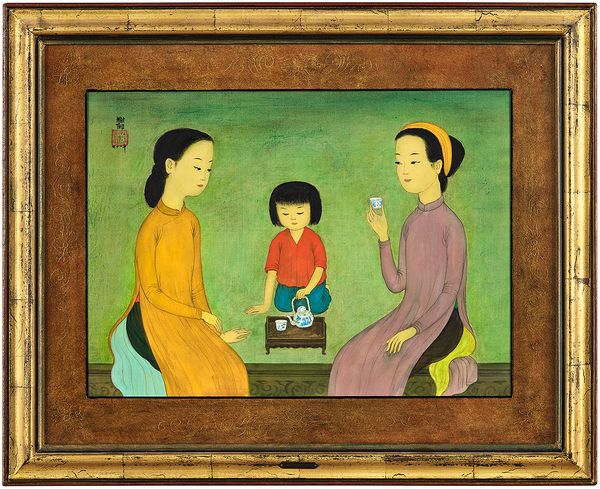
Mai Trung Thứ, Girl Serving Tea, 1971. Modern & Contemporary Art Day Sale Hong Kong.
Focusing on a leisure moment of tea serving, Girl Serving Tea is exemplary of one of the most recurring themes in Mai Thu’s oeuvre, looking back to the cultural world of his homeland, Vietnam. An endearing young girl pours tea for two adult women, likely her blood relatives, in an intimate tableau. The two adult women, donned in áo dài, Vietnam’s traditional long tunic, reflect a sense of nostalgia and emphasize elegance and dignity. In Vietnamese tradition, this act serves as a gesture of respect and gentility.
Mai Thu’s treatment here deftly exerts the quality of the silk medium, which he would carefully stretch, size and layer with washes of water-based pigment to create a surface of luminous delicacy, where colour seems to hover above the weave, and forms emerge in a haze of softness. The effect is a convergence of clarity and ambiguity: figures are crisply outlined, but the world they inhabit is tenderly dematerialised, suffused with nostalgia and lyricism.
Belonging and cultural synthesis
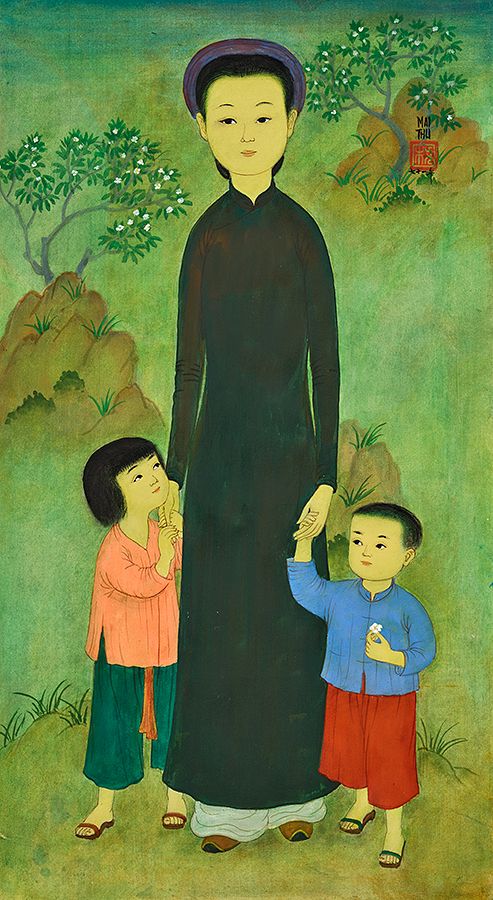
Mai Trung Thứ, Walk in the Garden, 1971. Modern & Contemporary Art Day Sale Hong Kong.
Walk in the Garden intriguingly exemplifies a more inclusive facet in Mai Thu’s art as a palimpsest of his transcultural experience. In the painting, a mother postures solemnly in the middle, while her hands gracefully hold the two children. Her black áo dài contrasts with the children’s brighter garments, yet retains an air of elegance through the rendering of gouache on silk. The children, depicted with innocence and sincerity, maintain physical closeness to the mother. Another portrayal of Eastern family life at first glance, the work also recalls the canonical Western iconography of the Virgin, Chirst, and St. John the Baptist, reminiscent of Rapahel’s masterpiece. Mai Thu’s work offers a poetic reimagination of these influences, retouched with a sensibility of his own heritage.
Visions of solitude
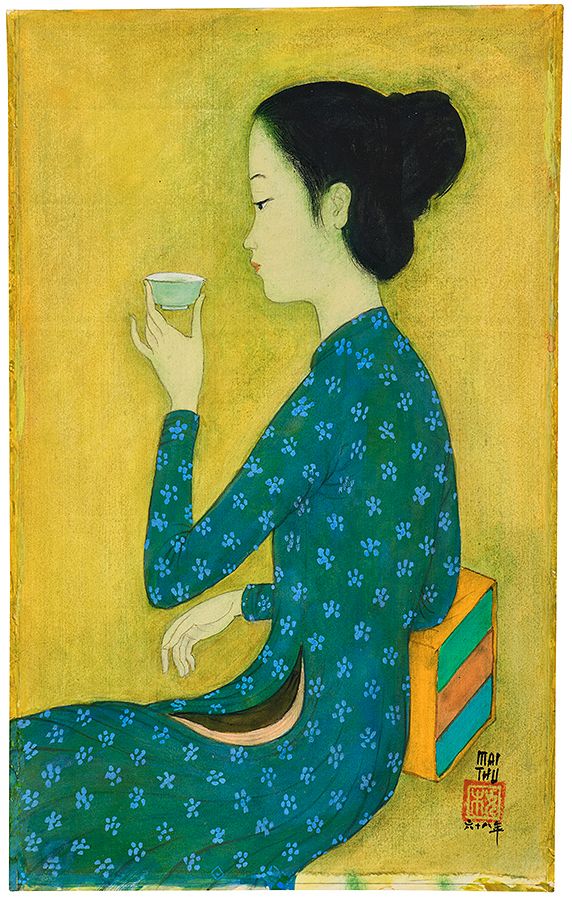
Mai Trung Thứ, Tea Cup, 1968. Modern & Contemporary Art Day Sale Hong Kong.
Two female portraits from 1968, Tea Cup and Sadness, epitomise Mai Thu’s mastery in capturing nuanced, private moments. In Tea Cup, a slender woman gently leans on a stool, her attention drawn toward the teacup. Her hands, curved with restrained precision, quietly hold it as she seems to contemplate its simplicity. The feminine figure, together with the warm palette, conveys serenity and calmness at this moment.
Sadness, on the other hand, evokes a more introspective atmosphere. In this piece, a solitary woman gazes out, her expression a blend of longing and contemplation. The muted colors and soft lines create an ethereal quality, allowing viewers to feel the weight of her emotions. Mai Thu’s play of light and shadow across her features adds psychological depth to her isolation.
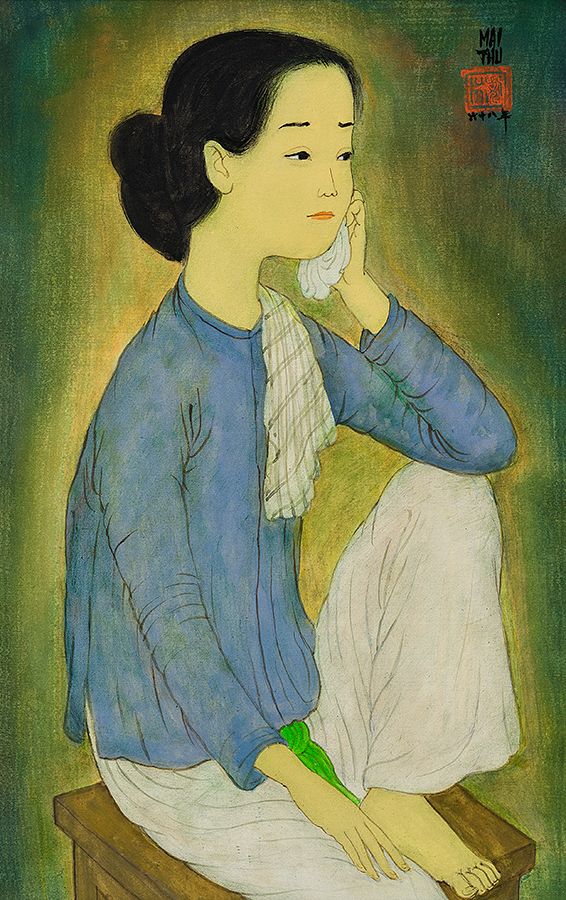
Mai Trung Thứ, Sadness, 1968. Modern & Contemporary Art Day Sale Hong Kong.
Mai Trung Thứ’s legacy today
Mai Thu’s work has been widely collected by public and private collections around the world. In March of this year, Musée Cernuschi concluded the first major retrospective in France of modern pioneers in Vietnamese art, featuring Mai-Thu as a central subject along with Lê Phô and Vu Cao Dam. Another masterpiece of Mai Thu, Mona Lisa—coming from around the same period as this collection — is currently on view as part of the special exhibition From Roots That Keep Reaching, at Quang San Art Museum, celebrating the centennial of École des Beaux-Arts de l’Indochine, running through January 2026.