Article | Why This Zao Wou Ki Is Unforgettable
Why this Zao Wou-Ki is Unforgettable
East meets West in a powerful work of lyrical abstraction by the great Chinese-French artist.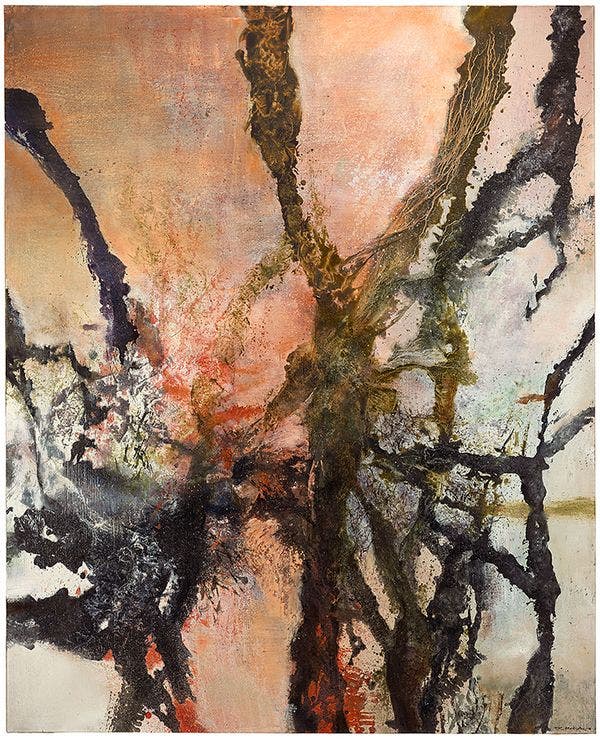
Zao Wou-Ki, 27.01.86, 1986. Modern & Contemporary Art Evening Sale, Hong Kong.
It was inspired by the Chinese painter Zhang Daqian and a trip to Taipei
Zao Wou-Ki was profoundly inspired by a 1981 visit to Taipei, where he met Chinese painter Zhang Daqian. The elder artist gifted Zao with several traditional Chinese hanging scroll landscapes. The encounter led Zao to create a series of vertical-format abstract paintings in the 1980s, which channeled a similar fluid energy and often depicted powerful natural scenes like waterfalls. These works beautifully fuse the spontaneity of Zhang’s splash-ink works with Zao’s modern abstraction, exemplified by compositions that honor Chinese artistic roots.
It is one of the largest and most complex works from the Life of Tree series
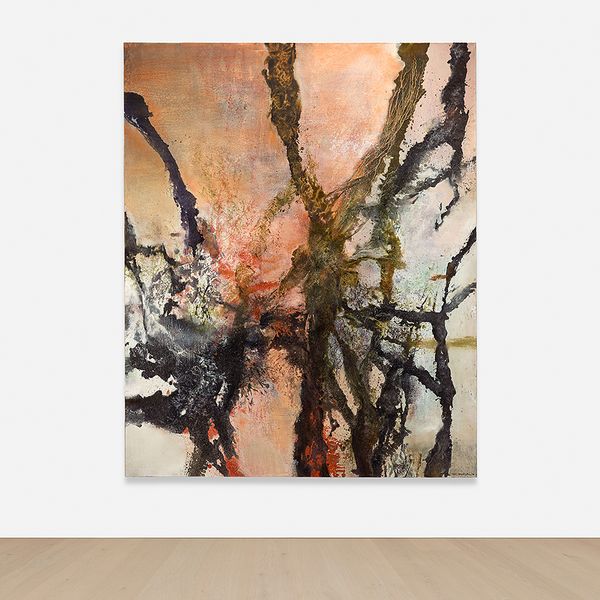
Zao Wou-Ki, 27.01.86, 1986. Modern & Contemporary Art Evening Sale, Hong Kong.
Standing more than two metres tall, 27.01.96 is one of the largest and most complex single-panel works from the Life of Tree series, which the artist explored from 1985 to 1990. In this work, Zao uses varied ink qualities — thick, thin, dry, and wet — to create an expansive multidimensional composition, featuring interwoven green ochre, ink grey, and burnished red lines that form a powerful central force. It’s like a tree of life reaching into infinite space.
The painting’s unparalleled international exposure
27.01.86 is exceptionally rare in Zao Wou-Ki’s body of work for its unparalleled international exposure. Exhibited throughout Europe and Asia and cited in major publications across Europe, America, and Asia, it achieves a scope that few of his pieces have. This extensive reach underscores the painting’s power to transcend cultural and geographic boundaries, marking a defining moment in Zao’s rise to global recognition. It resonates universally, bridging cultures and firmly establishing his place on the world stage.
It was adapted by Zao Wou-Ki for his 1988 Seoul Summer Olympics poster
Zao’s Seoul 1988 Summer Olympic poster “Life of Trees” was adapted from 27.01.86, created just two years earlier. In the 1980s, life came full circle for the artist as his international recognition blossomed. This time is now considered the pinnacle of Zao’s artistic career.
The painting captures a sense of spiritual balance
This work boldly contrasts dynamic black ink brushstrokes at its center with a warm, soft background reminiscent of a sunset. The black ink, rooted in Eastern art, conveys strength and motion, symbolizing yang — the active, masculine force — while the glowing background reflects yin, the receptive, feminine energy. Their interplay creates a powerful balance, embodying the Taoist principle of taichi (太極). This lyrical abstraction fuses deep philosophy with visual poetry, harmonizing opposing forces in a seamless dance.