Article | Revealed Important Works By Christo Jeanne Claude London Auction
In the Year of Our Christo
Our London Modern & Contemporary Art Day Sale offers further works from ‘Revealed: Important Works by Christo & Jeanne-Claude’ in a banner anniversary year for the artist couple.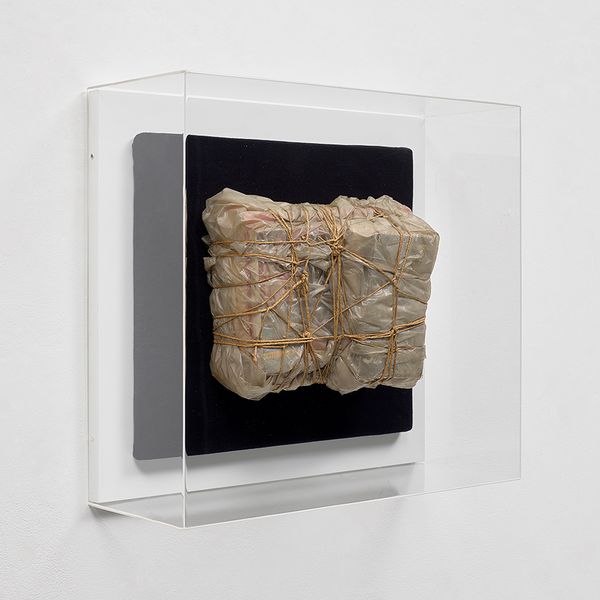
Christo, Wrapped Books and Magazines, 1962. Modern & Contemporary Art Day Sale London.
This article was originally published on the 13th of June, and that was quite intentional.
Christo and Jeanne-Claude were born 90 years ago on exactly the same day: 13 June 1935. This year, the global art world calendar celebrates the artist couple, whose works transcended traditional art spaces to meet the public head-on. Phillips also celebrates them this year in London, offering a remarkable collection of their works that has been amassed over decades by a single owner who held a close personal relationship with the artists. On this milestone anniversary year, these works are being offered so that other collectors may carry their story forward.
Famous for their monumental, temporary public installations, Christo and Jeanne-Claude entirely self-funded their projects by selling the kinds of sketches, drawings, and collages on offer here. In doing so, they decisively resisted the conventions of the art market, insisting on their projects’ independent, public, and temporary nature beyond the bounds of ownership, commercialization, and exclusivity.
Now, on the heels of the white-glove offering in Phillips London’s Modern & Contemporary Art auction this June, further works from this collection come to our October Modern & Contemporary Art Day Sale. These works highlight cornerstones of the artists’ practice, many of which also hold significant anniversaries this year: 2025 is the 30th anniversary of Wrapped Reichstag in Berlin and the 40th anniversary of The Pont Neuf, Wrapped in Paris.
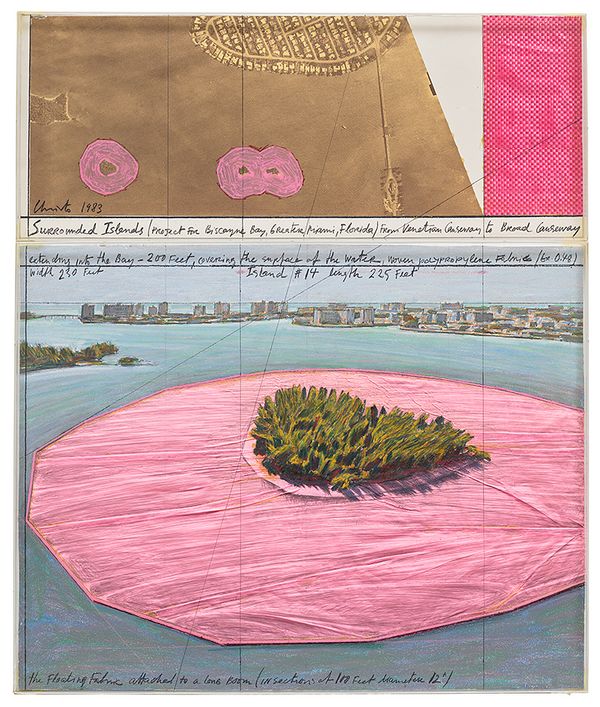
Christo, Surrounded Islands (Project for Biscayne Bay, Greater Miami, Florida), 1983. Modern & Contemporary Art Day Sale London.
Visitors to Paris this year will encounter Projet Pont-Neuf by the artist JR in collaboration with the Christo and Jeanne-Claude Foundation. The new work is an immersive installation inspired by Christo and Jeanne-Claude’s The Pont Neuf, Wrapped (Project for Paris), which will temporarily transform the bridge, celebrating Christo and Jeanne-Claude’s legacy with a major cultural event.
As the first public urban project realized on such an architectural and public scale, the Pont Neuf Wrapped occupies a special place in Christo and Jeanne-Claude’s oeuvre. The idea of wrapping the oldest bridge in Paris was initially rejected by then-mayor Jacques Chirac, who signed the permit approval only after a long and relentless period of lobbying orchestrated by the artists. The response of the public was nothing short of sensational: the installation attracted three million visitors and the press was enchanted.

Christo, Over the River (Project for Arkansas River, State of Colorado), 2006. Modern & Contemporary Art Day Sale London.
In the evenings through 20 June in Berlin, the west façade of the Reichstag showcased a projection mapping of Wrapped Reichstag, offering the public a chance to discover what the building looked like in June 1995. The original work took 24 years to execute, involved the artists meeting with 352 members of parliament, and included a seventy-minute debate in the German Bundestag.
Executed in 1986, Wrapped Reichstag (Project for Berlin) is a supreme example of Christo and Jeanne-Claude’s meticulously conceived preparatory collages. The Reichstag was one of only three buildings — along with The Kunsthalle, Bern, in 1968 and The Museum of Contemporary Art, Chicago, in 1969 — that the artist couple was able to fully wrap, realizing their intended project beyond the conceptual stage.
I often say, ‘Our work is a scream of freedom.’
—Christo

Christo, Wrapped Walkway (Project for Ueno Park - Tokyo), 1969. Modern & Contemporary Art Day Sale London.
Elsewhere in this collection, we find further notable works, including Christo's foundational early “package” works, which laid the conceptual and aesthetic groundwork for their later iconic wrappings. Christo began his wrapping experiments in 1958, shortly after escaping Bulgaria as a young refugee hidden in the back of a truck. What started as a practical act of wrapping his belongings was initially interpreted by some as a reference to mummification. However, his goal was not to preserve but to dematerialise, removing both practical and symbolic meaning to create something ambiguous.
Both conceptually and physically, these works are as much about concealment as they are about openness. While the wrapping shrouds, it also intrinsically invites engagement, prompting viewers to project their thoughts onto what remains unseen and to participate intimately in the work’s interpretation. It's this engaging quality, this invitation to participate in their works, that accounts for their undeniable appeal.
Discover more from Modern & Contemporary Art >
Recommended Reading