Article | Joan Snyder Editions Auction New York June 2025
The Artist’s Hand Is Closer Than It Appears
Joan Snyder's remarkable printmaking comes into focus through five prints spanning four decades of her career.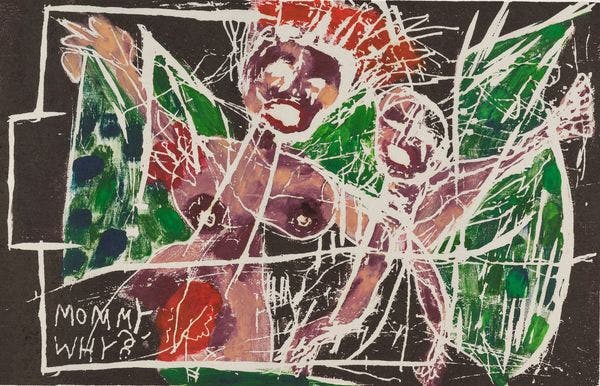
Joan Snyder, Mommy Why? (detail), 1983–84. Editions & Works on Paper New York.
For any great artist — be they painter or printmaker, composer or poet — what perhaps draws us in the most is the immediate sensation of their personal language. Encounter just two of their works and you’ll find the connection between them straightaway. From there, each further work we discover opens a greater understanding and lets us in, connecting the dots between our own experience of the world and theirs. In these wonderful moments, we can find ourselves wholly affected by just how much an artist has stayed true to themselves. It’s as if they invite us along in their own revelations, unveiling a bit more to us — and themselves — with each work.
The New York painter and printmaker Joan Snyder fits this mold, and our upcoming Editions & Works on Paper auction in New York offers a unique opportunity to unpack the progression of her visual language. On view at 432 Park Avenue from 17–23 June, this micro survey of her printmaking career promises to be eye-opening.
From her renowned Stroke paintings in the 1970s to her current work, Joan Snyder has developed a uniquely personal visual lexicon. Initially investigating the ontology of painting and emerging as a defining voice in feminist art, her autobiographical works make use of recurring motifs. From roses to breasts, ponds, mud, totems, screaming faces, scrawled words, cherry trees, and more, each tells us part of her personal story, connects to collective experience, and illustrates her own experience of womanhood. These motifs appear and reappear, growing and changing alongside the artist’s sensibility, much like how a melodic turn of phrase from her beloved Verdi’s Messa da Requiem can be heard anew in his later Otello.
Now late into a career that has included fellowships from the John Simon Guggenheim Foundation, the MacArthur Foundation, and the National Endowment for the Arts; participation in the 1973 and 1981 Whitney Biennials and the 1975 Corcoran Biennial; and with works included in institutional collections ranging from the Crystal Bridges Museum of American Art and the Art Institute of Chicago to what we’ll call a New York quadfecta (MoMA, Met, Guggenheim, Whitney), Snyder’s work has captured collectors’ attention as of late. She’s recently presented lauded solo exhibitions at Thaddaeus Ropac in London and CANADA NYC, and her latest auction results are impressive. Just this May, her 2020 work, OH Elena achieved more than twice its low estimate in Phillips’ Modern & Contemporary Art Day Sale in New York.
But for as much as her paintings are lauded, she’s just as ambitious a printmaker, bringing her unique sensibilities to the medium in a personal and experimental approach. Rather than always seeking to produce exact editions, she will often alter certain aspects during a print run, much in the way she may work and rework a canvas while painting. Subtle changes in coloring or hand additions help blur the lines, making it satisfyingly tricky to see where the painter ends and the printmaker begins.
“She is a printmaker with a capital P,” says Phillips New York Editions Specialist Jason Osborne. “She is a painter and a printmaker — they have both been huge parts of her practice throughout her entire career, from when she was in school all the way up until now — and she’s still doing it.”
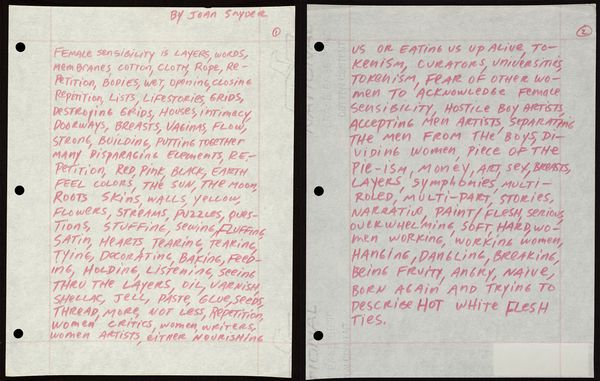
Joan Snyder's response to “What is Feminist Art?” 1976 or 1977 (click image to enlarge). Woman’s Building records, 1970–1992. Archives of American Art, Smithsonian Institution.
To begin to understand Snyder’s work, it’s helpful to look to the source. Later dubbed a “mini-manifesto,” her now-famous text, written as a response to the eponymous exhibition What is Feminist Art? at the Woman’s Building in Los Angeles, offers a guide map to her art and ideas.
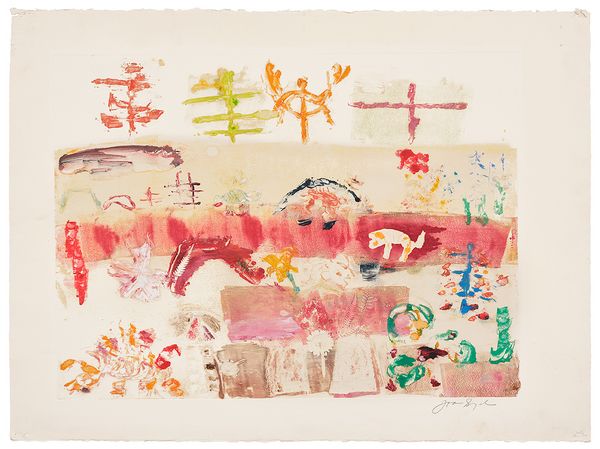
Joan Snyder, Untitled, c. 1978. Editions & Works on Paper New York.
The earliest work on offer is 1978’s Untitled, coming just two years after her pivotal text, and which begins to clue us in to her affinity for German Expressionism and imagery reminiscent of children’s paintings. It also allows us a window into how personal experience manifests in visual subject matter, as this work comes from the same year Snyder lost her son Oliver to a miscarriage. It was around this time that she began to more fully integrate the style of children’s drawings, a genre she understood well from her time as an art teacher, going as far as to save some of her students’ drawings and eventually pull imagery from them in her works. Much of her mark-making has the freedom and expressivity of a child’s hand, or even of an ancient people or those on the fringes of society.
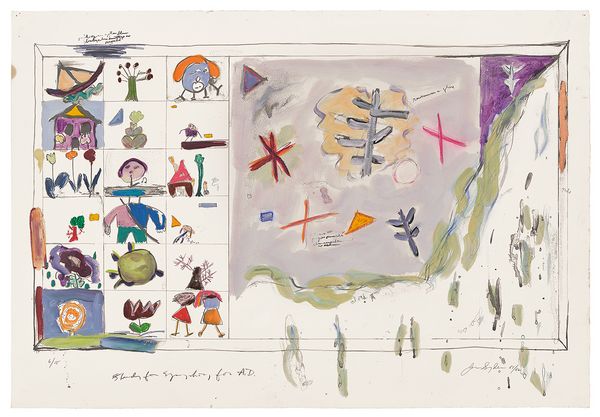
Joan Snyder, Study for Symphony, for A.D., 1981. Editions & Works on Paper New York.
A few years later, Study for Symphony for AD expresses further autobiographical details. This expressive and complex work was created just after the birth of her daughter, Molly, and is dedicated to Dr. Alvin Donnenfeld, the obstetrician who delivered her. This hand colored, black-and-white lithograph demonstrates Snyder’s active approach to printmaking and references her love of music — the narrative nature of its grid-like composition serving as a parallel to the temporal logic of musical forms. Across these two works and with Snyder’s personal struggles in mind, we find her fascination with ideas of birth and death, creation and loss, and a mother’s ability or inability to soothe or protect her children. This pushes us well into her remarkable 1983–1984 work, Mommy Why?
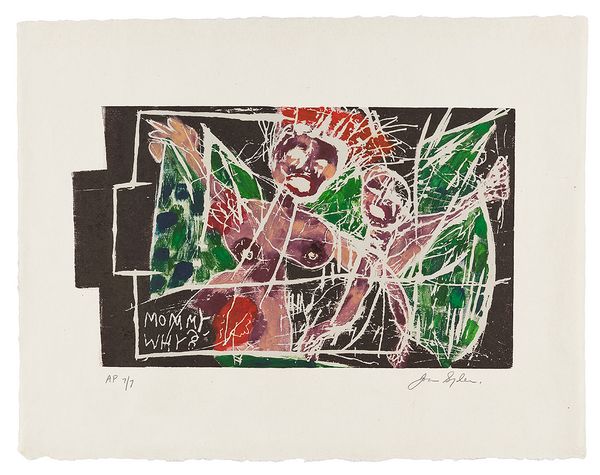
Joan Snyder, Mommy Why?, 1983–84. Editions & Works on Paper New York.
“The way I look at it, it’s kind of an anti-Pietà,” Osborne says. “An image of woman and child that is non-sentimental, not romanticized. There’s this really aggressive mark-making, and she’s taking material directly from her life experience. The subject matter feels familiar, but then it’s also not.” This unique woodcut was executed in an edition of 15, with seven artist’s proofs that all function like a musical set of theme and variations, each print featuring changes in coloration. This example is particularly charged due to the scorching red hue used to color points of hair growth on the mother figure. The dramatically chiseled plate and expressive use of color come together to convey a mother and her child’s shared sense of suffering and showcase the inherent strengths of the woodblock medium.
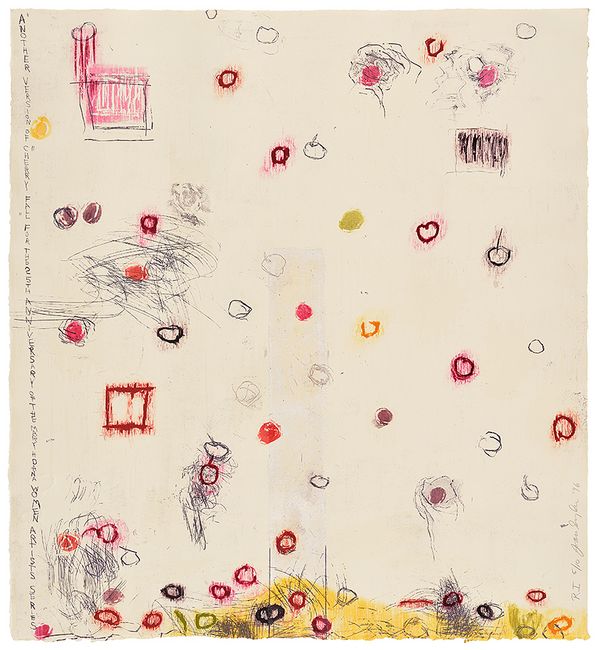
Joan Snyder, Another Version of Cherry Fall, 1996. Editions & Works on Paper New York.
Snyder’s continuous reinvention stretches beyond a single edition to her entire oeuvre. Another Version of Cherry Fall represents this clearly, seeing the artist revisit a painting created the prior year. Her return to cherry trees as a central motif is referential to her memories of passing a cherry tree each day she went to visit her dying father. In this sense, the cherry tree becomes a symbol of lifecycles, of rebirth and renewal as much as death and the void. Adding to the web of emotion, this print was made in collaboration with master printer Eileen M. Foti, whose husband was battling aggressive lymphoma at the time the edition was made, lending a connection to the symbolism for both artist and printer.
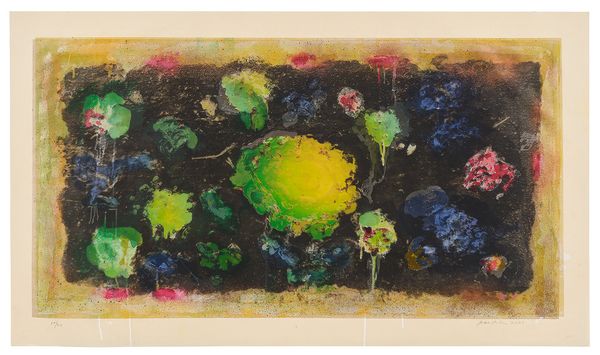
Joan Snyder, Black Lake Redux, 2021. Editions & Works on Paper New York.
These themes also emerge from the depths of Blake Lake Redux, the black water seemingly suggesting death in contradiction with water’s vital role in sustaining life. Also stemming from an earlier painting, Snyder’s invention within the printmaking medium, with hand-coloring in pastel, helps capture a similar dimension to the original painting.
Looking outside of Snyder’s personal world, it’s also fascinating to consider the backdrop of artistic movements that transpired as these works were created. It’s illuminating to realize that, as mainstream art trends perhaps came and went — Abstract Expressionism, Pop Art, Minimalism, Conceptual Art, etc. — Joan Snyder seemed to never drift too far from her innate need to create within her own language. The rigorous visual throughline and the consistency of her ideas are evidenced in an interview with Plaster Magazine conducted just last year in 2024. When asked if she stood by her 1976 statements in her “mini-manifesto,” Snyder simply replied, “Absolutely.”
With six decades behind her practice, it is incredibly engaging to look back on this process of becoming. Says Osborne, “It’s just great to get these works in front of people’s eyes to appreciate right now.”