Article | Longines 13zn12 Chronograph 5699 Doppia Lancetta Sommatore 1940s
Double the Hands, Double the History: The Longines Ref. 5699 'Doppia Lancetta' Chronograph
With its dual central chronograph hands and celebrated 13ZN-12 calibre, this 1940s Longines is one of the coolest watches the brand has ever made.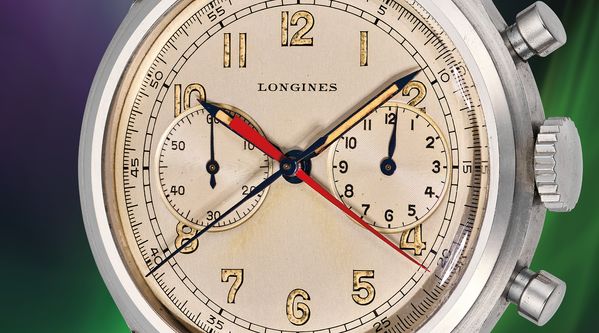
Our final live auction of the spring 2025 season, the New York Watch Auction: XII, takes place on 7-8 June, at our Manhattan headquarters. The auction includes 140 of the world's finest watches – and though we are loath to boast, we truly think it’s one of the best catalogues we've ever put together. We'll highlight several of the most interesting lots and stories featured in the sale over the next few weeks, including the watch highlighted in this article.
– By Logan Baker
The 1940s ref. 5699 "Doppia Lancetta" is one of the most desirable vintage watches ever produced by Longines, a brand with a lengthy history of crafting high-precision chronographs.
Introduced around 1945, the ref. 5699 represents a high-water mark in technical ingenuity and design for Longines. It houses the 13ZN-12 calibre, an offspring of the legendary Longines chronograph calibre 13ZN, which is a holy grail among vintage watch collectors.
Nicknamed Doppia Lancetta, meaning 'double hand' in Italian, and "Sommatore," referencing the chronograph functionality, the ref. 5699 stands apart from other 13ZN-equipped chronographs of its era for its unique chronograph layout.
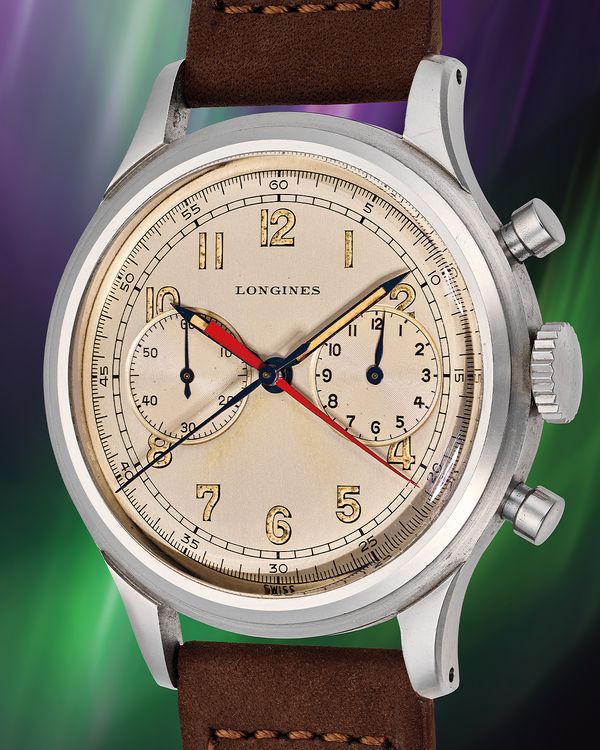
Lot 21: A circa 1945 Longines Chronograph ref. 5669 “Doppia Lancetta” in stainless steel that's included in the Phillips New York Watch Auction: XII. Estimate: USD $40,000 - 80,000
Instead of a conventional twin-register chronograph, the ref. 5699 features two centrally mounted chronograph hands (those aren't rattrapante hands!) — one for elapsed seconds and another for elapsed minutes. It's somewhat of a similar approach to what De Bethune has accomplished in the 21st century with the Maxichrono – except Longines' version came out more than 60 years earlier.
The Doppia Lancetta's stacked central handset creates a visually striking dial layout and offers an intuitive way to read elapsed time. The ref. 5669 also features a remarkable 39.5mm stainless steel case, a larger-than-life size when most chronographs of the era measured between 32mm and 36mm.
The 13ZN-12 calibre, produced in-house by Longines, is widely regarded as one of the finest chronograph movements of the mid-20th century. Initially developed in 1936, the manual-winding 13ZN was one of the first in-house flyback chronograph wristwatch movements ever made.
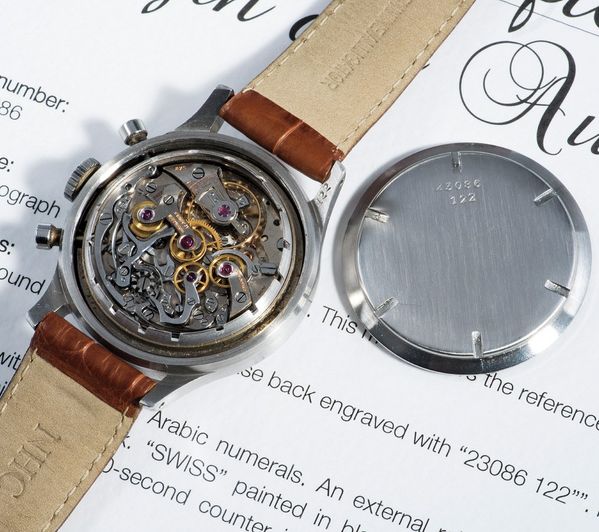
A 1947 Longines Chronograph ref. 5699 “Doppia Lancetta” in stainless steel that sold for CHF 62,500 at the Phillips Geneva Watch Auction: FIVE, in May 2017.
Its successor, the calibre 13ZN-12, first produced in 1942, built on the groundbreaking 13ZN, adding the central chronograph minute hand, a 12-hour counter to the dial, as well as removing the flyback functionality. You now have three counters to reset (hours, minutes, seconds) rather than just two (minutes, seconds) like most mid-century chronographs.
I also think it's important to remember: this is the 1940s. Patek Philippe, Audemars Piguet, and Vacheron Constantin were all still relying on sourcing movement blanks from makers like Valjoux and Lemania at the time. Longines didn't need to do that.
Most known examples of the ref. 5699 were delivered to the United States immediately following World War II, after wartime steel rationing had subsided, between 1945 and 1948.
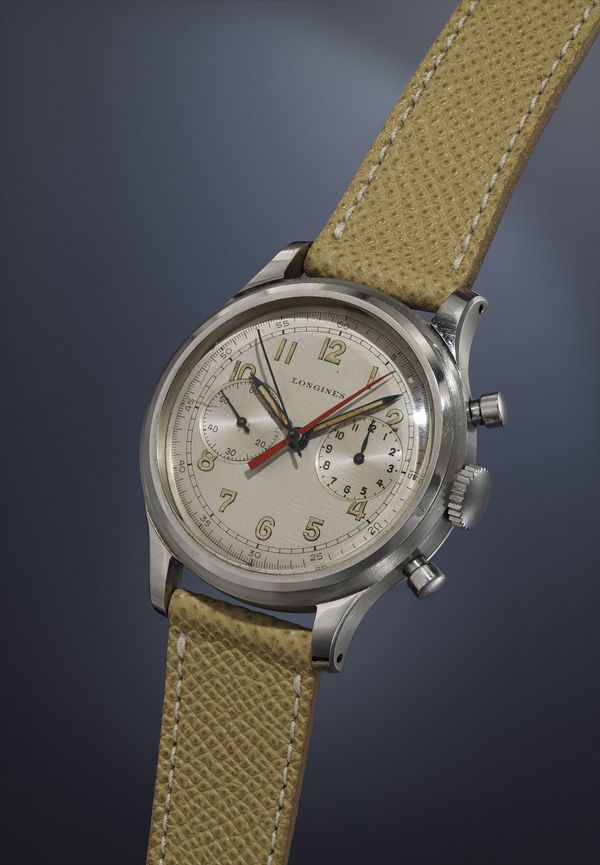
A 1947 Longines Chronograph ref. 5699 “Doppia Lancetta” in stainless steel that sold for CHF 87,500 at Phillips: Start, Stop, Reset Auction, in May 2016.
The watches were most typically delivered to the United States as part of batch number 23086 (a figure that is occasionally cited as the model's reference number online). As a result, you'll find that most Doppia Lancetta examples out there are stamped with an "LXW" import code on the movement, referencing the company's U.S. agent at the time, the Longines-Wittnauer Watch Co. About 500 pieces of the ref. 5669 are believed to have been produced in total, but only a small fraction have appeared publicly.
The larger case diameter of the Doppia Lancetta provides plenty of room for the dial to breathe. The hands are all heat-blued, save for the central chronograph minutes hand, which is a bright shade of red. The central chronograph seconds hand is a touch longer than its minute-tracking sibling, reaching out just far enough to meet up with the outer scale measuring one-fifth of a second increments. Of course, as a proper 1940s tool watch, the pencil-shaped central hour and minute hands are filled to the brim with radium lume, perfectly matching the painted luminescent Arabic hour numerals.
The calibre 13ZN-12 inside the ref. 5669 is protected by a hermetic "6 Tacche" screw-down caseback. If you flip the watch over, you'll find the batch number (23086) and specific case number engraved into the solid back. The case number is then repeated on the inside of the upper left lug.
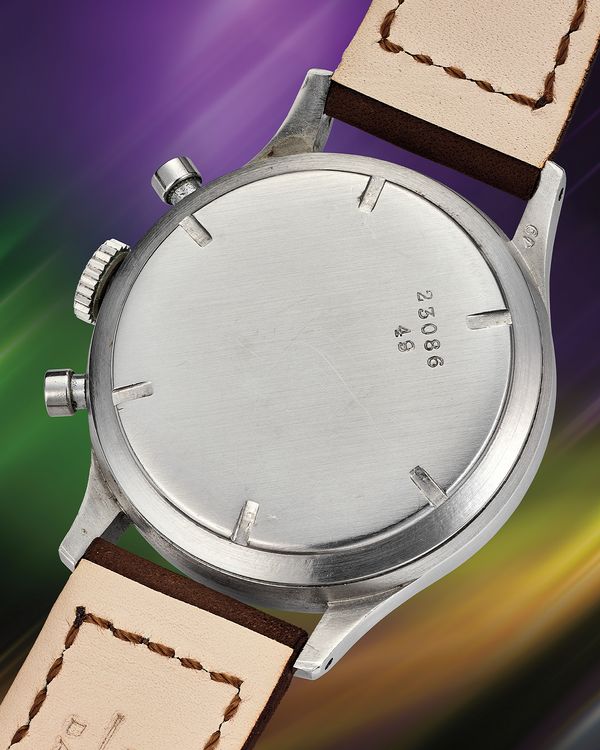
Lot 21: A circa 1945 Longines Chronograph ref. 5669 “Doppia Lancetta” in stainless steel that's included in the Phillips New York Watch Auction: XII. Estimate: USD $40,000 - 80,000
Almost all of the Doppia Lancetta examples known to the market are cased in stainless steel and feature matching circular pump pushers. However, scholarship states that there are a few variations out there, including models cased in gold as well as others with rectangular chronograph pushers.
The present example of the ref. 5699, being offered at the Phillips New York Watch Auction: XII (lot 21), is a stellar specimen with remarkable provenance. The watch was gifted to the consignor’s father by his parents as recognition for his safe return from World War II and his subsequent graduation from medical school. It's remained with the family ever since. The original owner became an internationally recognized oncologist whose work contributed to transformative cancer therapies.
Aside from this heartening provenance, this Doppia Lancetta is preserved in superb condition—certainly one of the best examples ever offered at Phillips. The case is, in our opinion, completely unpolished, with sharp facets; the lugs show their original finishing; the case numbers are deeply stamped; and even the movement is well-preserved.
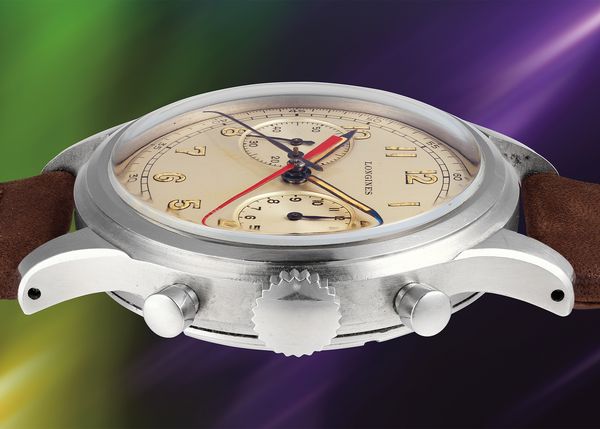
Lot 21: A circa 1945 Longines Chronograph ref. 5669 “Doppia Lancetta” in stainless steel that's included in the Phillips New York Watch Auction: XII. Estimate: USD $40,000 - 80,000
The dial, which in other examples can show significant age and patina, is in gorgeous, completely original condition, boasting a perfectly aged, satinated silver finish with matching luminescent material in the hands and hour markers that has aged to a warm, sandy hue. This is, without a doubt, one of the finest and best-preserved examples of the Longines ref. 5669 to ever appear on the market.
Accompanying the watch is a leather strap and a stainless steel bracelet, along with a Longines Extract from the Archives confirming the watch’s original delivery to the United States through Longines-Wittnauer on August 12, 1946. It's lot 21 in the upcoming Phillips New York Watch Auction: XII, and it carries an estimate between USD $40,000 and 80,000.
You can learn more, place a bid, and view the entire New York Watch Auction: XII catalogue right here.