Article | Gilot Life On Her Own Terms Exhibition New York
Françoise Gilot: A Life on Her Own Terms
Explore the breadth of the great artist alongside the PhillipsX selling exhibition 'Gilot, Une Vie.'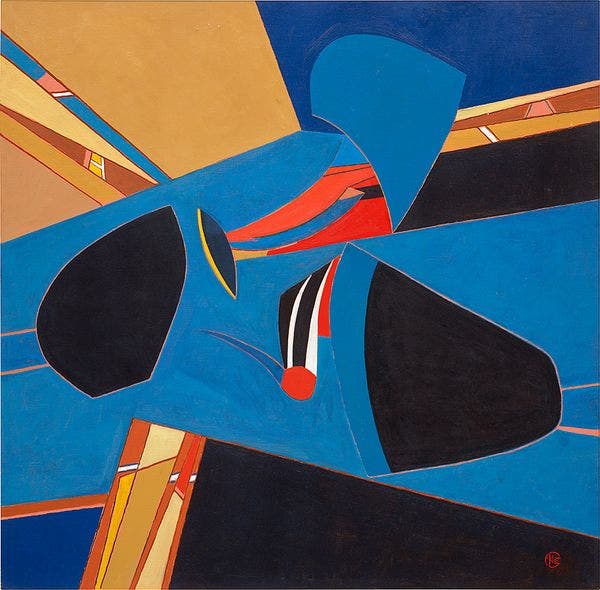
Françoise Gilot, Erratic Comet, 1998. Gilot, Une Vie.
—By Rebecca Schiffman
Françoise Gilot (1921–2023) is often unjustly confined to the margins of Pablo Picasso’s mythology, remembered only as his lover and muse — yet she stands out as an accomplished artist with a distinct legacy that deserves recognition. Over eight decades, Gilot forged her own path within French Modernism, producing a diverse and vast body of work that encompassed naturalistic portraiture, Fauvist landscapes, Cubist still lifes, and Nouveau Réalisme abstractions, all pulsing with dynamic rhythm and vibrant color, along with authoring several books including the best-selling 1964 memoir, Life with Picasso. The PhillipsX exhibition Gilot, Une Vie offers an expansive look at the remarkable scope of her career, marking the first selling exhibition of its kind to celebrate her legacy.
Early Life
Born Marie Françoise Gilot on 26 November 1921, in Neuilly-sur-Seine, a suburb of Paris, the artist was raised in an upper-middle-class household. While her mother, a ceramicist, nurtured her creativity by teaching her watercolor techniques and enrolling her in drawing classes, as their only child, her father envisioned a more conventional path for his daughter as a lawyer or scientist. Despite these conflicting expectations, young Gilot’s artistic talents flourished, especially with the support of her mother and maternal grandmother, who provided her with attic space in her home to serve as a studio. Her father persuaded her to enroll at the University of Paris, and she would go on to study at Cambridge, the Sorbonne, and the British Institute in Paris. In 1939, ahead of the threat of World War II, Gilot was sent to the city of Rennes to attend law school but returned to Paris the following year. In 1940, against her family’s wishes — and despite her father’s abusive fury — Gilot defied expectations by leaving law school to pursue her own path as an artist. Shortly thereafter, she began her art education under the tutelage of the Hungarian Surrealist painter Endre Rozsda and attended the renowned Académie Julian.
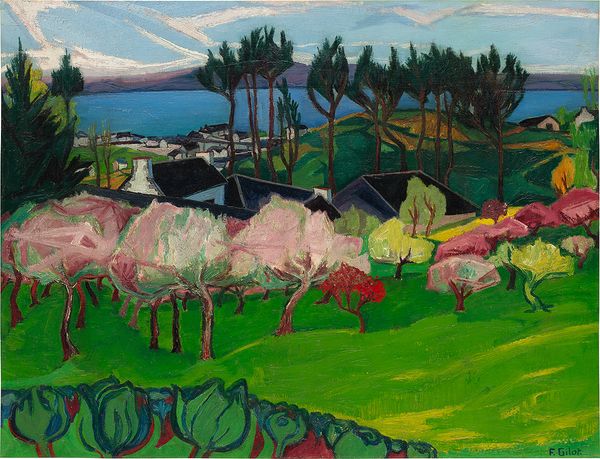
Françoise Gilot, Le Bois D’Isis, 1942. Gilot, Une Vie.
In the years that followed, Gilot emerged as a respected figure in the School of Paris, a movement that struggled for recognition during the Nazi occupation of France. Despite the Nazis outlawing most modernist work as “degenerate,” Gilot’s style began to crystallize, marked by organic forms, rhythmic lines, and a sensitivity to natural subjects. Influenced early on by the Fauvist movement, her work embraced bold colors and undistinguished brushstrokes. Her admiration for artists such as Henri Matisse is particularly evident in French Window in Blue (1939), which mirrors the composition of Matisse’s Open Window, Collioure (1905), with its open window framing a vivid landscape and balcony, enriched by bold color contrasts that create depth and atmosphere. Gilot further explores vibrant, expressive color in her depiction of a forest in Brittany, France, in Le Bois D’Isis (1942), where her family owned a cottage. In this work, she captures the liquid blue light, intertwining trees, rocks, and ocean, exemplifying her Fauvist influence through vivid tones and expressive strokes that resonate with Matisse’s treatment of natural landscapes.
Meeting Picasso
In 1943, Gilot was included in her first major exhibition, a joint show with her friend, artist Geneviève Aliquot at the Galerie de Madeleine Decre. Shortly after the show opened, at a dinner at Le Catalan with actor Alain Cuny, they met Pablo Picasso, who, captivated by the two female artists, invited them to his studio. This chance meeting initiated a decade-long relationship that bore two children and significantly influenced both artists’ trajectories. As Gilot famously concluded in her 1964 book Life with Picasso, a relationship with him was “a catastrophe I didn’t want to avoid.” While the artist’s partnership with Picasso offered her greater exposure to the Parisian art scene, Picasso biographer John Richardson observed that “Picasso took from her rather more than she took from him,” underscoring the imbalance in what each gained from the relationship. In the early years, Picasso's artistic output reflected a newfound happiness that mirrored the vibrancy of their relationship, frequently portraying Gilot as an ethereal nymph alongside his centaur persona. This representation starkly contrasts the somber, psychologically complex depictions of his earlier muse, Dora Maar, highlighting the emotional evolution in Picasso’s work during his time with Gilot.
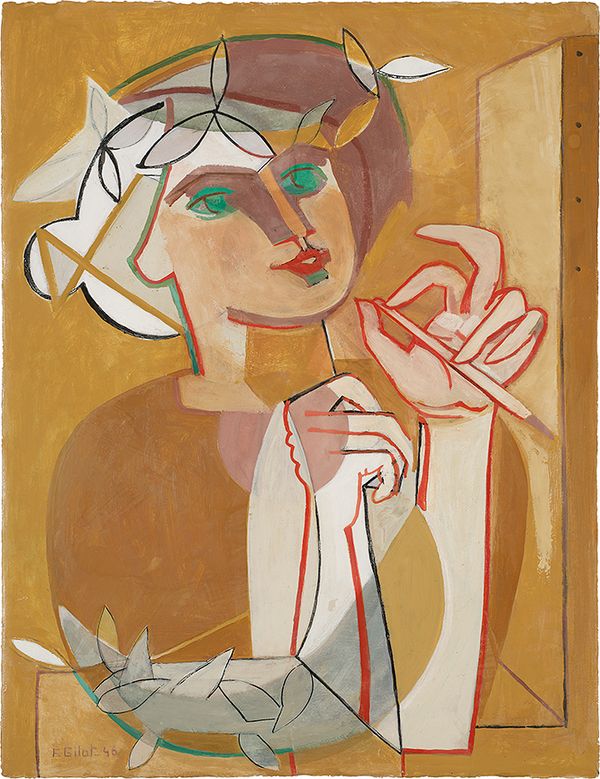
Françoise Gilot, The Painter (Self-Portrait at Work), 1942. Gilot, Une Vie.
From the outset of their relationship, Gilot asserted her individuality through her art, using shape, color, and form to convey a self-possession that defied the passive role of a muse. Even at the height of their partnership, she turned to self-portraiture — such as in The Painter (Self-Portrait at Work) (1942), where she combines the fractured geometries of Georges Braque with Fauvist coloration to present an image of the artist at work that is distinctly her own. As she later remarked, “One’s ego is not satisfied by the fact that one had been painted by Picasso.”
Gilot’s commitment to her painting practice intensified in the 1940s, perhaps in response to the challenges of living with Picasso, who demanded much of her time and energy. During this period, she sought to master both the formal and symbolic dimensions of her art through portraits of friends, family, and herself. She has noted that her emotional connection to her subjects enhances her ability to depict their likenesses on canvas, transcending superficial representation. From Gilot’s perspective, layered memories coalesce to form a coherent image, the interplay of idealization and direct observation culminates in a portrayal of the subject’s true essence. This throughline is evident in her varied styles, from the intimate portrayal in Geneviève Thoughtful (1942) to My Grandmother (1943), a work that beautifully conveys the love and devotion Gilot felt for her grandmother.
Motherhood’s Influence
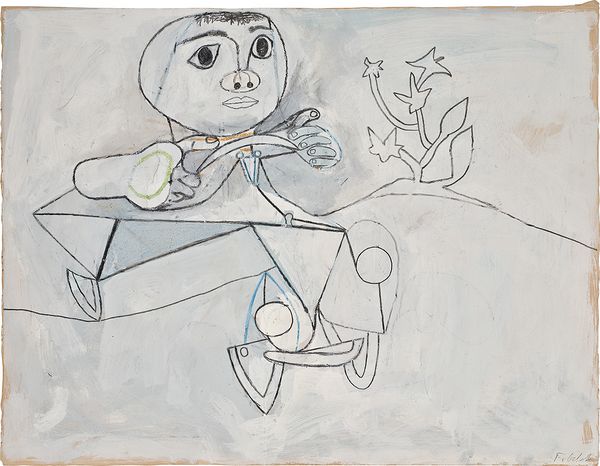
Françoise Gilot, Claude Driving his Car, 1949. Gilot, Une Vie.
After the birth of their son Claude in 1947 and daughter Paloma in 1949, Gilot began to depict her children with raw, emotional depth, reflecting the profound connection and new experience of motherhood. This period brought on a new series of paintings on board that portray her children in intimate settings, mainly composed of graphite pencil and white paint. In Claude Driving his Car (1949), her son and his toy car are broken down into simplified geometric forms, reduced to basic shapes and lines on a flattened plane. She forgoes color, using a subdued palette of grey, blue, and white. Perhaps this is a nod to Picasso’s Analytic Cubism, the pull of Picasso’s influence evident in her combination of abstraction and figuration, and the violence of clashing forms.
Françoise Gilot, Le Bateau, 1952. Gilot, Une Vie.
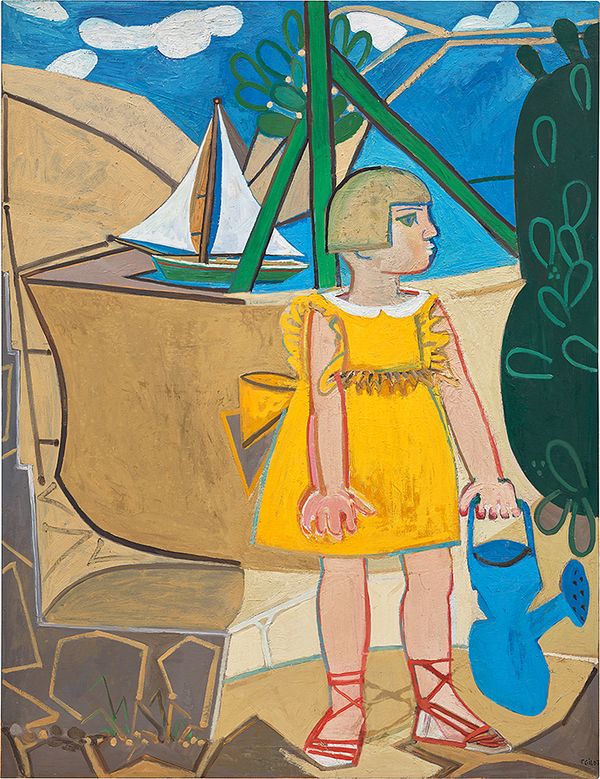
In another work, alive with vibrant color, Le Bateau (1952), the artist depicts her daughter Paloma standing in a landscape with a boat. Every primary color is present: Paloma wears a bright yellow sundress with a bow, red espadrille sandals, and holds a blue watering can. Around this time, Gilot’s relationship with Picasso had become increasingly unbearable, marked by his explosive temper and growing distance. Gilot, feeling trapped, turned inward and spent this time bonding with her children and focusing on her art.
A Fresh Start
After enduring Picasso’s anger and infidelity for a decade, Françoise Gilot decided to leave him on 20 September 1953 — a bold choice met with his defiant response: “No woman leaves a man like me.” Following their breakup, Picasso attempted to hinder her career, using his influence to pressure galleries and collectors, including his dealer Daniel-Henry Kahnweiler, who subsequently dropped her. Unfazed, Gilot focused on her own career, pushing forward with her work and exploring new styles. In 1964, she further reclaimed her story by publishing Life with Picasso with Carlton Lake, despite Picasso’s repeated attempts to prevent its release. She then married artist Luc Simon in 1955 and had a daughter, Aurelia, the following year. After divorcing Simon, she married the American polio vaccine pioneer Jonas Salk in 1969.
Françoise Gilot, The Visit, 1985. Gilot, Une Vie.
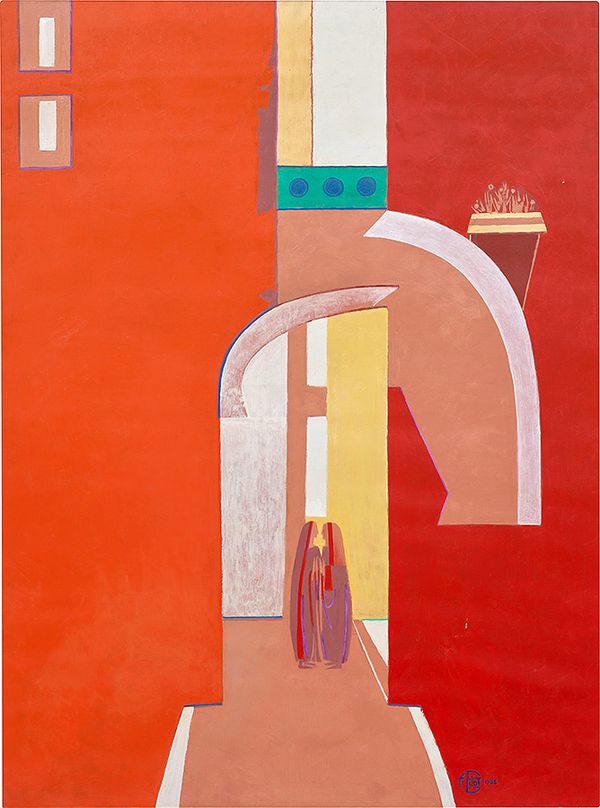
The pair moved to California and later to New York, and Gilot’s artistic creativity flourished through the 1970s, ‘80s, and ‘90s. She expanded her work to larger canvases, embracing greater spontaneity and experimenting with acrylic paint on paper. During this period, she developed a notable series of “floating paintings” that hung away from the wall and continued creating a wide range of works on paper, including watercolors, India ink drawings, and new monotypes. Many of these works on paper, including The Visit (1985), were inspired by her travels to India and Senegal. In The Visit, abstract blocks of orange and red form architectural motifs that encase two women dressed in robes who face one another.
A Legacy of Her Own
Françoise Gilot, Cosmic Disarray, 1998. Gilot, Une Vie.
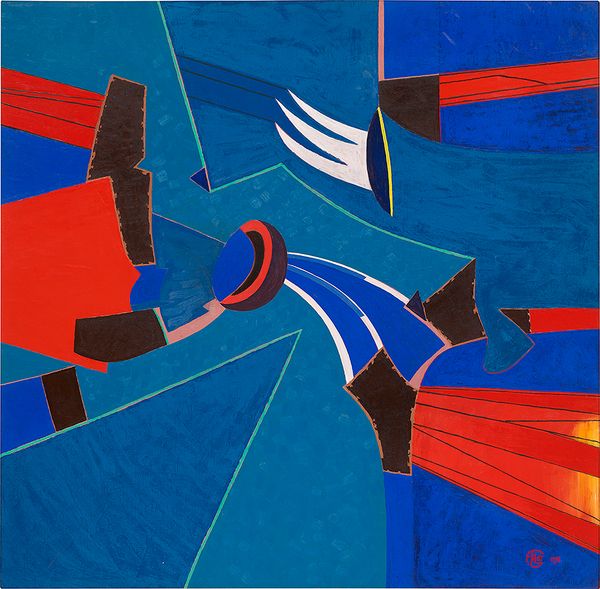
In the early 1990s, Gilot returned to abstraction after twenty-five years of focusing on figuration, exploring themes of wandering and utilizing her lifelong fervor for color to invigorate lyrical compositions. Her late 1990s canvases, filled with irony and cosmic overtones, reflect her contemplation of time and transformation. Works like Cosmic Disarray, 1998, and Erratic Comet, 1998, illustrate the dynamic interplay of nature, emphasizing the cyclical flow of night and day, sun and cloud, winds and seasons. In the night sky, erratic comets symbolize heavenly disarray, activating a sense of both chaos and harmony as they traverse the expanse of time.
Until the end, Gilot remained a vital presence in the art world, appointed a Chevalier de la Légion d’honneur in 1990 and named an Officier de la Légion d’honneur in 2010. She never stopped painting until her death at the age of 101 in 2023. While Picasso’s legacy looms large, Gilot’s distinct celestial vision and profound contributions to modern art shine just as brightly — as evidenced by her works being showcased at prestigious institutions like the Metropolitan Museum of Art and MoMA alongside his. As she herself declared, “I live my own life in my own way.”