Article | Specialist Picks Spot The Difference Damien Hirst Online Auction
Specialist Picks: Spot the Difference
Who wore it best? Our London specialists conjure up comparisons through time, showcasing their favorites from our Damien Hirst: Online Auction.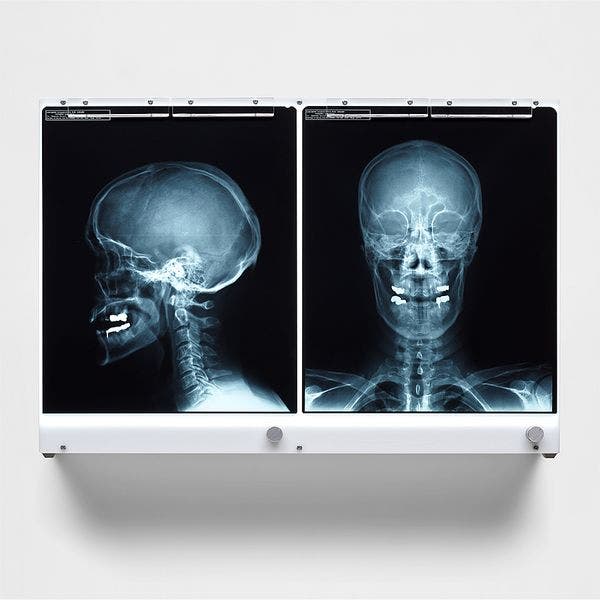
Damien Hirst, Self Portrait L., 2008. Damien Hirst: Online Auction.
Georges Seurat or Damien Hirst?
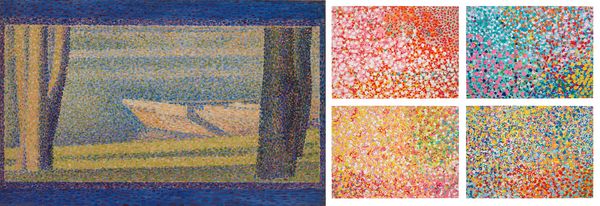
Left: Georges Seurat, Moored Boats and Trees, 1890, Philadelphia Museum of Art. Image: Philadelphia Museum of Art, Gift of Jacqueline Matisse Monnier in memory of Anne d'Harnoncourt, 2008, 2008-181-1.
Right: Damien Hirst, Veils (H4: 1-4), 2018. Damien Hirst: Online Auction.
Rebecca Tooby-Desmond, Specialist, Head of Sale
“From a couple of steps away, the eye no longer perceives the brushwork: the pink, the orange and the blue are composed on the retina, coalesced in a vibrant chorus.”
Félix Fénéon’s 1886 description of Pointillism rings clear as a bell in the mind of anyone viewing Damien Hirst’s Veils. Georges Seurat’s separation and placement of distinct, complementary colors paved the way for Hirst’s lifetime obsession with the formal quality of dots, from grids of discrete color circles to candy-land, pill-popping medicine cabinets.
In Seurat’s painting, there is a tantalizing promise of a concrete composition with small daubs of color that ripple across the surface of the canvas. If only you could squint harder or move closer, your eye could pin it down like a butterfly caught in household gloss paint. But the closer you look, the less you see, the more the image atomizes. It’s only when you step back that Seurat’s composition slides into focus like a Magic Eye illusion. But Hirst does not step back. He steps in, and through, submerging us in a ball-pit, bath-bomb explosion of unctuous pigment.
We fall into swirling confetti, submitting ourselves to experiencing a kind of dispersal: an out-of-body dissolution of the self. Akin to the infinity of Yayoi’s Kusama’s all-consuming polka dots, Hirst’s splodges of color lure us into an endless, unknowable abstraction: a veil between this world and the next.
Cabinet of Curiosity or Damien Hirst?
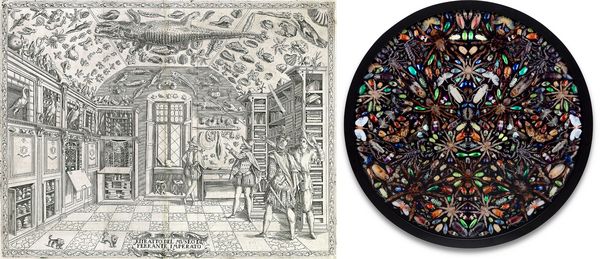
Left: Engraving from Ferrante Imperato, Dell'Historia Naturale, 1599.
Right: Damian Hirst, Phlegyas, 2016. Damien Hirst: Online Auction.
Louisa Earl, Associate Specialist
In the footsteps of his sixteenth and nineteenth century predecessors, the collector in Damien Hirst is revealed in this modern-day cabinet of curiosities. Rather than an entire room dedicated to the oddities and peculiar discoveries of scientists past, Hirst gathers his items of fascination into a compact living-room-friendly sized enclosure. The irony in having to kill something in order to look at it remains. But, the contemporary artist manages to capture the beauty of iridescent surfaces and prickly textures in a way that you forget about the creepy and the crawly.
The essence of the Wunderkammer perpetuates with rows of creatures and objects carefully categorized and presented in their respective species. Hirst refines the historical habits of collecting-en-mass, focusing on the items that challenge misconceptions of beauty in the natural world. More is more! Maximalism is the style for those investigating the fragility of life.
Robert Benard or Damien Hirst?
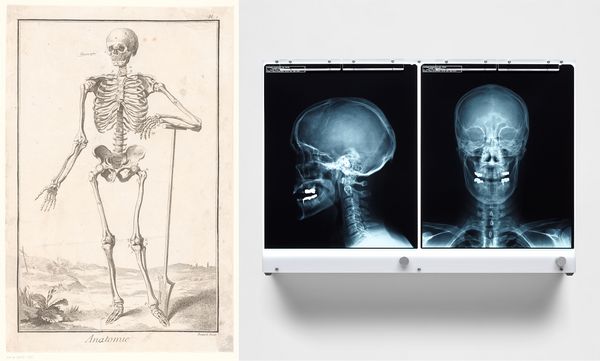
Left: Robert Benard, Anatomie, c. 1744 - 1777, Rijksmuseum, Amsterdam. Image: Rijksmuseum, Amsterdam, RP-P-2018-501.
Right: Damien Hirst, Self Portrait L., 2008. Damien Hirst: Online Auction.
Julia Paeslack, Cataloguer
In Self Portrait L., two x-ray films of Hirst’s skull are presented on a lightbox, stripping away the artist’s individuality to reveal the stark biological reality beneath. This reduction to skeletal forms shows anatomy as a subject worthy of artistic representation. During the Age of Enlightenment in the 18th century, the study of anatomy was no longer solely a scientific endeavor for medical education; it transformed into a macabre artistic pursuit, as illustrated by the works of artists and anatomists like Robert Benard (active c. 1765-85). Anatomical depictions are infused with meaning, creating skeletal characters that engage with themes of life and death, ultimately revealing humanity’s profound desire to comprehend itself. Similarly, Self Portrait L., while distinctly contemporary in its reliance on modern technology, carries forward this tradition of merging scientific inquiry with artistic expression.
Hirst’s illuminated scans, like Benard’s intricate engravings, are pursuits aimed at understanding the self, inviting viewers to confront the underlying structures that define human existence and emphasizing the fragility of life in the memento mori tradition. Art and science merge to illuminate our ongoing fascination with the human body and the mysteries of life and death. Eureka!
Edvard Munch or Damien Hirst?
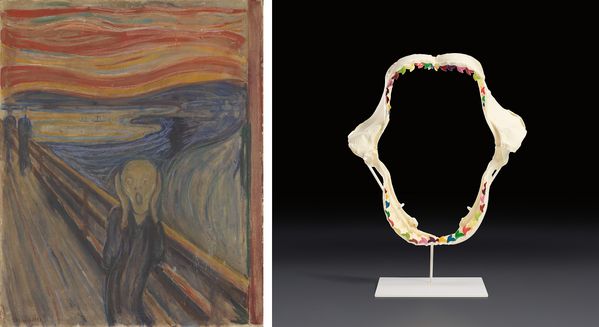
Left: Edvard Munch, The Scream, 1893, Nasjonalmuseet, Norway. Image: Nasjonalmuseet/Børre Høstland.
Right: Damien Hirst, Dark Rainbow, 2009. Damien Hirst: Online Auction.
Georgie Byworth-Morgan, Associate Researcher
Both Damien Hirst’s Dark Rainbow and Edvard Munch’s The Scream evoke a profound sense of existential dread. Hirst’s shark jaw is frozen mid-roar, agape as though on the brink of a kill — confronting us with our own mortality. At once absurd and terrifying, its multicolored teeth curve like a sinister carnival ride. In a not-dissimilar vein, Munch’s The Scream, presents a raw, existential howl that reverberates through the surrounding landscape, causing it to undulate and tremble with anguish. One of history’s most famous artworks, the distorted figure, framed by a swirling, apocalyptic sky, embodies a kind of deep universal psyche, so palpable we can almost hear the voiceless scream. Both Dark Rainbow and The Scream tap into primal human fears — dread, mortality, and the inevitability of being consumed by forces beyond our control. In this eerie duet of predator and victim, there is no escape, only the endless anticipation of jaws closing in.
Pietro di Francesco Orioli or Damien Hirst?
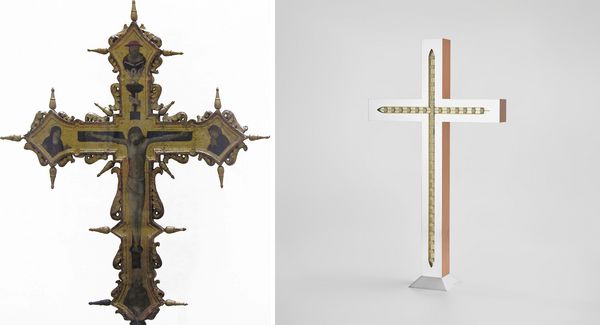
Left: Pietro di Francesco Orioli, Processional Crucifix, c. 1480s, The Metropolitan Museum of Art, New York. Image: The Metropolitan Museum of Art, New York, The Bequest of Michael Dreicer, 1921, 22.60.61.
Right: Damien Hirst, Sacrament, 2009. Damien Hirst: Online Auction.
Christian Rosolino, Editions Adminstrator
An opulent appropriation of Christian trauma ceremoniously embellished for an artistic end. But to which of the above works might I be referring? Quite simply, to both.
Hirst’s Sacrament, as a twenty-first century cross embodying twenty-first century issues, can be positioned at the metaphorical altar of the procession that is the history of iconographic art, as the product of the innumerable crucifixes that have come to adorn the canvases of masterpieces, the walls of churches, and pages of manuscripts alike. Yet, something — or indeed someone — is visibly missing from Hirst’s rendition. In the very space that Christ has been condemned to rest for eternity, Hirst metonymically places his own divisive icon of modern-day salvation: pharmaceuticals. The Hirstian pill motif encapsulates the coexistence and co-dependency of hope and despair, much like the image of a living savior juxtaposes that of its martyred counterpart on the two sides of Pietro di Francesco Orioli’s Processional Crucifix. And much like the fifteenth century crucifix is drenched in gold and adorned with intricate craftsmanship, so too is Hirst’s twenty-first century object bejewelled into a crux gemmata of today.
Nicolas Poussin or Damien Hirst?
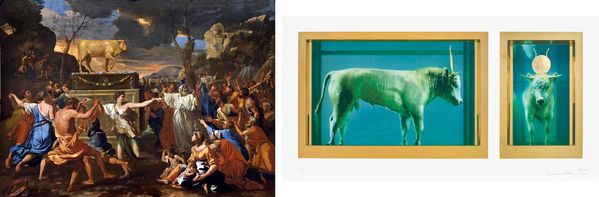
Left: Nicolas Poussin, The Adoration of the Golden Calf, 1633, National Gallery, London. Image: Peter Horree / Alamy Stock Photo.
Right: Damien Hirst, The Golden Calf, 2009. Damien Hirst: Online Auction.
Francesco Pierangeli, Editions Intern
Muuu muuu muuu! The golden calf has finally made it out of French Baroque (what an achievement!). Doesn’t it look a bit skinny, a bit sleepy in its formaldehyde vitrine though? The calf seems to have lost its shape. I mean, it has travelled through time, 375 years to be precise. After all, it is always the same golden calf. The one and only golden calf. It hasn’t changed, but people around him have. They used to adore it, dance around it, celebrate it. Now they fear it. The audience stands astonished in front of Hirst’s golden calf: we are forced to come to terms with the decay of death. Poor us! Goodbye baroque opulence and splendor, and welcome to Damien Hirst’s world.
Joseph Wright ‘of Derby’ or Damien Hirst?
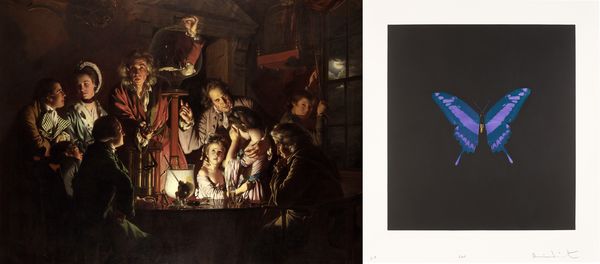
Left: Joseph Wright of Derby, An Experiment on a Bird in the Air Pump, 1768, National Gallery, London. Image: Photo 12 / Alamy Stock Photo.
Right: Damien Hirst, The Souls on Jacob's Ladder Take Their Flight (Unique), 2008-09. Damien Hirst: Online Auction.
Robert Kennan, Head of Editions, Europe
I think Wright of Derby’s An Experiment on a Bird in the Air Pump must be a favorite image of Hirst’s; it certainly is mine. I love all the characters, the emotions, human themes, and particularly the chiaroscuro lighting, as sharp a scalpel blade. I’m reminded of Hirst’s A Thousand Years and other elaborate presentations of his, the themes of which are all echoed in Wright of Derby’s marvelous painting. Is the young boy beneath the two lovers, eager to see the experiment reach its conclusion, a young Hirst? That selfie of him, With Dead Head comes to mind! So, to pair it with a lot from our sale, I wonder. In contrast to the exhausted wings of the parrakeet, it would be lot 28 — a butterfly, whose beautiful, iridescent blue wings are just about to take flight.
Recommended Reading