Article | When Art Became Smart Art
When Art Became Smart Art
From Ab Ex to Op and Conceptual to Pop: these seven objects in our Editions and Works on Paper auction are riveting simplicities for those who love Minimalism.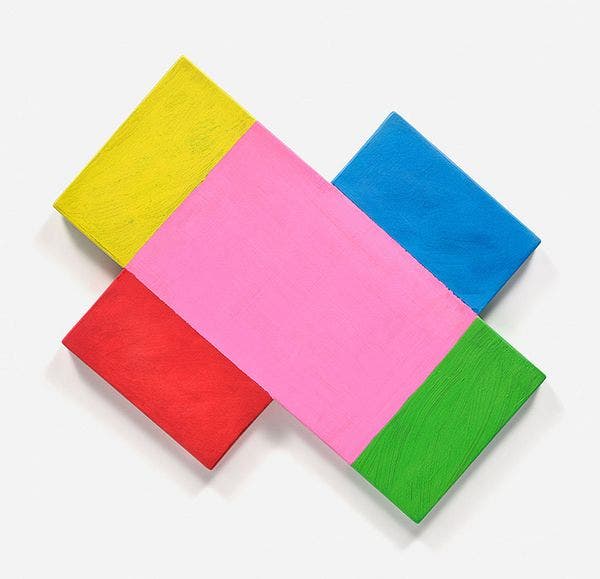
Mary Heilmann, Geometric Spin, 2021, archival pigment inks printed on shaped Duna board with acrylic paint, 21 x 26 x 1 in. (53.3 x 66 x 2.5 cm). Editions & Works on Paper.
Included in our Editions and Works on Paper auction on October 22–24 is a selection of radically reductive and palpably three-dimensional Post-war and Contemporary multiples by great innovators from the 1960s through the early 1990s. The artists are all recognizable names iconic of their eras, and their wall objects are triumphs of understatement that conceptually tinker with the fundamental nature of art at the sub-atomic level. They feel radical, smart, and cool, because they are.
It matters that these are objects, and not mere flat representations. The vanguard in the 1960s — bored by the Ab Ex enquiry into the “essential nature of flatness” — made objects. Flat paintings for many no longer cut it. The distinction is more than academic. This was a new kind of art powerfully experienced mind, body, and soul in the here and now. It was the dawn of new art zeitgeist.
The conceptual elegance grounding many of these works is profound: they swim backstrokes in the swirling currents of advanced Structural and Post-Structural theory. But the perfect “rightness” of an art object is something one apprehends intuitively. Smart doesn’t always mean intellectual. It means hitting the nail on the head.
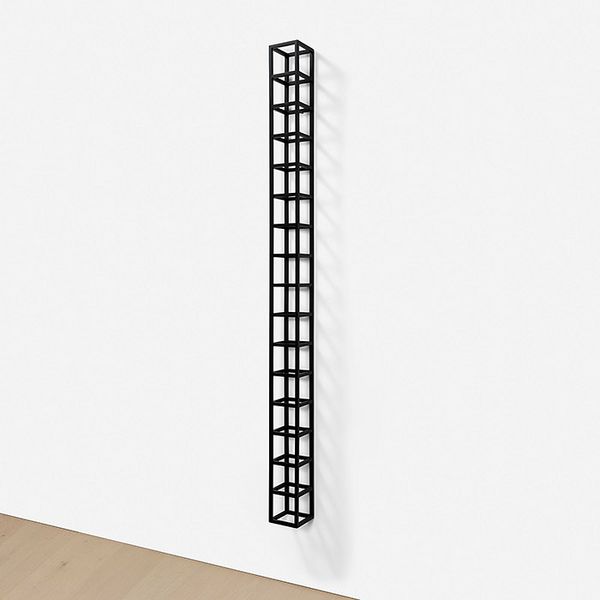
Sol LeWitt, Wall Piece (16 Modules High), 1988, pinewood construction painted in black. Editions & Works on Paper.
To say that Sol LeWitt’s concepts are groundbreaking is an understatement. He was a founding father of conceptual art — and arguably its most radical exponent and practitioner.
The artist launched his career in the mid-1960s with modular works, deploying the cube as a grammatical unit emptied of all associative content to explore techno-industrial themes of serialization, repetition, and progression. “These pieces are referred to as structures,” LeWitt said, “because they are neither paintings nor sculptures, but both.” Viewers didn’t need to comprehend to realize right away that what they were looking at — up against Abstract Expressionism — felt profoundly new.
In Wall Piece (16 Modules High) of 1988, LeWitt returns to the poignant simplicity and scale of the iconic his open-grid wall “structures” of the 1960s. Coming in the wake of monumental rule-based wall paintings, it is a supremely concise reaffirmation of his most fundamental principles that — at more than six feet in height — resonates on the wall like an elegant mathematical solution instantiated in the raw substance of pure abstraction.
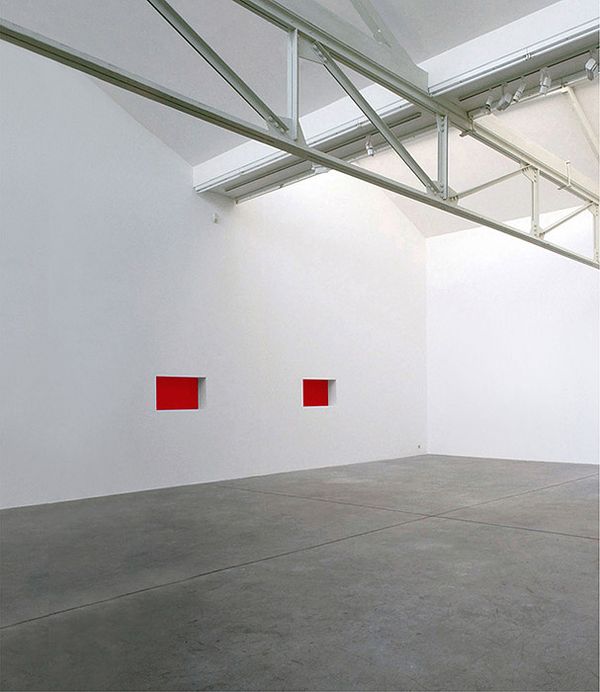
Donald Judd, Untitled (Wall Project), from Wall Works, 1992, two red Plexiglas sheets, to be installed in two recesses on a white painted wall, both Plexiglas sheets 60 x 85 cm (23⅝ x 33½ in.), installation size variable and according to wall. Editions & Works on Paper.
For many people around the world, Donald Judd is Minimalism. Although he resisted the label, his ideas and his work are compelling affirmations of the movement’s core concepts and values. Quite simply, he nails it. By 1963, having recognized that “actual space is intrinsically more powerful and specific than paint on a flat surface,” the artist abandoned painting to make three-dimensional “specific objects” that explore the relationship between the art object, the viewer, and the surrounding space.
A flat print might only hint at Judd’s genius. On offer is Untitled (Wall Project) of 1992 — a sculptural installation from an edition of only 12 that delivers on the immensity of his vision to anchor a visceral, physical, and powerfully monumental experience of space. It employs two red Plexiglas sheets to be embedded into recesses in the wall centered on the lines dividing the wall into thirds — all according to the artist’s specifications.*
In and of themselves, the twinned rectilinear volumes of nothingness feel beautifully resolved, pure, crisp, and weightless. The clarity of the conception, as they work together as one, is resolute and profound. Stand back to take in the whole — and they activate and engage the entire expanse of wall to become huge, the gestalt resonating with an undeniable impact at the scale of the entire room. It’s something you feel at the core of your being. As Judd wrote, “It isn’t necessary for a work to have a lot of things to look at, to compare, to analyze one by one, to contemplate. The thing as a whole, its quality whole, is what is interesting. The main things are alone and are more intense, clear and powerful.”
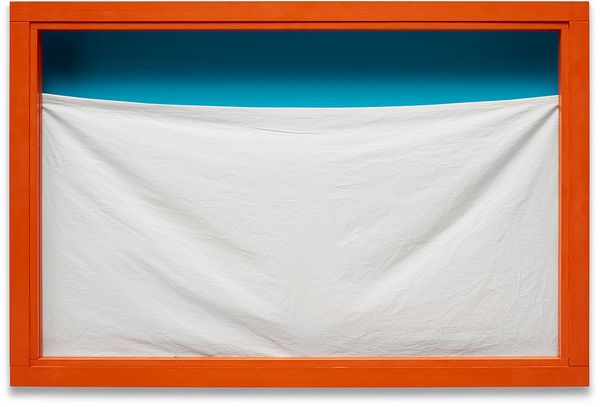
Christo and Jeanne Claude, Show Window, 2013, wooden frame painted with enamel in colours with fabric under Plexiglas, 61 x 92 x 7.5 cm (24 x 36¼ x 3 in.). Editions & Works on Paper.
What was cooler than when Christo and Jeanne Claude wrapped the Reichstag? And their massive curtains plowing through valleys for no apparent purpose, ridiculous and wonderful all at once. Because these gestures say everything — beautifully — by saying nothing at all.
Spectacle is a primary strategy of the Nouveau Realistes, with whom Christo and Jeanne Claude associated when they settled in Paris in the early 1960s. Inspired by the quasi-mystical and characteristically charming poetic actions and objects of Yves Klein and Arman, they began wrapping bicycles, cars, motorcycles, road signs, and female models in layers of semi-transparent materials and tying them with rope.
This multiple is emblematic of their entire oeuvre — and, not surprisingly, was used as the cover image of the Catalogue Raisonné published by Schellmann Art in 2013. A performative declaration of the profound rapport of the seen and the unseen, it detonates on the wall with potent Minimalist simplicity. We are looking both into the shop and out onto the sky into infinity. What is wrapped here? What is seen and what is hidden? —Both nothing and everything, perhaps, including the architectural space of the room — and even Modernism itself.
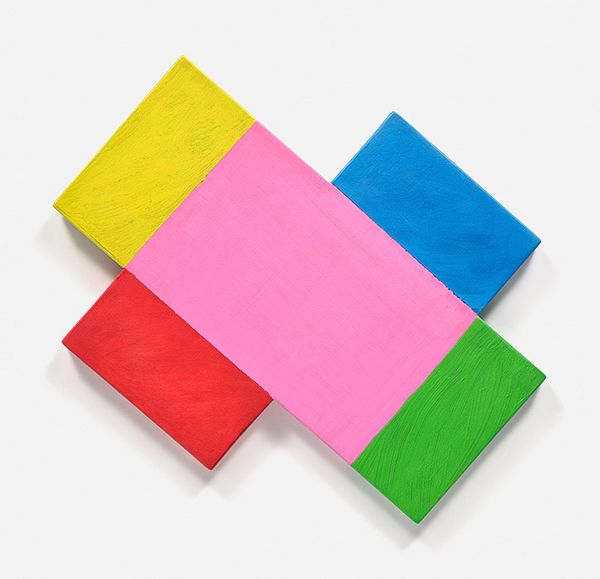
Mary Heilmann, Geometric Spin, 2021, archival pigment inks printed on shaped Duna board with acrylic paint, 21 x 26 x 1 in. (53.3 x 66 x 2.5 cm). Editions & Works on Paper.
Mary Heilmann’s Geometric Spin of 2021 twirls the Modernist grid with a buoyant devil-may-care playfulness. There’s no denying the elegance and grace of a thing so at ease with itself. But that is just the beginning… Think Minimalism. Think Pop. Think Punk. In the work of Mary Heilmann, it’s always a three-way, head-on collision.
Heilmann claims she turned to painting in the late 1960s because everyone insisted it was dead, and she thought so, too. She wanted to make “paintings that dissed painting.” She’s celebrated now as a counter-culture hero, who counts among her fans Martin Creed and Ross Bleckner, who wrote recently in Bomb magazine, “Mary Heilmann’s paintings contain a joy so contagious one smiles upon seeing them.”
Heilmann created this multiple to support Philip Johnson’s Glass House in New Canaan, CT. It’s a magnificent tribute, riffing on the building’s central pivot — the spiral staircase. Secondly, she declares the work to be an homage to Kazimir Malevich’s masterfully dynamic orchestrations of iconic geometry, which she sees in the architectural plan. The palette here is a lively, stream-of-consciousness mash-up —, bubble-gum pink, acid yellow, and other bright hues Heilmann plucked from her idiosyncratic Pop universe. Somehow, she makes it all work, as only a master could, to transform the Minimalist idiom into something so fresh and spontaneous.
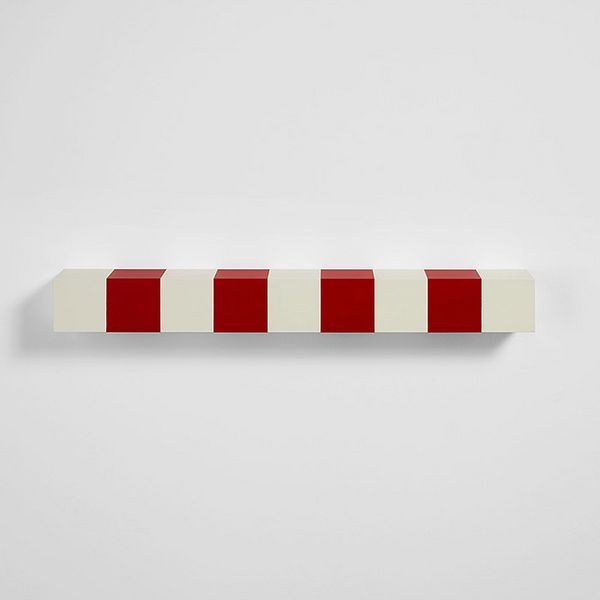
Daniel Buren, La barre haute (High Bar), 2001, unique wood (MDF) multiple lacquered in red and white, to be installed centered over a door, 3⅜ x 30⅞ x 3⅜ in.(8.7 x 78.3 x 8.7 cm). Editions & Works on Paper.
The work of legendary French conceptual artist Daniel Buren evokes the defiant and subversive excitement of Paris in 1968 — he is a true revolutionary! The artist became famous for epic site-specific museum installations and public works — which he calls “travaux in situ” (works in situ). The present work belongs to a body of work Buren launched in the 1980s —which he intends to be played again and again in different settings like music — thus affording a collector tremendous collaborative say as a curator in how the work is experienced. Buren is the real deal who did it all two decades before any New York based artist — in situ at the vibrant moment when Post-Structural philosophy first saw the light of day.
The artist created the La barre haute (The High Bar) of 2001 to surmount a door, where one would conventionally hang a sign to identify and announce what exists within. The bar grounds a radically conceptual installation that explicitly intervenes in the architectural space. Fundamentally, it is designed to activate the doorway as a dynamically ambiguous continuity. His alternating flat stripe is always 8.7 centimeters in width. He purposively built his entire oeuvre around it as an arbitrary empty signifier. What matters is that Buren, by radically negating the art object, casts lights instead on all ideologically-loaded cultural, political, and aesthetic context.
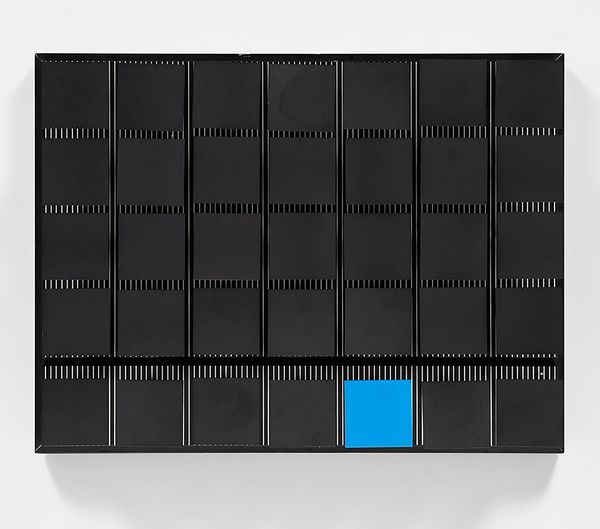
Jesús Rafael Soto, Homenaje al Humano, from An American Portrait, Volume 1, 1975, multiple comprised of painted wood and metal relief, 19¾ x 26 x 4¾ in. (50.2 x 66.0 x 12.1 cm). Editions & Works on Paper.
As you shift your gaze right to left over Jesús Rafael Soto’s Homenaje al Humano (Tribute to Humanity), with each movement the protruding squares buzz against the background of vertical lines to quiver and pulse with vibrational energy. Move around the object and you will see the blue one optically dematerialize before your eyes and free-float in space like a field of energy. This important Post-war Venezuelan artist was an early global pioneer of Kinetic Art and Op Art.
In 1953, newly settled in Paris, Soto aspired to build a new vanguard movement based on “dynamizing the neoplasticism” of Paul Klee, Piet Mondrian, and the Cubists that would challenge traditional Old World views of art in Latin America and the regionalist styles associated with the 60-year dictatorial rule of Juan Vicente Gómez. Over a career that spanned more than five decades, he never relented, ultimately achieving his ambition at a global level.
Inspired by innovative theories in particle physics, Soto came to see his artworks as an extension of the infinite realities of space and time — contingent energies in flux — and identified his creative process as a scientific enquiry into the nature of objects and the ambiguity of spatial perception.
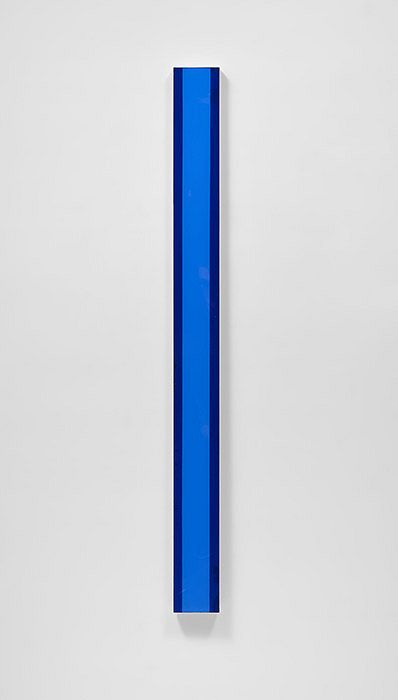
Barnett Newman, The Moment, 1966, 8 7⁄8 x 5 x 1 in. (124.1 x 12.7 x 2.4 cm), screenprint on Plexiglas, mounted on paperboard, on wood stretcher. Editions & Works on Paper.
Barnett Newman is a giant of Abstract Expressionism — and his trademark zip is among the movement’s most recognizable, enigmatic, and poignant icons. In The Moment of 1966, he presents it as a dense totality unto itself in the form of an object mounted to the wall. Silkscreened onto the underside of a Plexiglas sheet, the three vertical light and dark blue stripes constitute an indivisible unity representing the instantaneous flicker that lives at the center of all things. It is neither a sculpture nor a painting, but a hybrid that occupies both spaces at once.
Post-war critics championed Newman’s zip imagery for its dynamic plasticity that divided space and unified it, all at once. Art historian April Kinsgley sees the zip as emblematic of the artist’s enduring fascination with the cosmic sublime — as both the “flashing light of a nuclear explosion and the Old Testament pillar of fire.” But what the Minimalists most loved was its abstract reality. As Richard Serra noted, “When you reflect upon a Newman, you recall your experience, you don’t recall the picture.”
The Moment comes immediately on the heels of his second zip sculpture — his 1965 bronze Here II. "No Newman painting is as 'still' as this Plexiglas Newman,” wrote legendary critic Harold Rosenburg, “Close up, the vibrating edges of the light blue band energize the entire strip, but as the spectator moves back the play of the edges disappears. What the image retains of Newman's painting and sculpture is their reserved and simplified elegance."
Recommended Reading
A Legacy of Friendship — Marcel Broodthaers: The Herbig Collection >